
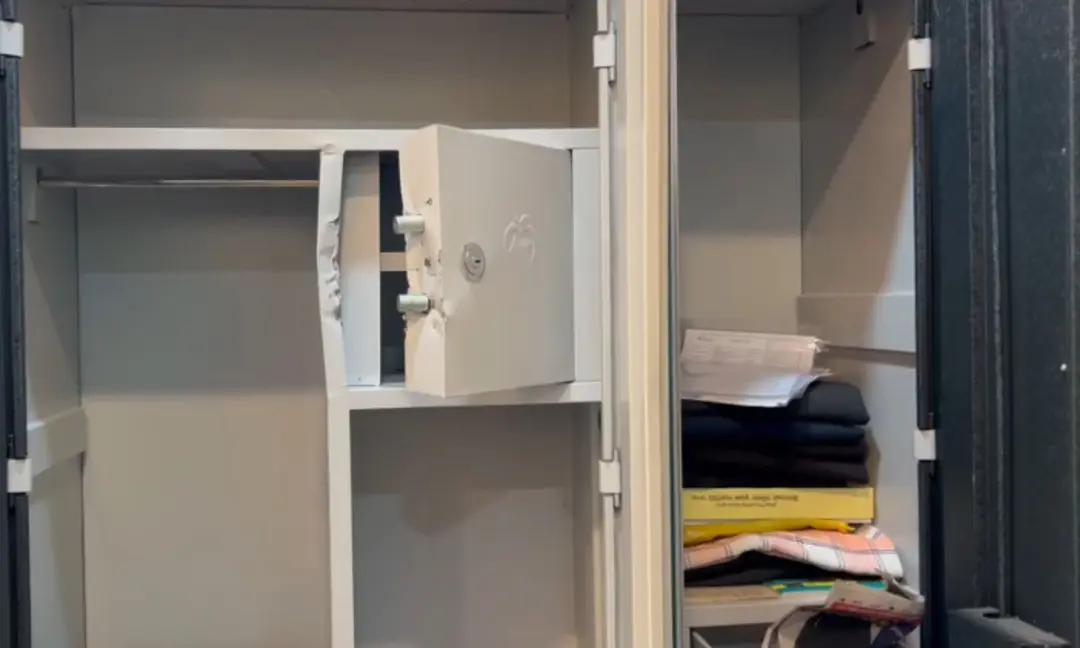
Five houses burgled in Nirmal district village
Thieves broke into five houses in Valegaon village of Bhainsa mandal in Telangana's Nirmal district. According to information, the burglars targeted houses that were locked and took away a large quantity of gold jewellery, silver and cash, along with a motorcycle. Visuals related to the theft were recorded on CCTV cameras. Police reached the spot after receiving information and began an investigation, and are working to trace the thieves using the CCTV footage.
Source
Nirmal — నేరాలు · read the original report ↗
Desk check · some claims need care
What the desk checked (5)
- Thieves broke into five houses in Valegaon village of Bhainsa mandal, Nirmal district. — Figure of five houses appears in source; no official or named source quoted.
- Locked houses were specifically targeted. — Stated in source without attribution.
- Gold jewellery, silver, cash and a motorcycle were stolen. — Source attributes this vaguely to 'information received'; no police confirmation or value given.
- The theft was recorded on CCTV cameras. — Stated in source; footage not independently described or attributed.
- Police reached the spot and began an investigation using CCTV footage. — Attributed to police action in general terms; no officer named.
Analysts’ view opinion
Five locked houses targeted in one village in quick succession is unlikely to be treated as ordinary petty theft; under Indian criminal law, breaking into locked dwellings — especially at night — falls into the aggravated house-breaking and house-trespass category that carries stiffer punishment. If more than one person is shown to have acted together, provisions on common intention and criminal conspiracy could also come into play. For now this is purely at the investigation stage: no accused has been named and the story says nothing about arrests.
- The deliberate choice of locked houses and the clustering of incidents in one locality are the kind of factors investigators weigh as indicators of a planned, organised offence.
- Because the victims are separate households, separate complaints or cases may be registered for each house, with a consolidated investigation if a single group is suspected.
- CCTV footage is electronic evidence, and its value in court depends on compliance with legal requirements around certification, integrity and chain of custody.
- Identification from camera footage must be reliable beyond doubt; police identification procedures and investigative methods are themselves open to judicial scrutiny.
- Anyone arrested retains constitutional and statutory protections — legal representation, the right to seek bail, and safeguards at the point of arrest — while recovered valuables are returned to owners only through the court's property-disposal process.
What to watch — Watch for how many FIRs are registered, the sections invoked, whether the CCTV leads to identifiable suspects and arrests, and how much of the stolen property is recovered.
The story does not establish the value of what was taken, whether one group was responsible for all five break-ins, or any detail of the FIRs, sections or arrests — these remain preliminary accounts.
Deep dive
Research brief · 8 facts · 3 dates · exam-readyThe brief
Context
Thieves struck five houses in a single night-time spree in Valegaon village of Bhainsa mandal in Nirmal district, Telangana, reported on 7 October 2026. The burglars specifically targeted houses that were locked, suggesting the homes were unoccupied at the time. Gold jewellery, silver, cash and a motorcycle were taken. CCTV cameras in the village recorded visuals of the theft, and police have begun an investigation based on that footage.
Key facts
- Five houses in Valegaon village, Bhainsa mandal, Nirmal district (Telangana) were burgled, as reported on 7 October 2026.
- The burglars targeted only houses that were locked, according to the report.
- A large quantity of gold jewellery, silver and cash was taken, along with one motorcycle.
- Visuals connected to the theft were recorded on CCTV cameras in the village.
- Police reached the spot after receiving information and started an investigation.
- Police are working to trace and catch the thieves on the basis of the CCTV footage.
- The exact value of the stolen property is not stated in the source.
- No arrests or suspect identities are stated in the source.
Timeline
- Before the report (exact date not stated in the source)Thieves break into five locked houses in Valegaon village, Bhainsa mandal, taking gold, silver, cash and a motorcycle.
- After the incidentPolice receive information, reach the spot and begin an investigation.
- 7 October 2026Report published; police engaged in tracing the thieves using CCTV camera footage.
Who has a stake
- Residents of the five burgled houses, Valegaon — Loss of gold jewellery, silver, cash and a motorcycle; recovery of property depends on the police investigation.
- Valegaon village and Bhainsa mandal residents — Sense of safety for locked or unoccupied homes; fear of repeat offences in the area.
- Nirmal district police — Credibility in solving a five-house burglary spree and tracing the accused using CCTV evidence.
- Owners of local CCTV cameras — Their recordings have become the primary investigative lead in the case.
Why it matters
A single spree hitting five locked homes in one village points to property crime that exploits unoccupied houses, a recurring vulnerability in rural and semi-urban India. It also shows how privately installed CCTV cameras have become the first and often decisive source of evidence for local police. For residents, the case is a test of how quickly district police can convert video leads into recoveries and arrests.
UPSC angle
Prelims pointers
- Valegaon village lies in Bhainsa mandal of Nirmal district, Telangana.
- Nirmal is a district in Telangana; Bhainsa is a mandal within it.
- The burglars targeted locked houses; five houses were hit in the reported spree.
- Items stolen: gold jewellery, silver, cash and a motorcycle.
- CCTV footage is the main basis of the ongoing police investigation.
- Date of report: 7 October 2026.
Mains framing
The Valegaon burglaries illustrate a pattern of organised property crime that exploits specific gaps in rural security: houses left locked and unoccupied, limited night patrolling, and scattered habitation that allows offenders to move between multiple targets in one operation. The immediate implication is economic and psychological loss for households whose savings are held largely in gold and silver, and a reputational test for district police who must convert CCTV visuals into identification, recovery and prosecution. The case also highlights the growing dependence of local policing on privately owned surveillance infrastructure, which raises questions of coverage, image quality and evidentiary handling. A grounded way forward, consistent with what the source supports, lies in sustained investigation using the recorded footage, intensified patrolling of villages with many locked homes, community alert mechanisms where residents inform police before leaving homes unoccupied, and quicker inter-mandal coordination since such gangs typically operate across jurisdictions. Beyond this, the episode is a reminder that crime prevention in villages depends as much on local vigilance networks as on formal police strength.
Key terms
- Mandal
- An administrative sub-division below the district level in Telangana and Andhra Pradesh; Bhainsa is a mandal in Nirmal district.
- Nirmal district
- A district in Telangana where the reported burglaries took place.
- Burglary
- Unlawful entry into a building, typically a dwelling, with intent to commit theft; here, five locked houses were broken into.
- CCTV footage
- Closed-circuit television recordings; in this case the primary evidence police are using to trace the accused.
- Investigation
- The formal police process of collecting evidence and identifying offenders, begun after police reached the spot.
Practice questions
- Discuss how the spread of privately installed CCTV cameras has changed the investigation of property crime in rural India, using the Valegaon burglaries as an illustration.
- What institutional and community measures can reduce burglaries targeting locked and unoccupied houses in villages? Examine with reference to policing capacity at the mandal level.
- Households in rural India hold much of their savings in gold and silver. Analyse the security and financial-inclusion implications of this pattern.
Grounded only in the source report — figures and dates are the source's, not inferred.