
Tamil Nadu extends free breakfast scheme to Classes 6 to 8
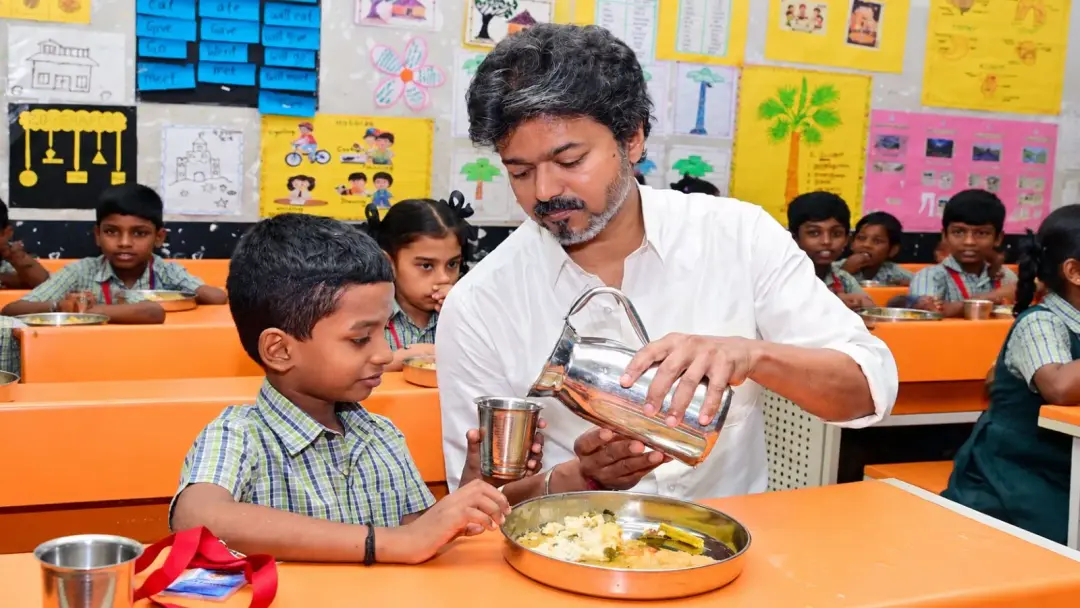
Tamil Nadu Chief Minister C Joseph Vijay on Tuesday expanded the state's free breakfast programme to students of Classes 6 to 8 in government and government-aided schools, adding about 15.30 lakh children. He launched the expanded Perunthalaivar Kamarajar Breakfast Scheme at Chennai Middle School in Gandhigramam, Thiruvanmiyur, sitting with students for breakfast. The expansion covers 7,537 additional schools with an extra Rs 217.63 crore this financial year. Overall, 34.64 lakh students across 44,984 schools will receive breakfast, at Rs 724 crore.
Source
Indian Express — Cities · read the original report ↗
Desk check · compared with the source
What the desk checked (5)
- Free breakfast scheme extended to Classes 6 to 8, adding about 15.30 lakh children. — Figure appears in source, attributed to the state government's expansion announcement.
- Expansion covers 7,537 additional schools with an extra Rs 217.63 crore this financial year. — Attributed in source to the state government.
- About 34.64 lakh students in 44,984 schools now covered at a total allocation of Rs 724 crore. — Figures appear in source, attributed to the state government; internally consistent.
- CM C Joseph Vijay launched the expanded scheme at Chennai Middle School, Gandhigramam, Thiruvanmiyur. — Stated in source as an event on Tuesday; no independent confirmation possible.
- State Planning Commission found 1,319 of 1,543 schools recorded higher attendance after the scheme began. — Attributed to a Tamil Nadu State Planning Commission evaluation cited in the source.
Analysts’ view opinion
By extending the free breakfast scheme to Classes 6 to 8, Chief Minister C Joseph Vijay is placing his own stamp on what has become one of Tamil Nadu's most politically potent welfare traditions. The scheme was introduced in 2022 under the then DMK government of M K Stalin — choosing to expand rather than rebrand or retire it is a classic move of absorbing a rival's idea and owning its dividend. The scheme's Perunthalaivar Kamarajar name also situates the incumbent within a long lineage running from Kamaraj through MGR, Karunanidhi and Jayalalithaa.
- About 15.30 lakh new beneficiaries and 34.64 lakh students in total is a very wide constituency that welfare touches directly at the household level.
- An additional Rs 217.63 crore within a total Rs 724 crore allocation signals that sustained welfare spending remains a stated budget priority.
- Because the scheme originated under the DMK, a credit-claiming contest is plausible, even as the government carrying out the expansion enjoys the immediate visibility.
- Sitting down to eat with students is standard high-signal political imagery, converting a budget line into a personal, relatable gesture.
- Attendance gains recorded by the State Planning Commission give the government an evidence-based argument that this is investment rather than a giveaway.
What to watch — Watch how opposition parties respond on the question of who deserves credit, and whether pressure builds to extend the scheme to Class 9 and above.
The story does not establish that the expansion will translate into votes or measurable long-term nutritional gains, and it records no formal reaction from any political party.
Deep dive
Research brief · 8 facts · 10 dates · exam-readyThe brief
Context
Tamil Nadu has run state-supported school meals for more than a century, from P Theagaraya Chetty's 1922 Chennai experiment to K Kamaraj's 1956 midday meals and M G Ramachandran's 1982 Nutritious Meal Programme. In 2022 the DMK government under M K Stalin added a free breakfast for Classes 1 to 5, later named the Perunthalaivar Kamarajar Breakfast Scheme. On Tuesday, Chief Minister C Joseph Vijay extended that breakfast to Classes 6 to 8 in government and government-aided schools, bringing about 15.30 lakh more children into the programme. The stated aim is to prevent children attending class hungry and to link nutrition with attendance and learning.
Key facts
- The expansion to Classes 6 to 8 adds about 15.30 lakh children to the breakfast programme.
- The extension covers 7,537 additional government and government-aided schools, with an extra Rs 217.63 crore in the current financial year.
- After the expansion, about 34.64 lakh students in Classes 1 to 8 across 44,984 schools will get breakfast, at a total allocation of Rs 724 crore.
- CM C Joseph Vijay launched the expanded scheme at Chennai Middle School, Gandhigramam, Thiruvanmiyur, sitting with students for breakfast.
- Phase one in 2022 covered about 1.14 lakh children in 1,545 schools at a cost of Rs 33.56 crore; the menu rotated upma, kichadi, pongal and rava or semiya kesari.
- By August 2025 the government said 17.53 lakh children across 34,987 schools were covered; Classes 1 to 5 coverage later reached about 19.34 lakh students.
- State Planning Commission evaluation: of 1,543 schools studied, 1,319 recorded higher attendance in January-February versus the preceding June-July; 1,086 saw rises up to 20% and 22 schools above 40%.
- NFHS-5 (2019-21) showed 57.8% of Tamil Nadu children aged six to 59 months were anaemic.
Timeline
- 1922P Theagaraya Chetty, Corporation of Chennai president and Justice Party leader, starts meals for underprivileged children in selected Chennai schools.
- 1922-1925About 800 students benefit before the programme is discontinued under British administration; reintroduced in 1927.
- 1956Congress CM K Kamaraj extends midday meals to poor children across Tamil Nadu for 200 days a year.
- 1982CM M G Ramachandran expands the scheme as the Nutritious Meal Programme for malnourished children aged 2 to 9.
- 1989M Karunanidhi government introduces one boiled egg every fortnight; eggs later increased to every working day, with a 100-gram banana alternative.
- 2013J Jayalalithaa government introduces variety meals: vegetable biryani, tomato, lemon and tamarind rice, and masala eggs.
- May 7, 2022CM M K Stalin announces the Chief Minister's Breakfast Scheme for Classes 1 to 5 on his government's first anniversary.
- September 2022Breakfast scheme launched; State Planning Commission later studies attendance change in 1,543 schools.
- February 2023Scheme extended to corporation and municipal schools.
- August 2023Scheme extended to all government schools.
Who has a stake
- Students of Classes 6 to 8 in government and government-aided schools — About 15.30 lakh children newly get a free school breakfast, addressing hunger during class hours.
- Tamil Nadu government / CM C Joseph Vijay — Owns the expansion and its Rs 217.63 crore additional outlay this financial year; total allocation Rs 724 crore.
- Government and government-aided schools (44,984, including 7,537 new) — Must deliver daily breakfast alongside existing meal programmes; attendance and learning outcomes at stake.
- Tamil Nadu State Planning Commission — Evaluated the scheme's attendance impact, providing the evidence base for expansion.
- Parents and low-income households — Relief for families where economic difficulty or long travel distances meant children reached school without eating.
Why it matters
Hunger at the start of the school day affects both attendance and concentration, and Tamil Nadu's own evaluation found attendance rose in 1,319 of 1,543 schools studied after breakfast began. With NFHS-5 recording 57.8% anaemia among Tamil Nadu children aged six to 59 months, school feeding is a frontline nutrition tool. Extending it to upper primary classes, where dropout and adolescent nutrition risks rise, tests whether a welfare scheme can scale from 1.14 lakh to 34.64 lakh beneficiaries while holding quality.
UPSC angle
Prelims pointers
- Perunthalaivar Kamarajar Breakfast Scheme: Tamil Nadu free school breakfast, now Classes 1 to 8, 34.64 lakh students, 44,984 schools, Rs 724 crore.
- Announced by CM M K Stalin on May 7, 2022; launched September 2022 for Classes 1 to 5.
- K Kamaraj extended midday meals across Tamil Nadu in 1956 for 200 days a year; M G Ramachandran launched the Nutritious Meal Programme in 1982.
- P Theagaraya Chetty, Justice Party leader and Corporation of Chennai president, began school meals in Chennai in 1922.
- NFHS-5 (2019-21): 57.8% of Tamil Nadu children aged 6-59 months anaemic.
- Boiled eggs introduced in school meals by the M Karunanidhi government in 1989; banana alternative of 100 grams for non-egg eaters.
Mains framing
Tamil Nadu's extension of its free breakfast to Classes 6 to 8 illustrates how a century-old school feeding tradition has been repurposed as a combined nutrition, attendance and learning intervention. The causes are explicit in the government's own rationale: official studies found children arriving at school unfed because of long travel distances or household economic distress, while NFHS-5 (2019-21) recorded 57.8% anaemia among children aged six to 59 months and research links poor dietary diversity to iron, vitamin A and zinc deficiencies. The implications are both educational and fiscal: the State Planning Commission's evaluation of 1,543 schools found attendance rose in 1,319, with a stronger positive trend than in 414 neighbouring uncovered schools, suggesting real returns; but the programme has grown from 1.14 lakh children and Rs 33.56 crore in 2022 to 34.64 lakh children and Rs 724 crore, raising questions of recurring cost, supply chains and food quality across 44,984 schools. The way forward, on the evidence in the source, lies in continuing independent evaluation of attendance and nutritional outcomes such as the Body Mass Index gains reported from millet ladoo and chikki experiments in Ariyalur and Perambalur, and in ensuring menu variety and delivery consistency as coverage widens to adolescents.
Key terms
- Perunthalaivar Kamarajar Breakfast Scheme
- Tamil Nadu's free school breakfast programme, named after former CM K Kamaraj, now covering Classes 1 to 8.
- Nutritious Meal Programme
- M G Ramachandran's 1982 expansion of school meals, initially for malnourished children aged 2 to 9 in rural preschools and primary schools.
- NFHS-5
- National Family Health Survey round five, whose 2019-21 data recorded 57.8% anaemia among Tamil Nadu children aged 6-59 months.
- Tamil Nadu State Planning Commission
- State body that evaluated the breakfast scheme's impact on school attendance across 1,543 schools.
- Government-aided schools
- Privately managed schools receiving state aid; brought into the breakfast scheme in phases from July 2024.
- Justice Party
- Early 20th-century party; its leader P Theagaraya Chetty began Chennai school meals in 1922 as Corporation president.
Practice questions
- Trace the evolution of state-supported school meals in Tamil Nadu from 1922 to the present. What does this history suggest about the role of state-level innovation in social policy?
- School feeding programmes are often justified on nutrition, attendance and learning grounds. Critically evaluate this claim using the evidence from Tamil Nadu's breakfast scheme.
- Discuss the fiscal and administrative challenges of scaling a welfare scheme from 1.14 lakh to 34.64 lakh beneficiaries, with reference to Tamil Nadu's breakfast programme.
Grounded only in the source report — figures and dates are the source's, not inferred.