
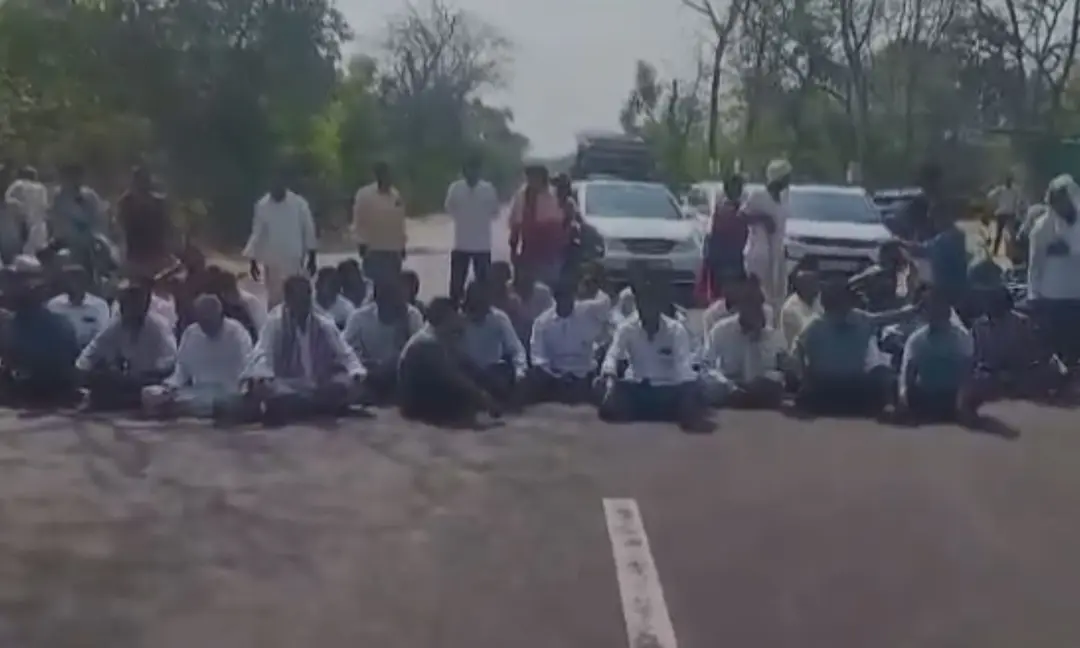
Farmers block National Highway 61 in Nirmal over paddy purchase
Farmers staged a dharna and rasta roko on National Highway 61 at New Sangvi in Mamada mandal of Telangana's Nirmal district, demanding immediate procurement of their paddy and supply of sufficient gunny bags. They raised slogans against the government. The farmers said the grain brought for sale had remained unpurchased for a week and sought immediate procurement as rain was likely. Officials who reached the spot tried to persuade them, but they refused to withdraw. Vehicles were held up on the highway.
Source
Nirmal — crime & civic · read the original report ↗
Desk check · compared with the source
What the desk checked (5)
- Farmers staged a dharna and rasta roko on National Highway 61 at New Sangvi in Mamada mandal, Nirmal district. — Reported as direct observation in the source; no official attribution given.
- Farmers demanded immediate procurement of their paddy and supply of sufficient gunny bags. — Attributed to the protesting farmers in the source.
- Farmers said the paddy they brought for sale has been lying unpurchased for a week. — Attributed to farmers speaking at the protest; not independently corroborated in the text.
- Officials reached the spot and tried to persuade the farmers, who refused to call off the protest. — Stated in the source without naming any official.
- Vehicles were held up on the national highway due to the protest. — Figure or duration not specified; appears as a general observation in the source.
Analysts’ view opinion
This is less a protest story than a case study in how a logistics failure inside the procurement chain converts directly into farmer losses. Farmers say paddy brought for sale has sat for a week, and a cheap, fixable bottleneck — a shortage of gunny bags — risks turning into a far more expensive crop loss if rain arrives. That risk is borne upfront by the grower, through moisture-based deductions or pressure to dump the crop in the open market at a lower price.
- Procurement delay works like a hidden tax: a support price announced on paper shrinks in net terms when the actual purchase does not happen on time.
- Gunny bags are among the cheapest inputs in the chain, so a shortfall there can cause losses many times its own cost — poor economics on a cost-benefit view.
- With rain a stated risk, time is effectively price: wet grain means higher moisture, deductions or rejection, and weaker bargaining power for the seller.
- Vehicles halted on a national highway add transport and freight costs, so the spillover is not confined to agriculture.
- From the administration's side, peak procurement strains centres, bags and haulage simultaneously — a genuine management challenge, but the cost of that coordination gap is currently sitting with farmers.
What to watch — Watch whether gunny bag supply and weighing throughput at purchase centres pick up in the coming days, and whether moisture norms are relaxed if rain does fall.
The story does not establish how much grain is stranded, how many farmers are affected, the underlying reason for the delay, or the government's response — so the size of the economic loss cannot be quantified from this account.
Deep dive
Research brief · 7 facts · 3 dates · exam-readyThe brief
Context
Farmers in Telangana's Nirmal district blocked National Highway 61 at New Sangvi in Mamada mandal, protesting delays in the purchase of their paddy at procurement points. They said the grain they had brought for sale had been lying unpurchased for a week, and that gunny bags were in short supply, even as rain was expected. Paddy is procured from farmers at designated purchase centres where gunny bags, transport and timely weighing are the administration's responsibility; delays leave harvested grain exposed to weather damage.
Key facts
- Farmers held a dharna and rasta roko on National Highway 61 at New Sangvi, Mamada mandal, Nirmal district (report updated 12 May 2026).
- Their two core demands: immediate procurement of the paddy they had grown, and supply of sufficient gunny bags for the crop.
- Farmers said the paddy brought for sale had remained unpurchased for a week.
- They pressed for immediate purchase because rain was likely, risking damage to the grain.
- Protesters raised slogans against the government.
- Officials who learned of the protest reached the spot and tried to persuade the farmers, but they refused to withdraw the dharna and continued to sit in.
- Vehicular traffic on the national highway was held up because of the blockade.
Timeline
- About a week before the protestFarmers brought their paddy to the purchase point for sale; it remained unpurchased.
- 12 May 2026 (as reported)Farmers launched a dharna and rasta roko on NH-61 at New Sangvi, Mamada mandal, halting vehicles.
- Same dayOfficials reached the spot and tried to pacify the farmers, who refused to call off the protest.
Who has a stake
- Paddy farmers of Mamada mandal, Nirmal district — Risk of crop loss and income loss if unpurchased grain is damaged by expected rain.
- Telangana government / procurement machinery — Faces slogans and protest over delayed paddy purchase and inadequate gunny bag supply.
- District officials who reached the site — Tasked with pacifying farmers, restoring traffic and arranging procurement.
- Highway users on NH-61 — Vehicles held up due to the road blockade.
Why it matters
Procurement delays at the peak of the marketing season can turn a good harvest into a loss, since paddy lying in the open is vulnerable to unseasonal rain. The protest shows how a logistical gap as small as gunny bag supply can escalate into a highway blockade affecting the public, and it puts the spotlight on the state's readiness at purchase centres.
UPSC angle
Prelims pointers
- National Highway 61 passes through Nirmal district, Telangana; New Sangvi falls in Mamada mandal.
- Farmers' demands: immediate paddy procurement and adequate supply of gunny bags.
- Gunny bags are the jute sacks used to pack and move procured paddy from purchase centres.
- 'Rasta roko' and 'dharna' are the forms of protest used in this agitation.
- Farmers said their grain had lain unpurchased for a week, with rain expected.
Mains framing
The Nirmal highway blockade is a case study in last-mile failure in agricultural procurement: the state's assurance to buy paddy is meaningful only if purchase centres have gunny bags, weighing and lifting capacity synchronised with the harvest calendar. Here, farmers reported a week's delay at a time when rain was forecast, meaning the cost of administrative slippage falls directly on the producer, whose grain can lose both weight and quality overnight. The immediate implication is a law-and-order and public-inconvenience problem — a national highway was blocked and officials' persuasion failed — but the deeper issue is trust: slogans against the government indicate that farmers see the delay as a policy failure rather than a local glitch. A way forward, grounded in what the protest itself demands, lies in advance stocking and rapid redistribution of gunny bags, transparent token and weighing schedules at purchase centres, weather-linked prioritisation of lifting, and covered or tarpaulin-protected storage at the centres so that delays do not automatically translate into crop loss. Not stated in the source: any government response, procurement volumes or prices.
Key terms
- Paddy procurement
- Government purchase of farmers' paddy at designated purchase centres, the subject of the farmers' demand here.
- Gunny bags
- Sacks used for packing procured paddy; farmers demanded sufficient supply for their crop.
- Rasta roko
- A road-blockade protest; used here on National Highway 61.
- Dharna
- A sit-in protest; farmers refused to withdraw it despite officials' persuasion.
- Mandal
- An administrative sub-district unit in Telangana; Mamada mandal is where New Sangvi is located.
Practice questions
- Delays in paddy procurement often escalate into public protests. Examine the administrative preparedness required at purchase centres to prevent crop loss during the marketing season.
- Discuss how weather risk interacts with procurement logistics in paddy-growing districts, with reference to the farmers' agitation in Nirmal district.
- Highway blockades by farmers pit the right to protest against public convenience. How should district administrations respond to such agitations?
Grounded only in the source report — figures and dates are the source's, not inferred.