
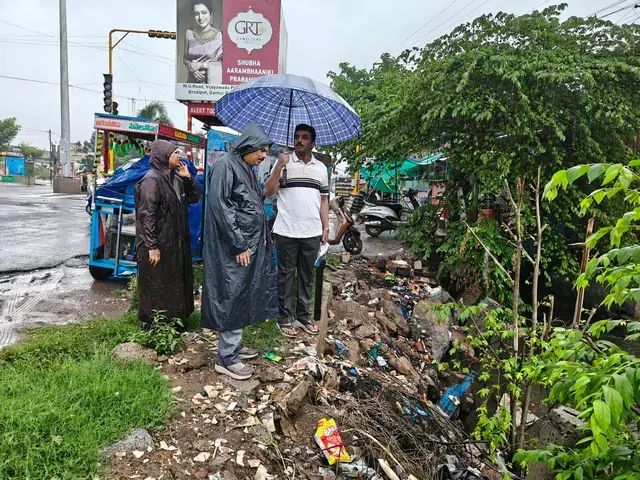
Commissioner says public safety is priority amid heavy rains
Mangalagiri-Tadepalli Municipal Commissioner Shaik Aleem Basha said drainage desilting and sanitation works taken up on Minister Nara Lokesh's directions have significantly reduced obstructions to rainwater flow. He inspected Mangalagiri TIDCO, NRI Junction, Ratnala Cheruvu and Tadepalli Nulakapeta on Thursday. He advised residents of hill and low-lying areas to stay alert, avoid dilapidated buildings, and not dump waste in drains. A 24-hour control room is available on 7093912653 and 08645-295193.
Source
Mangalagiri — స్థానికం · read the original report ↗
Desk check · compared with the source
What the desk checked (4)
- Drainage desilting and sanitation works carried out on Minister Nara Lokesh's directions reduced obstructions to rainwater flow in Mangalagiri-Tadepalli Municipal Corporation limits — Attributed to Municipal Commissioner Shaik Aleem Basha; no independent data given in source
- The Commissioner inspected Mangalagiri TIDCO, NRI Junction, Ratnala Cheruvu and Tadepalli Nulakapeta on Thursday — Stated in source as reported activity; no external corroboration possible
- A 24-hour control room and call centre operate with numbers 7093912653 and 08645-295193 — Figures appear in source, attributed to the Commissioner; numbers not independently verified
- Residents of hill and low-lying areas advised to move to safer places due to landslide and building-collapse risk — Advisory attributed to the Commissioner
Analysts’ view opinion
On the surface this is routine civic administration, but politically it is an exercise in pre-assigning credit and responsibility. By explicitly framing the desilting and sanitation work as having been done "on the orders of Minister Nara Lokesh", the commissioner's statement routes the credit for any smooth monsoon upward to the political leadership. Mangalagiri–Tadepalli sits in the capital region and within the minister's own political turf, which makes rain management here a high-visibility test.
- The phrase "on the minister's orders" is standard in official releases, but it deliberately links administrative outcomes to political leadership.
- The commissioner personally touring low-lying pockets like TIDCO, NRI Junction, Ratnala Cheruvu and Nulakapeta builds an on-record case that the administration acted before, not after, trouble.
- Publicising a 24-hour control room and helpline numbers channels grievances into an official pipeline, which tends to blunt street-level anger.
- The appeal to residents not to dump garbage and plastic in drains partly shifts responsibility to citizens — a line that can later be used to share blame if flooding occurs.
- If heavy rain does cause waterlogging, this same statement becomes material for the opposition to contrast claims against conditions on the ground.
What to watch — Watch whether images of waterlogging emerge from the low-lying wards in the coming spells and how residents rate the control room's response — that will decide whether this statement ages well politically.
The story does not establish the scale or cost of the desilting work, offers no independent verification that flooding actually reduced, and carries no opposition or resident response.
Deep dive
Research brief · 8 facts · 3 dates · exam-readyThe brief
Context
Mangalagiri–Tadepalli Municipal Corporation, which covers part of Andhra Pradesh's capital region, is facing continuous heavy rainfall. Municipal Commissioner Shaik Aleem Basha says drainage desilting and sanitation works taken up on the directions of Minister Nara Lokesh have significantly reduced obstructions to rainwater flow. On Thursday he toured low-lying and hill-side localities, ordering officials to ensure no waterlogging and asking residents in vulnerable areas to move to safety.
Key facts
- Commissioner Shaik Aleem Basha said drainage desilting and sanitation works taken up on Minister Nara Lokesh's directions have significantly reduced obstructions to rainwater flow during heavy rains.
- On Thursday the Commissioner inspected Mangalagiri TIDCO, NRI Junction, Ratnala Cheruvu and Tadepalli Nulakapeta, among other areas.
- He inspected main drains, canals and stormwater flow paths and ordered immediate measures for smooth flow of water.
- Officials were told to continuously monitor low-lying areas so that silt, garbage and plastic waste do not block drains, and to take up additional desilting where needed.
- Residents were warned that dilapidated walls and old buildings could collapse, and that landslides are possible in hill areas; those in dangerous zones were asked to shift to safe places in advance.
- Officials were directed to immediately remove fallen trees and branches so that road traffic is not disrupted, and to coordinate on roads, drainage, sanitation and street lights.
- A 24-hour control room and call centre is operating under the corporation; complaints can be given on 7093912653 and 08645-295193.
- The inspection was attended by Additional Commissioner K. Venkateswara Rao, Deputy Commissioner Srikanth, DEE Ramu, AE Prasanna and engineering officials.
Timeline
- Before the inspection (date not stated in the source)Drainage desilting and sanitation works taken up across the Mangalagiri–Tadepalli Municipal Corporation area on Minister Nara Lokesh's directions.
- Thursday (amid continuous heavy rains)Commissioner Shaik Aleem Basha tours Mangalagiri TIDCO, NRI Junction, Ratnala Cheruvu and Tadepalli Nulakapeta and issues field directions.
- Ongoing24-hour control room and call centre kept available for waterlogging, fallen trees and drainage complaints.
Who has a stake
- Residents of low-lying areas — Risk of waterlogging and drainage overflow; depend on desilting and rapid response by the corporation.
- Residents of hill areas and occupants of dilapidated buildings — Risk of landslides and collapse of old walls/buildings; advised to move to safe places in advance.
- Mangalagiri–Tadepalli Municipal Corporation officials — Accountable for keeping drains clear, removing fallen trees, sanitation and street lights, and acting on control-room complaints.
- Commissioner Shaik Aleem Basha — Leads field monitoring and has stated that ensuring smooth rainwater flow without public inconvenience is the goal.
- Minister Nara Lokesh — Issued the directions under which drainage desilting and sanitation works were taken up.
- Road users and commuters — Traffic disruption from fallen trees, branches and stagnant water on roads.
Why it matters
Urban flooding in the capital region is driven less by rainfall alone than by blocked drains, plastic waste and unmanaged low-lying settlements, which is why routine desilting and citizen behaviour matter as much as emergency response. The story shows a municipal body shifting to pre-emptive measures — field inspection, evacuation advisories for hill and dilapidated-building residents, and a round-the-clock control room. It also underlines that municipal disaster preparedness depends on coordination across drainage, sanitation, roads and street lighting wings.
UPSC angle
Prelims pointers
- Shaik Aleem Basha is the Municipal Commissioner of Mangalagiri–Tadepalli Municipal Corporation (Andhra Pradesh).
- Areas inspected: Mangalagiri TIDCO, NRI Junction, Ratnala Cheruvu, Tadepalli Nulakapeta.
- Corporation's 24-hour control room numbers: 7093912653 and 08645-295193.
- Drainage desilting and sanitation works were taken up on the directions of Minister Nara Lokesh.
- Hazards flagged: waterlogging, fallen trees, collapse of dilapidated walls/buildings, landslides in hill areas.
- Officials present at inspection: Additional Commissioner K. Venkateswara Rao, Deputy Commissioner Srikanth, DEE Ramu, AE Prasanna.
Mains framing
Heavy, continuous rainfall exposes the structural weaknesses of fast-urbanising municipal areas: silted and garbage-choked stormwater drains, encroached low-lying pockets, unsafe hill-slope settlements and ageing structures. The Mangalagiri–Tadepalli case illustrates the standard municipal response chain — pre-monsoon desilting and sanitation drives, commissioner-level field inspection of main drains and flow paths, directions to clear fallen trees to keep roads open, coordination across drainage, sanitation and street-lighting wings, and a 24x7 control room for citizen complaints. It also highlights the demand-side problem: the Commissioner had to appeal to residents not to dump garbage and plastic waste into drains and to use designated disposal points, showing that engineering fixes fail without solid waste discipline. Equally important is anticipatory action — advising people living below dilapidated walls or in landslide-prone hill areas to shift in advance, rather than responding after collapse. The way forward implied by the source is continuous monitoring rather than seasonal effort: additional desilting where required, zero tolerance for lapses in sanitation, rapid field response to control-room alerts, and citizen cooperation as a co-producer of urban flood safety.
Key terms
- Mangalagiri–Tadepalli Municipal Corporation
- The urban local body whose area covers Mangalagiri and Tadepalli, headed by Commissioner Shaik Aleem Basha.
- Desilting (poodika teeta)
- Removal of accumulated silt, garbage and plastic from drains and canals so rainwater can flow freely.
- Control room / call centre
- A 24-hour municipal facility (7093912653, 08645-295193) where citizens report waterlogging, fallen trees or drainage problems for field action.
- TIDCO
- The name of the Mangalagiri locality/housing area inspected by the Commissioner during the rains.
- Dilapidated buildings advisory
- Warning that weak walls and old structures may collapse in heavy rain, with residents asked to stay alert and move to safety.
Practice questions
- Urban flooding in Indian cities is as much a solid waste management failure as a drainage design failure. Examine with reference to municipal pre-monsoon preparedness measures.
- Discuss the role of urban local bodies in disaster preparedness and response during heavy rainfall, using the example of drainage desilting, control rooms and evacuation advisories.
- How can municipal corporations combine engineering measures with citizen participation to reduce waterlogging and rain-related hazards in low-lying and hill-slope settlements?
Grounded only in the source report — figures and dates are the source's, not inferred.