
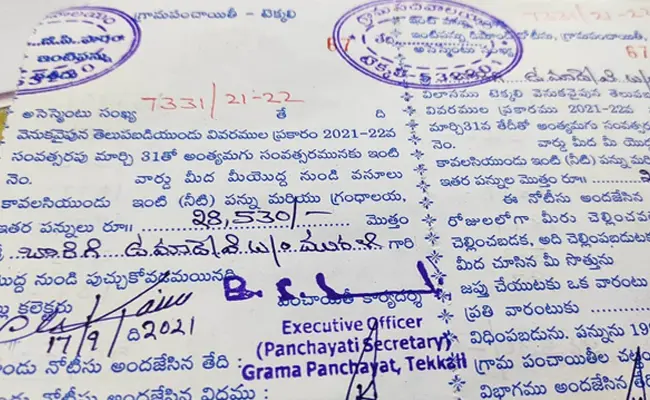
Fake receipts in Tekkali panchayat: Rs 16.46 lakh diverted
A preliminary inquiry has found that property tax money was misappropriated in Tekkali major panchayat of Srikakulam district using fake demand notices and self-printed receipt books. Only part of the tax collected from over 9,000 houses was credited to the panchayat account. EO Ajay Babu identified diversion of Rs 7,67,999 in 2018-19, Rs 4,22,416 in 2019-20 and Rs 4,55,787 in 2020-21, totalling Rs 16,46,202. DPO Ravikumar suspended bill collector CH Kaisu, and a comprehensive inquiry was ordered.
Source
Tekkali — MLA & నియోజకవర్గం · read the original report ↗
Desk check · some claims need care
What the desk checked (5)
- Over Rs 16.46 lakh of house tax collections was diverted in Tekkali major panchayat over three years. — Figure appears in source, attributed to a preliminary inquiry by panchayat EO Ajay Babu; yearly breakup Rs 7,67,999 (2018-19), Rs 4,22,416 (2019-20), Rs 4,55,787 (2020-21) is given.
- Bill collector CH Kaisu was suspended by District Panchayat Officer Ravikumar and barred from leaving Tekkali without permission. — Attributed in source to suspension orders; names and designations stated.
- Fake demand notices and self-printed receipt books were used to collect tax from about 9,000-plus houses. — Stated in source without a named official source; presented as reporting.
- Two others, including a serving and a retired employee, were involved; irregularities flourished under MLA Kinjarapu Atchannaidu's period. — Source uses phrases such as 'it is learnt' and 'opinion being expressed'; unattributed and speculative.
- In-charge DLPO S Hariharao collected details and reported to district officials, who ordered a comprehensive inquiry. — Attributed to named officials in the source.
Analysts’ view opinion
At this stage this is purely a departmental matter — a preliminary inquiry, a suspension and an order for a detailed investigation. If the allegations of fabricated demand notices and fake receipt books are established, the conduct would go well beyond indiscipline into territory that is criminal in character: forgery, breach of trust and misappropriation of public money. But the story records no FIR so far, and a suspension is a precautionary step during inquiry, not a finding of guilt.
- Suspension is not punishment — under service rules it is an interim measure to keep the inquiry clean; charges must still pass through a charge memo, the employee's reply and an inquiry officer's report.
- Departmental proceedings and a criminal case can run in parallel, and one can survive the failure of the other because the standards of proof differ.
- The direction not to leave Tekkali without permission is typically aimed at keeping the employee available to the inquiry, though how far such conditions may restrict an employee's freedom of movement is always a contestable question.
- References to "two others" and a retired employee are framed in the story as impressions and suspicions — unnamed allegations carry no legal weight without documented evidence, and departmental power over retired staff is in any case limited.
- The rights angle for the 9,000-plus householders matters: if payments were genuinely made, even against bogus receipts, the burden of correcting the records should not fall back on the taxpayers.
What to watch — Watch for the detailed inquiry report, whether it is followed by a police complaint or FIR, what recovery is ordered, and how the tax accounts of residents who paid are reconciled.
This rests on a preliminary finding: no one's guilt has been legally established, the Rs 16.46 lakh figure is not final, the suspended employee's response is not on record, and the story's political references establish nothing in law.
Deep dive
Research brief · 8 facts · 6 dates · exam-readyThe brief
Context
Tekkali major panchayat in Srikakulam district of Andhra Pradesh has become the focus of a series of alleged irregularities, earlier involving fake 1-B and adangal land records, name changes in revenue records and bank loans obtained on fake pattas. The latest case involves misappropriation of property (house) tax revenue collected from the panchayat's residents through fake demand notices and self-printed receipt books. A preliminary inquiry by the panchayat Executive Officer has put the diversion at over Rs 16.46 lakh across three years, and the bill collector has been suspended pending a comprehensive inquiry. The source notes that Tekkali is the constituency of MLA Kinjarapu Atchannaidu.
Key facts
- Preliminary inquiry found Rs 16,46,202 of house tax money diverted in Tekkali major panchayat over three years.
- Year-wise misappropriation: Rs 7,67,999 in 2018-19, Rs 4,22,416 in 2019-20 and Rs 4,55,787 in 2020-21.
- House tax is collected from more than 9,000 houses in Tekkali major panchayat.
- Fake demand notices were issued and fake receipt books were printed privately; only part of the collection was shown officially to avoid suspicion.
- Bill collector CH Kaisu was suspended by District Panchayat Officer Ravikumar for tax collection irregularities and issuing fake receipts.
- The suspension order directs Kaisu not to leave Tekkali without permission until the inquiry is completed.
- Panchayat EO Ajay Babu conducted the inquiry at his level and reported it to higher officials; the amount may rise further.
- In-charge DLPO S. Hariharao collected details and reported them to district officials; a comprehensive inquiry has been ordered.
Timeline
- Before this caseFake 1-B and adangal records, altered revenue record names, bank loans on fake pattas and land encroachments surfaced in Tekkali.
- 2018-19Rs 7,67,999 of collected house tax not credited to the panchayat account.
- 2019-20Rs 4,22,416 diverted.
- 2020-21Rs 4,55,787 diverted, taking the three-year total to Rs 16,46,202.
- A few days agoThe scam came to light; EO Ajay Babu inquired and reported to higher officials.
- SubsequentlyDPO Ravikumar suspended bill collector CH Kaisu and a comprehensive inquiry was ordered.
Who has a stake
- Tekkali major panchayat — Lost over Rs 16.46 lakh of own-source house tax revenue meant for local civic services.
- Property tax payers of over 9,000 houses — Paid tax against fake demand notices and received fake receipts, risking disputed payment records.
- Bill collector CH Kaisu — Suspended, held primarily responsible, barred from leaving Tekkali till inquiry ends.
- EO Ajay Babu and in-charge DLPO S. Hariharao — Detected and escalated the diversion; responsible for reporting to district officials.
- District Panchayat Officer Ravikumar — Ordered the suspension and comprehensive inquiry; accountable for recovery and action.
- MLA Kinjarapu Atchannaidu — Named in the report as the local MLA amid allegations that irregularities surfaced repeatedly in the constituency.
- A former and a retired panchayat employee — Suspected of involvement; a retired employee reportedly continued to stay on with leaders' backing.
Why it matters
Property tax is one of the few own revenues of a gram/major panchayat, and its diversion directly shrinks the money available for local services. The case shows how weak receipt controls and non-computerised, manual demand notices allow frontline collectors to pocket public money for years before detection. It also raises the question of political shelter for staff, since the source suggests others beyond the suspended bill collector may be involved.
UPSC angle
Prelims pointers
- Tekkali major panchayat is in Srikakulam district, Andhra Pradesh; Tekkali MLA is Kinjarapu Atchannaidu.
- Preliminary loss figure: Rs 16,46,202 over 2018-19 to 2020-21 from house tax collections.
- Officials involved in detection: panchayat EO (Ajay Babu), in-charge DLPO (S. Hariharao), District Panchayat Officer (Ravikumar).
- Modus operandi: fake demand notices plus privately printed fake receipt books; partial remittance to panchayat account.
- Action taken: suspension of bill collector CH Kaisu with a condition not to leave Tekkali without permission.
- Earlier irregularities in Tekkali cited: fake 1-B and adangal, altered revenue records, loans on fake pattas.
Mains framing
The Tekkali case is a textbook example of leakage in local-body own revenue: a bill collector, allegedly with help from a serving and a retired employee, issued fake demand notices and privately printed receipt books to more than 9,000 house-tax payers, remitting only a fraction to the panchayat account and pocketing Rs 16,46,202 over 2018-19 to 2020-21. The enabling causes are structural — manual demand-and-collection registers, no independent reconciliation between demand raised and amounts credited, single-point handling of both notice and receipt, and, as the source suggests, political shelter that let a retired employee continue to operate informally. The implications go beyond the amount: citizens who paid in good faith hold invalid receipts, the panchayat's service delivery is starved of funds, and trust in local taxation erodes, weakening voluntary compliance. The way forward suggested by the facts is what the administration has begun — escalation by the EO, reporting through the DLPO to district officials, suspension of the accused bill collector with movement restrictions, and a comprehensive inquiry to establish the full extent, which officials say may be larger. Sustained fixes would require verification of every receipt against panchayat accounts and fixing responsibility on supervisory officers, though the source does not detail any such measures.
Key terms
- Major panchayat
- A larger gram panchayat with higher population and revenue; Tekkali major panchayat collects house tax from over 9,000 houses.
- Demand notice
- Official notice served on a property owner stating the tax due; fake ones were created here to collect money off the books.
- Bill collector
- Panchayat field staff who serves demand notices and collects house tax against receipts; CH Kaisu held this post at Tekkali.
- EO (Executive Officer)
- Officer in charge of a panchayat's administration and accounts; EO Ajay Babu detected the Rs 16.46 lakh diversion.
- DPO / DLPO
- District Panchayat Officer and District Level Panchayat Officer, the district supervisory authorities for panchayats; DPO Ravikumar ordered the suspension.
- 1-B and adangal
- Andhra Pradesh land records showing ownership and cultivation details; fake versions were earlier found in Tekkali.
Practice questions
- Property tax is a key own-source revenue of rural local bodies. Examine, with reference to the Tekkali case, the systemic weaknesses that allow diversion of such collections and suggest safeguards.
- Discuss the role of the Executive Officer and District Panchayat Officer in financial oversight of panchayats. How far did departmental machinery succeed in the Tekkali fake receipts case?
- 'Digitisation of demand, collection and balance registers is the surest audit of local taxation.' Critically analyse in the light of fake demand notices and receipt books used at Tekkali.
Grounded only in the source report — figures and dates are the source's, not inferred.