
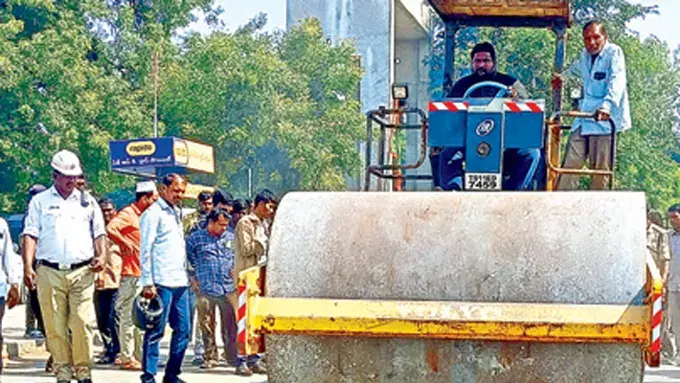
Police act against loud silencers in Nizamabad district
Police seized a two-wheeler at Velpur in Nizamabad district after residents complained that a youth had fitted a silencer producing loud noise while riding through colonies. Seized silencers were destroyed with a roller in the city. Police said two-wheeler noise in the country must stay below 80 decibels; beyond that, Section 190(2) of the Motor Vehicles Act provides a Rs 10,000 fine, jail up to three months and possible three-month licence suspension. Complaints may be made on Dial 112.
Source
Nizamabad — స్థానికం · read the original report ↗
Desk check · compared with the source
What the desk checked (5)
- A youth in Velpur fitted a modified silencer; police seized the two-wheeler after local complaints — Attributed to police/News Today district crime desk; no names given
- Two-wheeler noise in India must stay below 80 decibels — Figure appears in source, attributed to police guidance; no document cited
- Section 190(2) of the Motor Vehicles Act allows a Rs 10,000 fine and up to three months' jail — Stated in source as legal provision; statutory wording not quoted
- Driving licence can be suspended for three months — Presented in source as a possibility, unattributed to a named official
- Police ask the public to report loud silencers via Dial 112 — Attributed to police in source
Analysts’ view opinion
This falls into a category of cases that are legally easy to act on but procedurally sensitive. Using a modified high-noise silencer is clearly an offence the police can cite under Section 190(2) of the Motor Vehicles Act, with fine, imprisonment and licence suspension all on the table as stated. What the story does not set out is the legal basis and stage at which the seized silencers were crushed with a roller — and that is the central legal question here.
- Section 190(2) targets using a vehicle in violation of noise and air pollution standards; establishing a breach of the 80-decibel limit ordinarily depends on measurable evidence.
- The penalties described are maximum possibilities, not automatic outcomes — fine, jail and licence suspension normally flow from a court or competent authority, not from roadside action alone.
- Seizure is a preventive step; destroying seized property before a case concludes can raise property-rights and natural-justice questions, which is why the existence of a prior order or judicial sanction matters.
- On the other hand, noise-pollution enforcement rests on a strong public-interest footing linked to health and the right to a peaceful environment, giving authorities solid grounds to remove non-compliant parts.
- Inviting complaints via Dial 112 speeds enforcement, but complaint-driven action still requires verification and uniform standards to stay defensible.
What to watch — Watch for the order or authority under which the silencers were destroyed, and how charges and court proceedings progress for the seized vehicles.
The story does not establish how noise levels were measured, how many cases were registered, who authorised the destruction, or what charges were formally laid.
Deep dive
Research brief · 8 facts · 3 dates · exam-readyThe brief
Context
Police in Telangana's Nizamabad district have begun a drive against modified, loud motorcycle silencers after residents complained of noise in residential colonies. A silencer's purpose is to muffle engine noise and route exhaust fumes out, but some youths replace company-fitted silencers with louder aftermarket ones to draw attention. Police seized a two-wheeler at Velpur following local complaints, and seized silencers were crushed with a roller in Nizamabad city. Officials are citing Section 190(2) of the Motor Vehicles Act, which penalises noise and air pollution offences.
Key facts
- A youth at Velpur in Nizamabad district fitted a loud silencer to his two-wheeler; after residents' complaints, police seized the vehicle.
- Seized silencers were destroyed by crushing them with a roller in Nizamabad city.
- Noise from a two-wheeler in India must remain below 80 decibels, as per police.
- Exceeding the limit attracts Section 190(2) of the Motor Vehicles Act: Rs 10,000 fine and jail up to three months under noise and air pollution provisions.
- In some cases all penalties apply together, and the driving licence can also be cancelled for three months.
- Police have asked the public to report loud silencers through Dial 112.
- Police say modified silencers increase noise pollution, cause stress in people, harm the environment and lead to hearing problems.
- The original purpose of a silencer is to control high engine noise and expel smoke.
Timeline
- Not dated in the sourceA youth at Velpur fits a loud silencer to his two-wheeler; residents complain about noise while he rides through colonies.
- After the complaintPolice seize the two-wheeler at Velpur.
- SubsequentlySeized silencers are destroyed with a roller in Nizamabad city as part of a district drive against noise pollution.
Who has a stake
- Nizamabad district police — Enforcing noise-pollution rules under the Motor Vehicles Act, seizing vehicles and destroying modified silencers.
- Residents of colonies in Velpur and Nizamabad — Relief from disturbing noise levels linked to stress and hearing problems.
- Youths using modified silencers — Face vehicle seizure, Rs 10,000 fine, up to three months' jail and three-month licence cancellation.
- Dial 112 emergency helpline — Serves as the public reporting channel for loud silencer violations.
- Vehicle manufacturers — Company-fitted silencers are being replaced by louder aftermarket units, defeating the design purpose.
Why it matters
Noise pollution from modified silencers is not a mere nuisance: the source links it to stress, hearing damage and environmental harm, especially in dense residential colonies. The Nizamabad action shows how routine traffic enforcement under Section 190(2) of the Motor Vehicles Act can be used as an environmental health tool, with seizure, fines, jail and licence suspension as deterrents.
UPSC angle
Prelims pointers
- Permissible noise from a two-wheeler in India: below 80 decibels (as stated by police).
- Section 190(2), Motor Vehicles Act: penalty for driving a vehicle violating noise and air pollution standards.
- Punishment cited: Rs 10,000 fine, jail up to three months, licence cancellation up to three months.
- Dial 112 is the helpline for reporting loud silencer use in Nizamabad district.
- Velpur and Nizamabad city are in Nizamabad district, Telangana.
Mains framing
The Nizamabad silencer crackdown illustrates how a lifestyle-driven violation becomes a public health and environmental problem. The immediate cause is the replacement of factory-fitted silencers, designed to muffle engine noise and vent exhaust, with aftermarket units chosen for loudness and visibility; the consequence, as police note, is rising noise pollution, stress, hearing impairment and ecological harm in residential areas. Enforcement rests on Section 190(2) of the Motor Vehicles Act, which allows a Rs 10,000 fine, imprisonment up to three months and three-month licence cancellation, supplemented by deterrent measures such as seizure of the vehicle and public destruction of silencers with a roller. The way forward suggested by the story's own logic is a mix of citizen reporting through Dial 112, consistent on-road checks against the 80-decibel ceiling, and awareness among young riders that modification is not cosmetic but a punishable pollution offence. Sustained enforcement, rather than episodic drives, is what converts such actions into lasting behavioural change.
Key terms
- Silencer (muffler)
- Vehicle part whose purpose is to control high engine noise and expel exhaust smoke.
- Section 190(2), Motor Vehicles Act
- Provision penalising use of a vehicle violating noise and air pollution standards, with fine, jail and licence action.
- Decibel (dB)
- Unit of sound intensity; the source cites a limit of below 80 decibels for two-wheelers in India.
- Dial 112
- Emergency helpline number through which the public can inform police about loud silencer violations.
- Noise pollution
- Excess sound causing stress, hearing problems and environmental harm, as cited by Nizamabad police.
Practice questions
- Discuss how enforcement of the Motor Vehicles Act can be used as an instrument of environmental and public health regulation, with reference to noise pollution from modified vehicle silencers.
- What penalties does Section 190(2) of the Motor Vehicles Act provide, and how effective are seizure and destruction of modified silencers as deterrents?
- Examine the role of citizen reporting mechanisms such as Dial 112 in controlling everyday civic violations like noise pollution.
Grounded only in the source report — figures and dates are the source's, not inferred.