
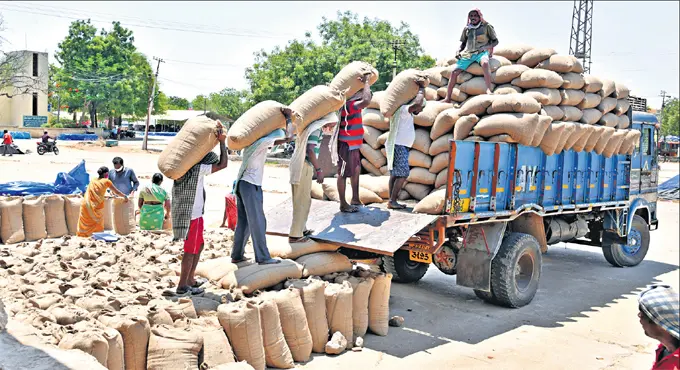
Yasangi paddy procurement gains pace across Telangana districts
Paddy procurement for Yasangi 2020-21 is gaining momentum in Telangana, with a majority of proposed centres opened by IKP, PACS, the Marketing Department and others, and transactions held as per Covid protocols. Till May 9, Warangal Urban procured 38,620 tonnes, Jangaon 50,921 tonnes and Mahabubabad 47,689 tonnes, while no payments were made in Jayashankar Bhupalpally and Mulugu. Karimnagar procured 1.36 lakh tonnes worth Rs 256.9 crore from 19,563 farmers. Fine paddy with 17 per cent moisture fetches Rs 1,888 per quintal.
Source
Jayashankar Bhupalpally — agriculture · read the original report ↗
Desk check · compared with the source
What the desk checked (5)
- Warangal Urban opened 102 of 105 proposed centres, purchased 38,620 tonnes and paid Rs 12.87 crore to farmers till May 9. — Figure appears in source; attributed to district procurement data, no document cited.
- Jayashankar Bhupalpally and Mulugu districts had procured 3,229 and 8,201 tonnes respectively with no payments made to farmers. — Stated in source as of May 9; internally consistent with claim that procurement is slower than last Yasangi.
- Fine quality paddy with 17 per cent moisture is being paid Rs 1,888 per quintal. — Figure appears in source, attributed to Civil Supplies Department data in erstwhile Adilabad district.
- In Karimnagar, 1.36 lakh tonnes worth Rs 256.9 crore was procured from 19,563 farmers. — Figure appears in source; related comments attributed to District Agriculture Officer V Sreedhar.
- Kothagudem procurement may peak by May 15. — Attributed statement by District Collector MV Reddy; a forecast, not verified.
Analysts’ view opinion
The core economic message here is that the state's procurement machinery is functioning even during a second Covid wave — and payments at Rs 1,888 per quintal of MSP-grade paddy are an immediate injection into rural incomes and local demand. But procurement and payment are not the same thing: officials in Karimnagar say money reaches accounts in four to five days, while the story itself records that farmers in Jayashankar Bhupalpally and Mulugu have been paid nothing so far. As long as that payment gap persists, farmers' working capital stays squeezed and the next crop's input spending leans on borrowing.
- Decentralising centres — one per village in Karimnagar, 1,306 in all — cuts farmers' transport costs and crowding risk, but raises the state's administrative, gunny-bag and logistics bill.
- The wide gap between expected arrivals and actual purchases (Warangal Urban expected 2.13 lakh tonnes but had bought 38,620 tonnes by May 9) signals the season is still early; if the rush peaks by May 15 as the Kothagudem Collector expects, storage and milling capacity will be tested.
- Karimnagar's 9.12 lakh acres sown and 22.17 lakh tonnes expected yield, on the back of Kaleshwaram water, illustrate that irrigation investment raises output and simultaneously raises the burden on procurement, storage and milling chains.
- The 17 per cent moisture condition protects quality-linked pricing, but in a season flagged for unseasonal-rain risk that risk sits largely with the farmer.
- Direct bank transfers reduce leakage and the gainer is the farmer; the payer is the state exchequer, with the ultimate cost spread through food subsidy and the milling chain.
What to watch — Watch how fast the pending dues in districts like Bhupalpally and Mulugu are cleared once arrivals peak after May 15, and how quickly procured paddy is moved to rice mills.
The story does not establish why payments are delayed, the total size of pending dues, or the overall fiscal cost to the state — these are provisional district figures as of May 9 only.
Deep dive
Research brief · 8 facts · 5 dates · exam-readyThe brief
Context
Telangana's rabi (locally "Yasangi") paddy crop of 2020-21 was harvested amid the second wave of Covid-19. State agencies — IKP centres, PACS, the Marketing Department, ODCMS, DCCB and the Civil Supplies Department — set up village-level procurement centres to buy paddy at MSP, with transactions conducted under Covid protocols and payments credited directly to farmers' bank accounts. Expanded irrigation, including Kaleshwaram water filling tanks and projects, pushed paddy acreage up sharply this Yasangi, raising procurement volumes. The story maps progress across the erstwhile Warangal, Adilabad, Karimnagar and Kothagudem districts as on 9-10 May 2021.
Key facts
- Fine quality paddy with 17 per cent moisture is being paid Rs 1,888 per quintal, with money credited directly to farmers' bank accounts.
- Warangal Urban: 102 of 105 proposed centres opened; 38,620 tonnes purchased and Rs 12.87 crore paid to farmers till May 9, against 2.13 lakh tonnes expected.
- Warangal Rural: 126 centres opened against 175 proposed; 21,777 tonnes purchased, Rs 2.69 crore paid till May 9, against 1.99 lakh tonnes expected.
- Jayashankar Bhupalpally: 126 centres opened for about 1.22 lakh tonnes, but only 3,229 tonnes purchased and no amount paid to farmers.
- Mulugu: 8,201 tonnes purchased through 135 centres against 1.30 lakh tonnes expected arrival; no farmer was paid.
- Mahabubabad procured 47,689 tonnes through 152 centres and paid Rs 18.91 crore; Jangaon procured 50,921 tonnes through 194 centres and paid Rs 22.98 crore, till May 9.
- Karimnagar: 1.36 lakh tonnes worth Rs 256.9 crore procured from 19,563 farmers; erstwhile Karimnagar sowed paddy in 9.12 lakh acres with 22.17 lakh tonnes expected and 18 lakh tonnes to be bought via 1,306 centres.
- Erstwhile Adilabad: 278 of 472 identified centres operational, 30,000 tonnes procured in Nirmal and Adilabad; 2,18,915 acres sown and 3,99,537 tonnes expected.
Timeline
- Yasangi 2019-20 (previous rabi season)Procurement pace in erstwhile Warangal district was faster than in the current season, as per the report.
- About 10 days before 10 May 2021Farmer Gujjula Ramgopal of Vangapahad sold nearly 100 quintals at a village procurement centre; payment still pending.
- Till 9 May 2021District-wise procurement and payment figures recorded for Warangal Urban, Warangal Rural, Jayashankar Bhupalpally, Mahabubabad, Jangaon and Mulugu.
- Monday (as on report date, 10 May 2021)Kothagudem district had procured 17,790 tonnes through 151 centres and paid Rs 9.02 crore of Rs 33.39 crore due.
- 15 May 2021 (expected)Kothagudem Collector MV Reddy says procurement will peak; officials directed to prepare for the rush and protect paddy from unseasonal rains.
Who has a stake
- Paddy farmers of Telangana — Assured MSP of Rs 1,888 per quintal for fine paddy at 17 per cent moisture, but face payment delays in districts such as Jayashankar Bhupalpally and Mulugu.
- IKP, PACS, Marketing Department, ODCMS and DCCB — Agencies running the procurement centres; responsible for opening proposed centres and completing purchases under Covid protocols.
- Civil Supplies Department / Civil Supplies Corporation — Provides procurement data, gunny bags and centres; must shift procured paddy to rice mills promptly.
- District Collectors (Warangal Urban's Rajeev Gandhi Hanumanthu, Kothagudem's MV Reddy) — Oversee centre operations, acreage assessment, peak-season rush management and protection of paddy from unseasonal rains.
- Rice millers — Receive procured paddy — 17,354.8 tonnes shifted from Kothagudem to mills in Kothagudem (13,557 tonnes) and Warangal Rural (4,233 tonnes).
- District Agriculture Officer V Sreedhar (Karimnagar) — Says centres were set up in every village, farmers asked to bring crop at 17 per cent moisture, and payments made in four to five days.
Why it matters
Paddy procurement at MSP is the main income event for lakhs of Telangana farmers, and doing it during the second Covid wave required village-level decentralisation to avoid crowding. The gap between procurement and payment — with zero payments in Jayashankar Bhupalpally and Mulugu even as Karimnagar paid most of Rs 256.9 crore — shows how unevenly the same system performs across districts. With acreage rising on the back of Kaleshwaram irrigation, the state's capacity to buy, pay and mill on time directly determines whether the expanded output translates into farm income.
UPSC angle
Prelims pointers
- Yasangi is the Telangana term for the rabi season; Vaanakalam refers to the kharif season.
- Fine paddy with 17 per cent moisture was procured at Rs 1,888 per quintal in Yasangi 2020-21.
- Procurement agencies named: IKP, PACS, Marketing Department, ODCMS and DCCB, alongside the Civil Supplies Department/Corporation.
- Erstwhile Karimnagar districts (Karimnagar, Peddapalli, Jagitial, Rajanna Sircilla) sowed 9.12 lakh acres; 1,306 centres planned to procure 18 lakh tonnes of an expected 22.17 lakh tonnes.
- Kaleshwaram project water filling tanks and projects was credited with the jump in Yasangi paddy acreage.
- Warangal Urban's paddy area rose by 9,500 acres over Vaanakalam, per Collector Rajeev Gandhi Hanumanthu.
Mains framing
Telangana's Yasangi 2020-21 procurement illustrates both the reach and the friction of MSP-based public procurement. Expanded irrigation, notably Kaleshwaram water filling tanks and projects, lifted paddy acreage (9.12 lakh acres in erstwhile Karimnagar alone, 2,18,915 acres in erstwhile Adilabad), forcing the state to decentralise buying to one centre per village so that Covid protocols could be observed; gunny bags and centres were arranged in advance. Yet outcomes diverged sharply: Karimnagar procured 1.36 lakh tonnes worth Rs 256.9 crore from 19,563 farmers with payments in four to five days, while Jayashankar Bhupalpally (3,229 tonnes) and Mulugu (8,201 tonnes) recorded no payments at all and Kothagudem had cleared only Rs 9.02 crore of Rs 33.39 crore due. Several districts also opened fewer centres than proposed (126 of 175 in Warangal Rural, 278 of 472 in erstwhile Adilabad), and overall pace lagged behind Yasangi 2019-20. The way forward implied by the source lies in administrative measures already flagged — timely crediting to bank accounts, moisture-based staggered arrivals to avoid dumping at centres, immediate shifting of stock to rice mills, and readiness for the mid-May peak and unseasonal rains.
Key terms
- Yasangi
- The rabi or winter-irrigated cropping season in Telangana usage; here the 2020-21 paddy crop being procured.
- Vaanakalam
- The kharif or monsoon cropping season in Telangana usage, used as the comparison for acreage change.
- IKP (Indira Kranthi Patham) centres
- Self-help-group-linked village organisations that run paddy procurement centres on behalf of the state.
- PACS
- Primary Agricultural Cooperative Societies, village-level cooperatives acting as procurement agencies.
- DCCB / ODCMS
- District Cooperative Central Bank and the cooperative marketing society network, also listed as paddy purchasing agencies.
- MSP
- Minimum Support Price — the government-assured rate, here Rs 1,888 per quintal for fine paddy at 17 per cent moisture.
Practice questions
- Decentralised, village-level procurement centres were Telangana's response to buying paddy during the Covid second wave. Evaluate the administrative strengths and weaknesses this model revealed, using the 2020-21 Yasangi experience.
- Why do payment delays persist in MSP procurement even where purchases are brisk? Discuss with reference to the district-level variation seen in Telangana in May 2021.
- Expanded irrigation has increased paddy acreage in Telangana. Examine the implications for procurement logistics, milling capacity and crop diversification.
Grounded only in the source report — figures and dates are the source's, not inferred.