
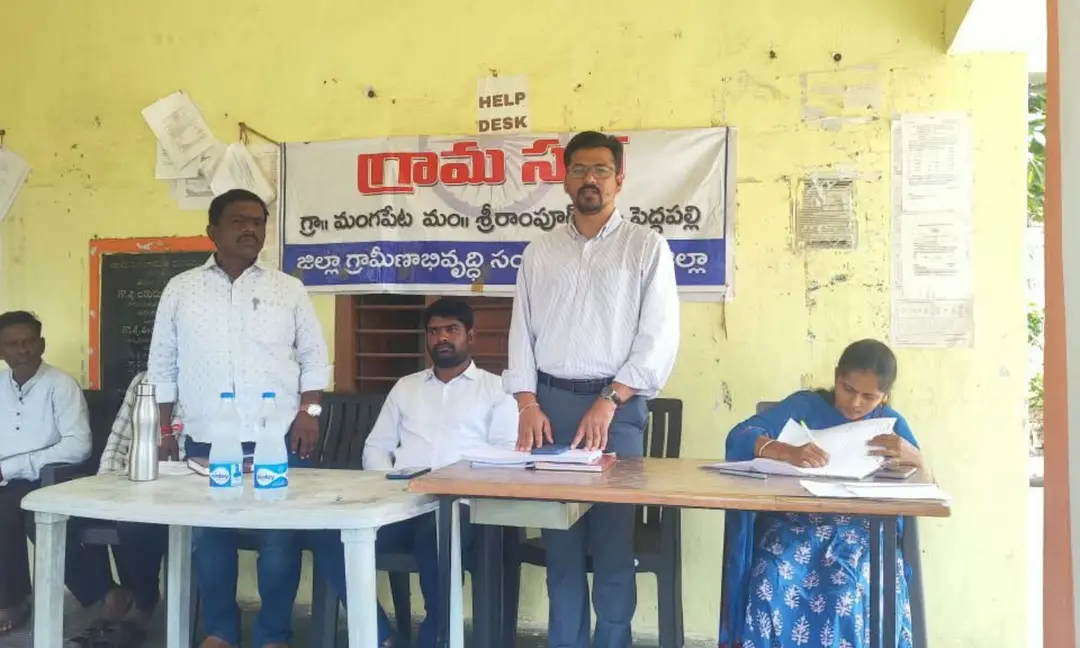
Special gram sabha held on land resurvey in Mangapeta
A special gram sabha on the land resurvey was held in Mangapeta village of Kalva Srirampur mandal, Peddapalli district, under sarpanch Akula Srinivas. Tahsildar Ramudu said Kunaram, Mangapeta, Vennampalli, Kistampeta and Motlapalli were chosen as pilot project villages in the mandal. Work began on July 14, but only 600 of the village's 1,300 acres were resurveyed in 80 days. He said the sabha was convened on the collector's orders and that farmers' cooperation would help correct records and ensure clear titles.
Source
Peddapalli — వార్తలు · read the original report ↗
Desk check · compared with the source
What the desk checked (5)
- Kalva Srirampur tahsildar Ramudu urged farmers to cooperate for speedy completion of land resurvey. — Attributed directly to the tahsildar at the gram sabha in the source.
- Kunaram, Mangapeta, Vennampalli, Kistampeta and Motlapalli were selected as pilot project villages for the resurvey in the mandal. — Attributed to the tahsildar; no order number or date given.
- Of 1,300 acres in Mangapeta, only 600 acres were resurveyed in 80 days since the first gram sabha on July 14. — Figures appear in the source as stated by the tahsildar; no official record cited.
- The fresh gram sabha was convened on the district collector's instructions due to slow progress. — Attributed to the tahsildar; collector not quoted directly.
- The sabha was held in the gram panchayat premises under sarpanch Akula Srinivas. — Stated in the source with named participants; no independent confirmation.
Analysts’ view opinion
Land resurvey is not merely a revenue-records exercise; it is economic infrastructure that clarifies rural property rights. The figure cited by the tahsildar — only 600 of Mangapeta's 1,300 acres covered in 80 days — suggests a pace problem even at the pilot stage. Clear titles typically improve credit access, land transaction values and reduce dispute costs; delay simply pushes those gains further out.
- Less than half the village's 1,300 acres done in 80 days means both the pilot timeline and the per-acre cost of survey staff and equipment stretch further.
- Record clarity converts fairly directly into economic value: bank and crop loans, mortgageability and easier transactions all rest on unambiguous title.
- The story does not state why farmers are holding back; in general, fears of boundary changes, unresolved inheritance or partition issues and lost workdays impose immediate private costs against benefits that arrive only later.
- The fiscal cost sits with the state — surveyors, equipment, administration — while the gains accrue mainly to landholders, making this public spending that secures private assets.
- Pilot village outcomes will shape cost estimates for wider rollout, so slippage here could affect the district's implementation timeline and budget.
What to watch — Watch the pace on the remaining 700 acres, whether farmer turnout improves after this gram sabha, and how the other four pilot villages progress — that is what will reveal the true cost-benefit picture for scaling up.
The story does not establish the actual reasons for the slowdown, the project's budget or deadline, any cost to farmers, or whether disputes in the completed 600 acres were resolved.
Deep dive
Research brief · 8 facts · 3 dates · exam-readyThe brief
Context
Telangana is carrying out a village-level land resurvey to update and correct land records so that landholders get clear, undisputed titles. In Peddapalli district's Kalva Srirampur mandal, five villages — Kunaram, Mangapeta, Vennampalli, Kistampeta and Motlapalli — have been chosen as pilot project villages for the exercise. Progress in Mangapeta has been slow because farmers are not coming forward, so on the district collector's orders a special gram sabha was convened in the gram panchayat premises under sarpanch Akula Srinivas, with Tahsildar Ramudu as chief guest explaining the importance of the survey.
Key facts
- A special gram sabha on land resurvey was held in Mangapeta village, Kalva Srirampur mandal, Peddapalli district, in the gram panchayat premises.
- Kunaram, Mangapeta, Vennampalli, Kistampeta and Motlapalli were selected as pilot project villages in the mandal for the land resurvey.
- The first gram sabha in Mangapeta was held on July 14, when resurvey work was launched.
- In 80 days, only 600 acres out of the village's total 1,300 acres have been resurveyed.
- Tahsildar Ramudu said farmers were not coming forward for the resurvey, slowing the work.
- The fresh gram sabha was arranged on the orders of the district collector because resurvey had slowed in Mangapeta.
- Tahsildar Ramudu said faster farmer cooperation would allow the remaining land to be measured and records corrected, giving clear rights.
- Participants included sarpanch Akula Srinivas, GPO Raju, surveyor Raju, village secretary Ramya, public representatives, village elders, revenue staff and a large number of farmers.
Timeline
- July 14First gram sabha held in Mangapeta village and land resurvey works began.
- Within 80 days of the startOnly 600 of the village's 1,300 acres were resurveyed; progress described as slow.
- Later (date not stated in the source)Special gram sabha convened again on the district collector's orders to push farmer participation.
Who has a stake
- Farmers of Mangapeta — Getting their land measured correctly means corrected records and clear titles; non-participation leaves disputes unresolved.
- Tahsildar Ramudu, Kalva Srirampur — Responsible for completing the resurvey quickly and for creating awareness among farmers.
- Sarpanch Akula Srinivas and gram panchayat — Hosted and led the special gram sabha; mobilising villagers for the survey.
- Peddapalli district collector — Ordered the fresh gram sabha after resurvey progress slowed in Mangapeta.
- Revenue staff, surveyor Raju, GPO Raju, village secretary Ramya — Field-level execution of measurement and record correction work.
- Pilot villages Kunaram, Vennampalli, Kistampeta, Motlapalli — Their experience will shape how the resurvey proceeds across the mandal.
Why it matters
Unclear and outdated land records are a primary source of rural litigation, and a resurvey is the only way to fix boundaries and confirm ownership on the ground. Mangapeta shows the practical bottleneck: less than half the village's 1,300 acres were covered in 80 days because farmers did not turn up, forcing the collector to order a fresh gram sabha. Whether pilot villages succeed will determine the pace and credibility of the wider record-correction exercise.
UPSC angle
Prelims pointers
- Mangapeta village is in Kalva Srirampur mandal of Peddapalli district, Telangana.
- Five pilot project villages for resurvey in the mandal: Kunaram, Mangapeta, Vennampalli, Kistampeta, Motlapalli.
- Mangapeta's resurvey began with a gram sabha on July 14; 600 of 1,300 acres done in 80 days.
- The special gram sabha was convened on the district collector's orders.
- Tahsildar is the mandal-level revenue officer leading the resurvey awareness drive.
- Stated purpose of resurvey: correct land records and ensure clear titles, preventing future land disputes.
Mains framing
Land record modernisation in India fails less for want of technology than for want of participation: measurement requires the landholder to be present, to point out boundaries and to accept the result, and where farmers fear losing extent, revealing encroachment or triggering family disputes, they simply stay away. Mangapeta is a textbook case — despite a pilot-village designation, a launch gram sabha on July 14 and 80 days of fieldwork, only 600 of 1,300 acres were covered, prompting the district collector to order a second special gram sabha with the tahsildar as the awareness-builder. The implications are significant: incomplete resurvey leaves hybrid records that are neither old nor new, prolonging litigation and weakening the security of title that underpins credit, crop support and land transactions. The way forward suggested by the source is institutional rather than coercive — using the gram sabha as the forum for transparency, mobilising the sarpanch, village secretary, surveyor and revenue staff together, and communicating the direct benefit to farmers that corrected records yield clear rights and fewer future disputes. Pilot villages must therefore be treated as demonstration sites whose completion builds trust for scale-up across the mandal.
Key terms
- Land resurvey
- Fresh field measurement of village lands to update boundaries and correct land records so holders get clear titles.
- Gram sabha
- Assembly of a village's voters; used here as the official forum to explain the resurvey and seek farmers' cooperation.
- Tahsildar
- Mandal-level revenue officer, here in charge of driving and explaining the resurvey in Kalva Srirampur.
- Sarpanch
- Elected head of the gram panchayat; Akula Srinivas led the Mangapeta special gram sabha.
- Pilot project village
- Village selected for the first phase of resurvey to test the process before wider rollout — five such villages in the mandal.
- District collector
- Head of district administration, who ordered the fresh gram sabha after resurvey slowed in Mangapeta.
Practice questions
- Why do land resurvey programmes stall at the village level despite administrative backing? Discuss with reference to the Mangapeta experience.
- Examine the role of the gram sabha as an institution for transparency and participation in land record correction.
- 'Clear land titles are a precondition for rural credit and dispute-free agriculture.' Critically analyse in the Indian context.
Grounded only in the source report — figures and dates are the source's, not inferred.