
Ladakh observes Martyrs' Day with shutdown in Leh, Kargil
A shutdown was observed in Leh, Kargil and other parts of Ladakh on Wednesday, marking one year since the September 24, 2025 violence during protests for statehood and Sixth Schedule safeguards, in which four people died. Some observed the day as 'Shaheed Diwas'. Sonam Wangchuk led a symbolic 20-km padyatra in Leh and demanded public release of the judicial inquiry report. Lieutenant Governor Vinai Kumar Saxena approved withdrawal of cases against 20 people.
Source
Hindustan Times — India · read the original report ↗
Desk check · compared with the source
What the desk checked (5)
- Four people died in the September 24, 2025 violence during statehood and Sixth Schedule protests — Figure appears twice in the source and is internally consistent; attributed to the source's own reporting.
- LG Vinai Kumar Saxena approved withdrawal of criminal cases against 20 people booked over the violence — Attributed to the Ladakh administration in the source; number consistent with linked report referenced in text.
- Sonam Wangchuk led a symbolic padyatra of about 20 km in Leh, reaching Shaheed Memorial Park around 7 pm — Attributed to organisers and Wangchuk; distance and time given in source, not independently verifiable.
- Automatic weapons were allegedly used against protesters and a firing order may have been issued — Presented as questions raised by Wangchuk for the judicial inquiry, not as established fact.
- Wangchuk was detained under the NSA two days after the incident and released in March this year — Stated in source without further attribution; no official document cited.
Analysts’ view opinion
The shutdown and the observance of "Shaheed Diwas" in Ladakh are not only acts of mourning — they are a demonstration of political strength. That the Leh Apex Body and the Kargil Democratic Alliance are still standing together a year on preserves their bargaining power in talks with the Centre. At the same time, the thin turnout and the shortened march suggest the movement has shifted from the street to the negotiating table, while the Lieutenant Governor's approval of withdrawing cases on the same day reads as an attempt to lower the temperature.
- A shutdown observed in both Leh and Kargil signals that unity across regional and religious lines on the core demands is holding — a crucial political asset for the local leadership.
- The approval to withdraw cases against 20 people landing on the anniversary itself can be read as an administrative move to defuse anger and keep the dialogue channel alive.
- The judicial inquiry report remaining unpublished after a year has become the movement's sharpest political lever, widening the demand from statehood to accountability.
- Organisers' decision not to appeal widely outside Ladakh looks like a deliberate effort to keep the cause locally owned and blunt any charge of outside politicisation.
- Sonam Wangchuk's return to a public platform after detention under the NSA and release suggests his standing in local politics has not been diminished.
What to watch — Watch whether the judicial inquiry report is made public, and whether the Apex Body and KDA treat an Article 371 framework as an acceptable substitute for Sixth Schedule protections.
The story does not establish the motive behind the withdrawal of cases, the current state of talks, the reason for the report's delay, or the scale of public participation in the shutdown — these are inferences from the reported facts.
Deep dive
Research brief · 8 facts · 7 dates · exam-readyThe brief
Context
On September 24, 2025, protests in Leh demanding statehood for Ladakh and safeguards under the Sixth Schedule of the Constitution turned violent, leaving four people dead and several injured. The Union Territory administration ordered a judicial inquiry into the firing. One year later, on Wednesday, Leh, Kargil and other parts of Ladakh observed a shutdown, with some marking the day as "Martyrs' Day" or "Shaheed Diwas". Climate activist Sonam Wangchuk, a prominent face of the movement, led a symbolic padyatra and demanded the public release of the inquiry report.
Key facts
- The September 24, 2025 violence during statehood and Sixth Schedule protests in Leh left four people dead and several injured.
- A shutdown was observed on Wednesday in Leh, Kargil and other parts of Ladakh; shops and business establishments remained closed and traffic was thin.
- Ladakh Lieutenant Governor Vinai Kumar Saxena on Wednesday approved withdrawal of criminal cases against 20 people booked in connection with the violence.
- Sonam Wangchuk led a symbolic padyatra in Leh, covering around 20 km and reaching Shaheed Memorial Park at about 7 pm.
- A padyatra proposed by the Apex Body Leh (LAB) and Kargil Democratic Alliance (KDA) for September 19-24 was cut down to a symbolic march in Leh on Wednesday due to changing weather.
- Wangchuk announced that September 24 will be observed as Shaheed Diwas.
- Wangchuk demanded early submission and public release of the judicial inquiry report, saying a year has passed without it being made public.
- Wangchuk was detained two days after the September 24, 2025 incident under the NSA and released in March this year.
Timeline
- September 24, 2025Protests for statehood and Sixth Schedule safeguards turn violent in Leh; four killed and several injured in firing.
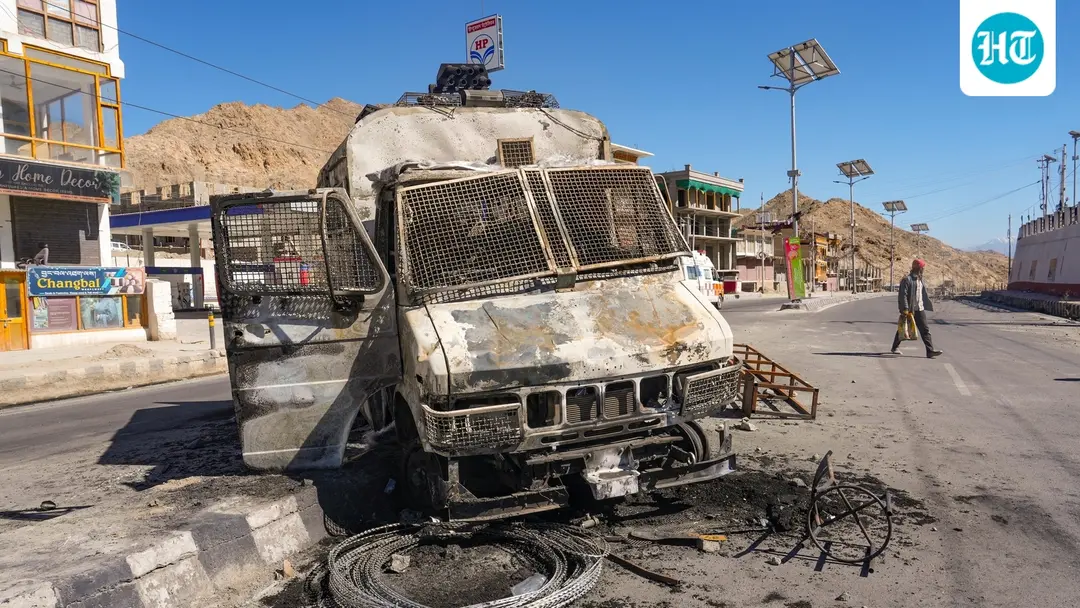
- September 25, 2025Charred remains of a vehicle seen in Leh in the aftermath of clashes between demonstrators and police.
- Two days after the incident (September 2025)Sonam Wangchuk detained under the National Security Act (NSA).
- After the incidentUnion Territory administration orders a judicial inquiry into the September 24 violence.
- March this yearSonam Wangchuk released from detention.
- September 19-24 (proposed)LAB and KDA proposed a padyatra; later limited to a symbolic march in Leh.
- Wednesday (September 24, one-year anniversary)Shutdown in Leh and Kargil; tribute programmes; 20-km symbolic padyatra; LG approves withdrawal of cases against 20 people.
Who has a stake
- People of Ladakh (Leh and Kargil) — Seeking statehood and Sixth Schedule constitutional safeguards; families of the four killed await accountability.
- Apex Body Leh (LAB) and Kargil Democratic Alliance (KDA) — Lead the movement and are engaged in dialogue with the Centre on Ladakh's demands.
- Sonam Wangchuk, climate activist — Prominent face of the protests; was detained under NSA and now demands public release of the judicial inquiry report.
- Lieutenant Governor Vinai Kumar Saxena / UT administration — Ordered the judicial inquiry and approved withdrawal of cases against 20 accused; must manage law and order and public trust.
- Union Government / Centre — In dialogue with LAB and KDA; reportedly framing special safeguards for Ladakh under Article 371.
- Police and security forces — Face questions in the inquiry over whether a firing order was issued and alleged use of automatic weapons against protesters.
Why it matters
Ladakh's demand for statehood and Sixth Schedule protection remains unresolved a year after four people died in police firing, and the judicial inquiry report is still not public. How the Centre and the UT administration respond — through the promised Article 371 framework, the inquiry's findings and steps like withdrawing cases against 20 people — will shape trust between a strategically sensitive border region and the state.
UPSC angle
Prelims pointers
- September 24, 2025 Leh violence during statehood and Sixth Schedule protests left four dead.
- Sixth Schedule of the Constitution provides for autonomous administration of tribal areas.
- Apex Body Leh (LAB) and Kargil Democratic Alliance (KDA) are the two platforms negotiating with the Centre on Ladakh.
- Vinai Kumar Saxena is the Lieutenant Governor of Ladakh; he approved withdrawal of cases against 20 people.
- Sonam Wangchuk was detained under the National Security Act (NSA) and released in March this year.
- A new framework for special safeguards for Ladakh is being made under Article 371, per the chief secretary.
Mains framing
The first anniversary of the September 24, 2025 Leh violence highlights the unresolved political question of Ladakh's constitutional status. Since Ladakh became a Union Territory without a legislature, demands for statehood and inclusion in the Sixth Schedule have been driven by fears over land, jobs, demography and cultural identity, coordinated by the Apex Body Leh and the Kargil Democratic Alliance. The deaths of four people in firing, the detention of activist Sonam Wangchuk under the NSA and the continued non-publication of the judicial inquiry report have added a trust deficit to the substantive demand; questions raised include whether a firing order was issued and how automatic weapons were allegedly used against protesters. Confidence-building steps such as the Lieutenant Governor's approval of withdrawal of cases against 20 accused and the chief secretary's statement that a framework for special safeguards is being drafted under Article 371 indicate a negotiated route, but the shutdown across Leh and Kargil shows sentiment remains raw. A credible way forward would rest on time-bound completion and public release of the inquiry, sustained dialogue with LAB and KDA, and clarity on the promised safeguards.
Key terms
- Sixth Schedule
- Constitutional provision for autonomous administration of tribal areas, which Ladakh's leaders want extended to the UT as a safeguard.
- Apex Body Leh (LAB)
- Leh-based platform of groups leading the statehood and Sixth Schedule demand and in dialogue with the Centre.
- Kargil Democratic Alliance (KDA)
- Kargil-based alliance jointly negotiating Ladakh's demands with the Centre along with the LAB.
- National Security Act (NSA)
- Preventive detention law under which Sonam Wangchuk was detained two days after the September 24, 2025 violence.
- Shaheed Diwas / Martyrs' Day
- The day Wangchuk announced would mark September 24 in memory of those killed in the 2025 firing.
- Article 371
- Constitutional provision under which, per the chief secretary, a new framework for special safeguards for Ladakh is being prepared.
Practice questions
- Examine the demands for statehood and Sixth Schedule status for Ladakh. What administrative and constitutional options are available to the Union government?
- Discuss how delays in making judicial inquiry reports public affect public trust in state institutions, using the September 24, 2025 Leh violence as a case study.
- Preventive detention laws such as the NSA are often used during mass protests. Critically evaluate their use in the context of democratic dissent in border regions.
Grounded only in the source report — figures and dates are the source's, not inferred.