
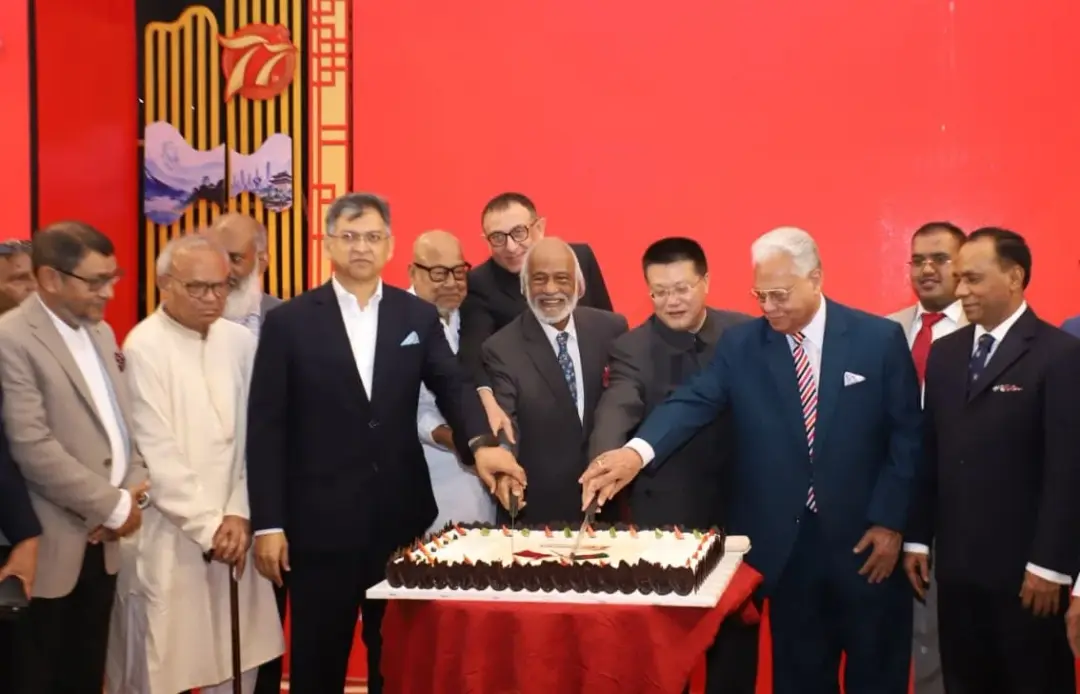
Bangladesh, China pledge stronger ties at National Day reception
The Chinese Embassy hosted a reception at Hotel Sheraton in Dhaka to mark China's 77th National Day. Chief guest Dr. Abdul Moyeen Khan, Minister for Local Government, Rural Development and Co-operatives, said Prime Minister Tarique Rahman's recent visit to China had opened a new chapter in bilateral cooperation. Ambassador Yao Wen said China's economy grew 4.7 percent in the first half of the year and noted 51 years of diplomatic ties. A cultural programme and cake-cutting followed.
Source
Bangladesh — govt & media · read the original report ↗
Desk check · some claims need care
What the desk checked (5)
- The Chinese Embassy hosted a reception at Hotel Sheraton, Dhaka on Wednesday, September 23, 2026, for China's 77th National Day. — Date and venue appear in source; the future-dated day and the '77th' anniversary framing are internally inconsistent with the 1949 founding date also cited, and need editor review.
- Local Government Minister Dr. Abdul Moyeen Khan attended as chief guest and said Prime Minister Tarique Rahman's recent visit to China opened a new chapter in ties. — Attributed directly to the named minister in the source.
- China's economy grew 4.7 percent in the first half of the current year. — Figure attributed to Chinese Ambassador Yao Wen; no independent data source cited.
- This year marks the 51st anniversary of Bangladesh-China diplomatic relations and the 10th anniversary of the Belt and Road Initiative. — Attributed to Ambassador Yao Wen; figures appear in source as stated.
- Ties were elevated to a 'Comprehensive Strategic Cooperative Partnership' after the Prime Minister's first visit to China. — Attributed to Ambassador Yao Wen; no document or date cited.
Analysts’ view opinion
A National Day reception is normally protocol theatre, but the language used in Dhaka this week was strategically loaded. The elevation of ties to a "Comprehensive Strategic Cooperative Partnership" after Prime Minister Tarique Rahman's first visit to China, paired with Beijing's explicit pledge to back Bangladesh's new government, uphold its sovereignty and oppose "interference in internal affairs", signals that China intends to lock in early influence with a freshly installed administration. For a country sitting at the head of the Bay of Bengal, that is less about cake-cutting than about positioning in a contested neighbourhood.
- The partnership upgrade and the reference to the Prime Minister's first China visit suggest Beijing moved quickly to institutionalise ties with Bangladesh's new government rather than wait out a political transition.
- China's stated support for Bangladesh's "national independence, sovereignty and territorial integrity" and its opposition to external interference is standard Beijing phrasing, but in a post-transition context it reads as a signal to other outside players as well as reassurance to Dhaka.
- The listed cooperation basket — infrastructure, energy, industry, technology, digitalisation — is where Chinese leverage typically becomes durable, since such projects create long financing and maintenance dependencies; the story gives no figures, so the scale is unclear.
- The tenth-anniversary framing of the Belt and Road Initiative alongside the 51st year of diplomatic relations indicates Dhaka remains a priority node in China's connectivity architecture in South Asia.
- Bangladesh's own emphasis on people-to-people ties, small entrepreneurs and human resource development reads as an attempt to broaden the relationship beyond big-ticket projects — and, implicitly, to keep it politically sustainable at home.
What to watch — Watch whether the partnership upgrade is followed by concrete agreements or financing announcements, and how India, the United States and other Indo-Pacific players recalibrate their own engagement with the new government in Dhaka.
This story is an account of ceremonial speeches: it establishes declared intent and diplomatic framing, not any specific project, defence arrangement, financial commitment or the reaction of any third country.
Deep dive
Research brief · 8 facts · 5 dates · exam-readyThe brief
Context
The Chinese Embassy in Dhaka hosted a reception at Hotel Sheraton on Wednesday, September 23, 2026, to mark the 77th National Day of the People's Republic of China, founded in 1949. Bangladesh's Minister for Local Government, Rural Development and Co-operatives, Dr. Abdul Moyeen Khan, was chief guest, and Chinese Ambassador Yao Wen spoke of a bilateral relationship now at 51 years of diplomatic ties. Both referred to Prime Minister Tarique Rahman's recent first visit to China, after which the relationship was elevated to a "Comprehensive Strategic Cooperative Partnership". Ambassador Yao Wen, nearing the end of a tenure of almost three years and nine months, indicated his departure from Bangladesh was imminent.
Key facts
- The reception marking China's 77th National Day was held at Hotel Sheraton, Dhaka, on Wednesday, September 23, 2026, organised by the Chinese Embassy.
- The event opened with the national anthems of both Bangladesh and China, and closed with a Chinese cultural programme and a cake-cutting ceremony.
- Chief guest was Dr. Abdul Moyeen Khan, Bangladesh's Minister for Local Government, Rural Development and Co-operatives.
- Ambassador Yao Wen said China's economy grew 4.7 percent in the first half of the current year despite the international energy crisis and industrial and supply chain disruptions.
- The year marks the 51st anniversary of China-Bangladesh diplomatic relations and the 10th anniversary of China's Belt and Road Initiative, per Yao Wen.
- Relations were upgraded to a "Comprehensive Strategic Cooperative Partnership" after Prime Minister Tarique Rahman's first visit to China.
- Yao Wen said China, as the world's largest developing nation and a permanent member of the UN Security Council, opposes interference in Bangladesh's internal affairs and backs its independence, sovereignty and territorial integrity.
- Yao Wen said he had served nearly three years and nine months in Bangladesh and that his departure was imminent.
Timeline
- 1949Founding of the People's Republic of China, the anniversary marked by National Day.
- 51 years ago (year not stated in the source)Establishment of diplomatic relations between China and Bangladesh.
- 10 years ago (year not stated in the source)Launch of China's Belt and Road Initiative, whose 10th anniversary falls this year.
- Recent (exact date not stated in the source)Prime Minister Tarique Rahman's first visit to China; ties elevated to a Comprehensive Strategic Cooperative Partnership.
- Wednesday, September 23, 2026Chinese Embassy reception in Dhaka for China's 77th National Day.
Who has a stake
- Government of Bangladesh — Seeks Chinese cooperation in trade, investment, infrastructure, energy, industry, technology and digitalisation, and lessons from China's development experience.
- Government of China / Chinese Embassy in Dhaka — Wants to consolidate the Comprehensive Strategic Cooperative Partnership and support Bangladesh's new government while opposing external interference.
- Dr. Abdul Moyeen Khan, Minister for Local Government, Rural Development and Co-operatives — Chief guest; framed the next decade of ties around culture, people-to-people contact, human resource development and small business empowerment.
- Ambassador Yao Wen — Outgoing envoy credited with advancing trade, investment, infrastructure, green energy, healthcare and people-to-people ties.
- Prime Minister Tarique Rahman — His recent visit to China is presented as the pivot that lifted bilateral relations to a new level.
- Bangladeshi businesspeople, students, academics, journalists and youth — Named as the bridges for expanded people-to-people exchange and beneficiaries of future cooperation.
Why it matters
A National Day reception doubles as a diplomatic signal: both sides used it to lock in the newly upgraded Comprehensive Strategic Cooperative Partnership and Beijing's explicit backing for Bangladesh's new government, sovereignty and non-interference. For India's neighbourhood watchers, the deepening of Chinese infrastructure, energy and technology engagement in Bangladesh, coupled with a change of ambassador, shapes the regional balance. It also shows how development-model diplomacy, not just aid or trade numbers, is being used to build influence.
UPSC angle
Prelims pointers
- China's National Day marks the founding of the People's Republic of China in 1949; the 2026 reception marked the 77th anniversary.
- China is a permanent member of the UN Security Council and describes itself as the world's largest developing nation.
- Belt and Road Initiative (BRI): its 10th anniversary was noted at the event.
- Bangladesh-China relations have been elevated to a "Comprehensive Strategic Cooperative Partnership".
- China's GDP growth in the first half of the current year: 4.7 percent, as stated by Ambassador Yao Wen.
- Chinese Ambassador to Bangladesh at the time of the event: Yao Wen; Bangladesh's Local Government Minister: Dr. Abdul Moyeen Khan.
Mains framing
Bangladesh-China relations, at 51 years of formal diplomatic engagement, have moved from trade and infrastructure lending into a declared Comprehensive Strategic Cooperative Partnership, driven by a recent prime ministerial visit and Beijing's prompt endorsement of Bangladesh's new government along with pledges on sovereignty, territorial integrity and non-interference. The drivers are structural: Bangladesh's demand for infrastructure, energy, technology and large-scale digitalisation, and China's search for partners and legitimacy for its development model and the Belt and Road Initiative in its 10th year, even as its own growth moderates to 4.7 percent in the first half of the year amid energy and supply-chain stress. The implications are twofold: real development gains for Bangladesh in green energy, healthcare and industry, and a shifting strategic equation in South Asia that India must factor into its neighbourhood policy. The way forward suggested at the event itself is to broaden the relationship beyond government-to-government megaprojects towards people-to-people exchange among students, academics, journalists and entrepreneurs, human resource development and support to small businesses, so that cooperation is diversified and less dependent on single large projects or on political transitions.
Key terms
- National Day (China)
- Annual commemoration of the founding of the People's Republic of China in 1949; the 2026 edition marked 77 years.
- Comprehensive Strategic Cooperative Partnership
- The upgraded top tier of China-Bangladesh ties announced after Prime Minister Tarique Rahman's first visit to China.
- Belt and Road Initiative (BRI)
- China's connectivity and infrastructure initiative, whose 10th anniversary the ambassador noted this year.
- People-to-people contact
- Non-governmental exchange among students, academics, journalists, businesspeople and professionals, flagged as the next growth area.
- UN Security Council permanent member
- Status invoked by Ambassador Yao Wen to frame China's role in global governance, peace and development.
- Non-interference
- Principle cited by China in pledging not to interfere in Bangladesh's internal affairs while supporting its sovereignty.
Practice questions
- Examine the drivers behind the elevation of Bangladesh-China relations to a Comprehensive Strategic Cooperative Partnership and its implications for India's neighbourhood policy.
- "Development-model diplomacy is as significant as trade or aid in contemporary South Asian geopolitics." Discuss with reference to China's engagement with Bangladesh.
- How can people-to-people exchanges and small-business linkages make bilateral partnerships more resilient to political transitions? Illustrate with the Bangladesh-China case.
Grounded only in the source report — figures and dates are the source's, not inferred.