
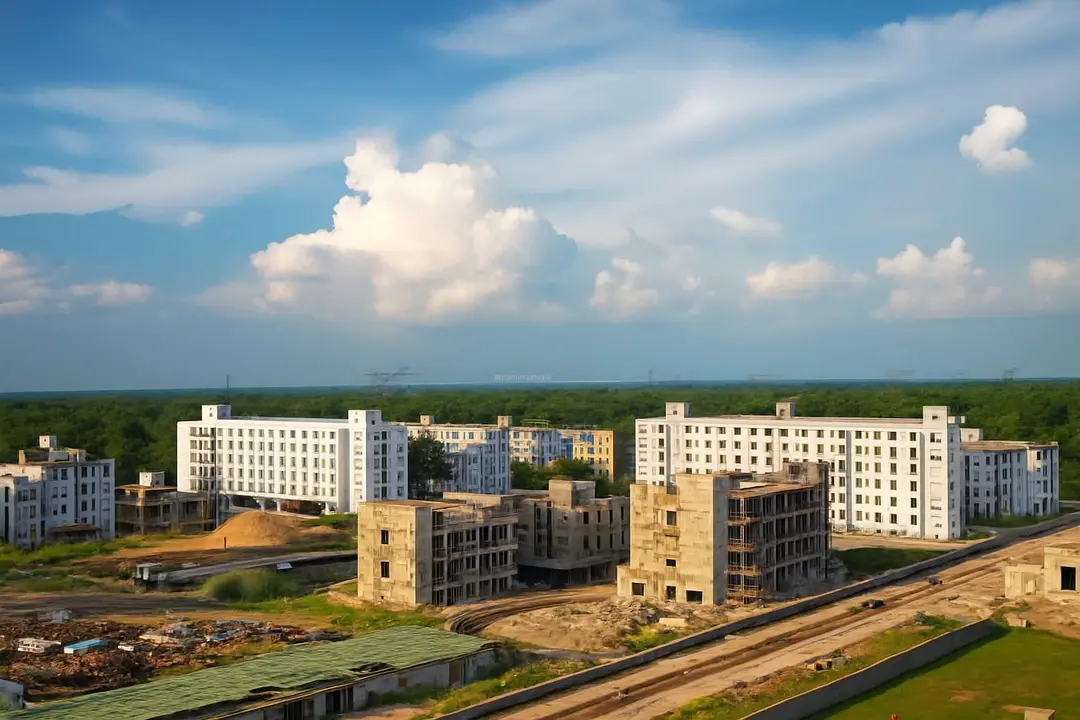
Assam targets 4,000 MBBS seats by 2031, says Chief Minister
Assam plans to increase its MBBS seats to 4,000 by 2031, Chief Minister Himanta Biswa Sarma announced while inaugurating the 750-bed Baba Baidyanath Medical Trust Hospital in Deoghar, Jharkhand. He said the state now has 16 medical colleges producing about 2,200 doctors annually. Sarma added that the government envisages 32 more medical colleges, of which 16 are already established. He also cited the State Budget provision to deploy two doctors at each of Assam's 5,000 sub-health centres.
Source
Assam — CM & govt · read the original report ↗
Desk check · compared with the source
What the desk checked (5)
- Assam plans to raise MBBS seats to 4,000 by 2031. — Attributed to Chief Minister Himanta Biswa Sarma; figure appears in source.
- Assam has 16 medical colleges and produces about 2,200 doctors annually. — Attributed to Sarma; source also cites an earlier figure of around 350 doctors, while separately saying about 300 earlier — minor internal inconsistency.
- The state has a vision of 32 more medical colleges, of which 16 are already established. — Quoted statement by Sarma; wording in source is ambiguous about the total count.
- The latest State Budget announced deployment of two doctors at each of Assam's 5,000 sub-health centres. — Attributed to Sarma citing the State Budget; not independently verified.
- Announcement made at inauguration of the 750-bed Baba Baidyanath Medical Trust Hospital in Deoghar, Jharkhand, on Wednesday. — Detail appears in source, dateline Guwahati/Ranchi, Sep 23, via IANS.
Analysts’ view opinion
Assam's move from three medical colleges and roughly 300 doctors a year to 16 colleges and about 2,200 shows genuine momentum, and the 4,000-MBBS-seat target for 2031 is the next step on that trajectory. But in policy-design terms the binding constraint is rarely seat numbers — it is faculty, functioning teaching hospitals, regulatory approvals and whether doctors stay in rural postings. The budget announcement of two doctors at each of 5,000 sub-health centres reads as an attempt to link supply with absorption, which is the harder half of the problem.
- The contrast with decades of near-static capacity — one new college per decade from the 1950s — makes the recent expansion measurable rather than merely rhetorical.
- With 16 of the planned 32 additional colleges already established, the target is not purely aspirational, though the story gives no timeline for the remaining half.
- The real bottleneck in scaling seats is qualified faculty, patient-load-backed teaching hospitals and regulatory clearance, not buildings alone.
- Two doctors at each of 5,000 sub-health centres implies demand for roughly ten thousand doctors — a serious demand-side idea, but recurring costs and service conditions are not spelt out.
- Because the announcement came at a private trust hospital inauguration in another state, it should be read as a stated goal rather than a notified policy document.
What to watch — Watch coming budgets for faculty recruitment, college-by-college regulatory approvals, and how many doctors actually take up sub-health-centre posts.
The story does not establish the funding, phasing, faculty pipeline or implementation status behind either the 4,000-seat target or the sub-health-centre deployment.
Deep dive
Research brief · 8 facts · 7 dates · exam-readyThe brief
Context
Assam Chief Minister Himanta Biswa Sarma has announced that the state aims to raise its MBBS seats to 4,000 by 2031, as part of a long-term push to expand medical education and the supply of doctors. He made the announcement on September 23 while inaugurating the 750-bed Baba Baidyanath Medical Trust Hospital in Deoghar, Jharkhand. Assam currently has 16 medical colleges producing around 2,200 doctors a year, up from three colleges and about 300-350 doctors annually for decades. The plan is paired with employment measures, including a State Budget provision to post two doctors at each of Assam's 5,000 sub-health centres.
Key facts
- Assam plans to raise its MBBS seats to 4,000 by 2031, Chief Minister Himanta Biswa Sarma announced.
- The announcement was made on Wednesday, September 23, at the inauguration of the 750-bed Baba Baidyanath Medical Trust Hospital in Deoghar, Jharkhand.
- Assam now has 16 medical colleges and produces around 2,200 doctors annually.
- The state government's vision is to establish 32 more medical colleges, of which 16 have already been established.
- AIIMS and an ESIC Medical College are already functioning in Assam, in addition to the planned expansion.
- Assam's first medical college came up in the 1950s, the second in the 1960s and the third in the 1970s.
- Despite a population of around 3.5 crore, Assam earlier had only three medical colleges producing about 300 doctors a year (around 350 earlier by another figure cited).
- The latest State Budget announced deployment of two doctors at each of Assam's 5,000 sub-health centres.
Timeline
- 1950sAssam's first medical college is established.
- 1960sThe state's second medical college is established.
- 1970sThe third medical college is established; the state stays at three colleges for decades, producing about 300 doctors a year.
- Recent yearsExpansion takes Assam to 16 medical colleges, producing around 2,200 doctors annually; AIIMS and ESIC Medical College also functioning.
- Latest State BudgetAssam announces deployment of two doctors at each of its 5,000 sub-health centres.
- September 23 (Wednesday)CM Sarma announces the 4,000 MBBS seats by 2031 target while inaugurating the 750-bed hospital in Deoghar, Jharkhand.
- By 2031Target year for Assam to reach 4,000 MBBS seats.
Who has a stake
- Government of Assam / CM Himanta Biswa Sarma — Owns the target of 4,000 MBBS seats by 2031, the 32-college vision and the budget commitment on sub-health centre doctors.
- Medical aspirants in Assam — More MBBS seats mean greater access to medical education within the state.
- Assam's population of around 3.5 crore — Stands to gain from a larger pool of trained doctors and better availability of healthcare professionals.
- Assam's 5,000 sub-health centres — Slated to get two doctors each under the latest State Budget, strengthening primary-level care.
- Newly trained doctors — CM said seat expansion will be accompanied by measures to provide employment opportunities to the growing pool of doctors.
- Baba Baidyanath Medical Trust Hospital, Deoghar (Jharkhand) — The newly inaugurated 750-bed facility that served as the venue for the announcement.
Why it matters
Assam's doctor output has risen from about 300 a year for decades to around 2,200, and a 4,000-seat target by 2031 would further reduce the doctor shortage for a population of roughly 3.5 crore. Pairing seat expansion with posting two doctors at each of 5,000 sub-health centres links medical education growth to primary healthcare delivery, the weakest link in rural health access.
UPSC angle
Prelims pointers
- Assam's MBBS seat target: 4,000 by 2031, announced by CM Himanta Biswa Sarma.
- Assam currently has 16 medical colleges; annual output about 2,200 doctors.
- Vision of 32 more medical colleges in Assam; 16 already established.
- AIIMS and ESIC Medical College are functioning in Assam.
- Assam's latest State Budget: two doctors for each of 5,000 sub-health centres.
- Announcement venue: 750-bed Baba Baidyanath Medical Trust Hospital, Deoghar, Jharkhand (Sep 23).
Mains framing
Assam's announced goal of 4,000 MBBS seats by 2031 illustrates how India's states are trying to correct a historical under-supply of medical education capacity: for decades Assam had only three medical colleges, set up in the 1950s, 1960s and 1970s, producing around 300 doctors a year for a population of about 3.5 crore. Recent expansion to 16 colleges and roughly 2,200 doctors annually, alongside AIIMS and an ESIC Medical College, shows that capacity can be scaled quickly, but it raises questions about faculty availability, clinical training infrastructure and quality assurance that the source does not address. The state has recognised the demand-side problem by promising employment measures and, in the latest State Budget, two doctors at each of its 5,000 sub-health centres, which connects seat expansion to primary-level service delivery rather than leaving graduates to migrate. The way forward, as outlined by the Chief Minister, is a stronger medical education ecosystem in which additional colleges, more MBBS seats and assured posting of doctors at the grassroots reinforce one another; the unresolved test will be whether recruitment, retention and training standards keep pace with the numerical target.
Key terms
- MBBS seats
- Undergraduate medical degree seats in medical colleges; Assam targets 4,000 by 2031.
- Sub-health centre
- The most peripheral rural health facility; Assam has 5,000 and the State Budget promises two doctors at each.
- AIIMS
- All India Institute of Medical Sciences; one is functioning in Assam alongside the state's medical colleges.
- ESIC Medical College
- A medical college run under the Employees' State Insurance Corporation, already functioning in Assam.
- Baba Baidyanath Medical Trust Hospital
- A 750-bed hospital in Deoghar, Jharkhand, inaugurated at the event where the Assam target was announced.
Practice questions
- Assam aims to raise MBBS seats to 4,000 by 2031. Examine how expansion of medical education capacity can address rural doctor shortages, and what complementary measures are required.
- Discuss the significance of deploying doctors at sub-health centres for strengthening primary healthcare, with reference to Assam's budget provision for its 5,000 sub-health centres.
- Assam moved from three medical colleges producing 300 doctors annually to 16 colleges producing about 2,200. What does this trajectory reveal about regional disparities in medical education in India?
Grounded only in the source report — figures and dates are the source's, not inferred.