
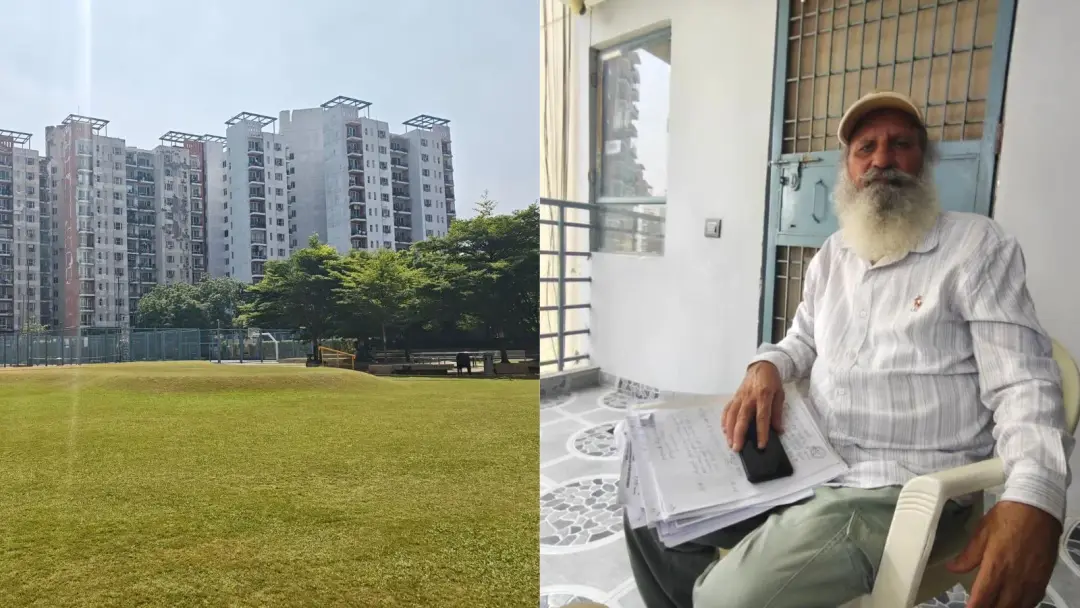
Registrar orders Gurgaon society to lift curbs on EWS residents
A dispute has emerged at Mahindra Aura society in Gurgaon's Sector 110A over access of 141 EWS residents to parks and internal pathways used by 799 condominium residents. Acting on a complaint by Kashmir Singh, 70, and his wife Meena Rani, 62, the District Registrar on September 15 directed the Aura RWA to lift all restrictions immediately. RWA president S S Gill cited conveyance deeds and said the order would be appealed.
Source
Indian Express — Cities · read the original report ↗
Desk check · some claims need care
What the desk checked (5)
- District Registrar of Firms & Societies, Gurugram, on September 15 directed the Aura RWA to lift all restrictions on EWS occupants. — Attributed to the Registrar's order, which is quoted at length in the source.
- The society has 799 condominiums selling upwards of Rs 2.5 crore and 141 EWS flats of 225 sq ft allotted for about Rs 1.5 lakh. — Figures appear in the source; no issuing authority or document cited for the prices.
- EWS block has accumulated nearly Rs 7 lakh in unpaid dues against a monthly charge of Rs 705. — Attributed to former RWA general secretary Rajesh Arora as a claim; not independently documented in the source.
- Kashmir Singh alleged that maids of tower residents can enter common areas while EWS residents cannot. — Presented as Singh's allegation, not verified in the source.
- In June, the District Town Planner (Enforcement) issued a show-cause notice to the RWA over locked fire tender gates and EWS parking encroachment. — Attributed to DTCP action; described as alleged in the source.
Analysts’ view opinion
This looks like a housing society squabble, but politically it is a stress test of how India's mandated EWS quota in private housing actually works on the ground. The District Registrar's order signals that the local administration has, for now, sided with elderly and low-income residents — a ruling that could become a reference point for the many gated complexes in Gurgaon built with the same social-housing obligation. By appealing, the RWA is trying to shift the fight from the terrain of class discrimination to the safer ground of property rights and jurisdiction.
- A handwritten complaint by one elderly couple has escalated into a broader policy contest between 141 EWS residents and 799 tower owners — a narrative with strong political resonance.
- RWAs in urban Haryana are organised, resourceful voter blocs, so collecting signatures and taking the matter to Chandigarh is pressure politics as much as litigation.
- The RWA's core argument now rests on the Registrar's authority rather than the merits, a classic strategy of moving from moral to procedural ground.
- With the DTCP already having issued a show-cause notice in June over the fire-tender path and reserved EWS parking, intervention from two separate arms of the administration weakens the RWA's position.
- Tower residents frame their case as cost-sharing rather than class bias, citing maintenance dues — an attempt to inoculate themselves against the discrimination charge.
What to watch — Watch whether the appeal secures a stay, whether officials actually initiate proceedings under the HRRS Act, and whether the case triggers similar complaints in other Gurgaon societies.
The story does not establish whether the order is being complied with, whether it will survive legal review, or that any political party has engaged with the issue; the arrears figures cited by both sides are also unverified.
Deep dive
Research brief · 8 facts · 8 dates · exam-readyThe brief
Context
Mahindra Aura in Gurgaon's Sector 110A is a gated group housing complex with 799 condominium units (selling upwards of Rs 2.5 crore) and a separate block of 141 EWS flats of 225 sq ft each, allotted for about Rs 1.5 lakh under state social housing mandates. About two years ago the Resident Welfare Association put up a signboard citing Clauses 18 and 20 of conveyance deeds, declaring EWS occupants have no right to use common areas, the Central Park or sports facilities, no RWA membership, no power backup and no parking entitlement. After 70-year-old EWS resident Kashmir Singh complained that he and his diabetic, visually impaired wife were confined to their home, the District Registrar of Firms & Societies, Gurugram, on September 15 ordered the RWA to lift all restrictions. The RWA disputes the Registrar's authority and plans to appeal.
Key facts
- Mahindra Aura, Sector 110A Gurgaon, has 799 condominium units and a separate block of 141 EWS flats.
- EWS flats are 225 sq ft units originally allotted for about Rs 1.5 lakh; condominium units sell for upwards of Rs 2.5 crore.
- Condominium owners pay about Rs 11,000 a month in Common Area Maintenance (CAM) charges; the EWS block's nominal monthly charge is Rs 705.
- RWA's seven-point signboard, erected about two years ago, cited Clauses 18 and 20 of conveyance deeds to bar EWS occupants from common areas, RWA membership, power backup and parking.
- On September 15, the District Registrar of Firms & Societies, Gurugram, directed the Aura RWA to immediately lift all restrictions on EWS occupants.
- Kashmir Singh, 70, wrote a handwritten plea on August 31 saying he and his wife Meena Rani, 62, had been 'locked inside our room for three days'.
- Former RWA general secretary Advocate Rajesh Arora claimed the EWS block owes nearly Rs 7 lakh in unpaid maintenance dues.
- In June, the District Town Planner (Enforcement) issued a show-cause notice to the RWA for allegedly locking gates on the emergency fire tender path and encroaching on the mandatory 5% reserved EWS parking.
Timeline
- 2012Kashmir Singh begins serving as a Radha Soami Satsang Beas preacher.
- 2021Singh moves into the EWS block of Mahindra Aura after decades of work on construction sites and as a driver in Delhi.
- About two years agoRWA erects a seven-point signboard in the EWS tower citing Clauses 18 and 20 of conveyance deeds to restrict EWS access to common areas.
- JuneDistrict Town Planner (Enforcement), DTCP, issues a show-cause notice over locked fire tender path gates and encroachment on 5% reserved EWS parking.
- Last monthFriction escalates after Singh is allegedly removed from a spot near a tower; main tower residents report 'alleged trespassing'.
- August 31Singh submits a handwritten plea to the administration describing confinement inside his room.
- September 15District Registrar orders the RWA to lift all restrictions and ensure unhindered movement and park access for EWS residents.
- After the order (Sunday RWA meeting)RWA resolves to appeal the order in Chandigarh and begins collecting residents' signatures; seeks that directions be kept in abeyance.
Who has a stake
- 141 EWS residents of Mahindra Aura — Access to internal pathways, parks and open spaces for pedestrian movement, recreation and health; dignity and freedom from exclusion.
- 799 condominium owners / Aura RWA — Claim exclusive rights over common areas under conveyance deeds and argue that facilities are funded by their CAM contributions.
- Kashmir Singh (70) and Meena Rani (62) — Complainants; she is diabetic with retinal vision loss, making daily walks and fresh air a health need.
- District Registrar of Firms & Societies, Gurugram — Authority to enforce its September 15 order is being contested; RWA says it is 'not a court of law or record'.
- S S Gill, RWA president, and Advocate Rajesh Arora — Defending deed-based exclusions, citing maintenance arrears of nearly Rs 7 lakh and operating costs; leading the appeal.
- Department of Town and Country Planning (DTCP) / District Town Planner (Enforcement) — Enforcement of fire safety access and the mandatory 5% reserved parking for EWS units.
Why it matters
The dispute tests whether private conveyance deeds and maintenance arrangements in gated enclaves can override basic mobility and access to open space for residents of state-mandated EWS housing. The Registrar's order frames the confinement of ailing senior citizens as harassment and systemic discrimination, raising questions about how inclusionary housing mandates work in practice once buildings are occupied. Its outcome will shape how RWAs across Gurgaon and similar cities treat EWS blocks built under social housing requirements.
UPSC angle
Prelims pointers
- District Registrar of Firms & Societies, Gurugram, passed the September 15 order directing the Aura RWA to lift restrictions on EWS occupants.
- EWS flats at Mahindra Aura: 141 units of 225 sq ft each, allotted for about Rs 1.5 lakh under state social housing mandates.
- Clauses 18 and 20 of the conveyance deeds were cited by the RWA to exclude EWS occupants from common areas and facilities.
- Officials warned of proceedings under the HRRS Act if EWS access is obstructed.
- DTCP's District Town Planner (Enforcement) enforces the mandatory 5% reserved parking for EWS units in group housing.
- CAM charges: about Rs 11,000 per month for condominium owners versus Rs 705 nominal monthly charge for EWS units.
Mains framing
The Mahindra Aura dispute illustrates the tension between market-driven gated housing and state-mandated inclusionary housing: builders were required to provide EWS units within premium complexes, but the conveyance deeds executed with condominium buyers (Clauses 18 and 20) purported to exclude EWS occupants from common areas, RWA membership, power backup and parking, and an RWA signboard operationalised that exclusion by threatening to bar access to the Central Park and sports facilities. The RWA's defence rests on cost-sharing logic - Rs 11,000 monthly CAM, swimming pool upkeep of Rs 3,000 a day, over 80 security and cleaning staff, and alleged EWS arrears of nearly Rs 7 lakh against a Rs 705 capped charge - and on the contention that an administrative officer cannot adjudicate property deeds. The District Registrar's order draws a distinction that is analytically important: contractual clauses may limit proprietary or club/commercial entitlements, but cannot authorise a blanket prohibition on ingress, egress and pedestrian movement, especially where it confines senior citizens with diabetes and vision ailments to their flats, which it termed harassment and systemic discrimination. A way forward suggested by the facts themselves includes clarity on which facilities are genuinely fee-linked versus basic access, a transparent and affordable maintenance formula (Singh says he is willing to pay more), enforcement of DTCP norms on fire tender paths and the 5% EWS parking, and a designated forum to settle deed disputes so that neither side relies on locked gates or self-help.
Key terms
- EWS housing
- Economically Weaker Section flats - here 225 sq ft units allotted for about Rs 1.5 lakh under state social housing mandates within a private group housing complex.
- Conveyance deed
- The legal instrument transferring property title; its Clauses 18 and 20 were cited by the RWA to exclude EWS occupants from common areas and facilities.
- CAM charges
- Common Area Maintenance charges paid by residents for upkeep of shared facilities - about Rs 11,000 a month for Aura condominium owners.
- RWA
- Resident Welfare Association, the body managing the housing complex; the notice said EWS owners hold no RWA membership rights.
- District Registrar of Firms & Societies
- District-level authority overseeing registered societies/RWAs; it ordered Aura RWA to lift EWS restrictions on September 15.
- DTCP
- Department of Town and Country Planning; its District Town Planner (Enforcement) issued a June show-cause notice on fire path and EWS parking violations.
Practice questions
- Can private conveyance deeds in group housing projects lawfully restrict the movement of EWS residents within a shared complex? Discuss with reference to the Mahindra Aura order.
- Inclusionary housing mandates create physical proximity without social integration. Examine the challenges of implementing EWS quotas in premium gated complexes in Indian cities.
- Evaluate the role of administrative authorities such as the District Registrar of Firms & Societies and the DTCP in resolving disputes between RWAs and residents. Should such disputes go to courts instead?
Grounded only in the source report — figures and dates are the source's, not inferred.