
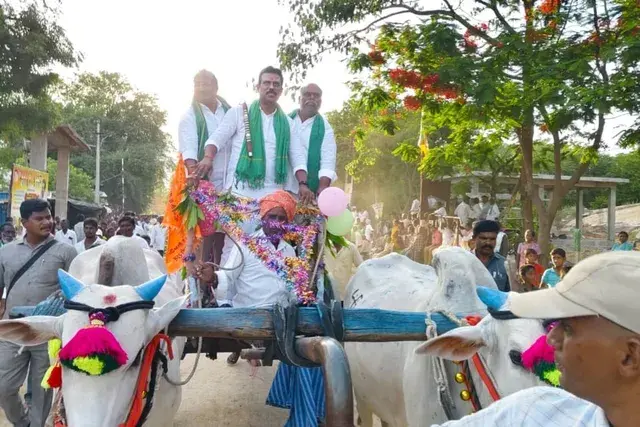
MLA rides bullock cart at Eruvaka festival in Jeenuguralla
Eruvaka celebrations were held in Jeenuguralla village of Devarakadra mandal on the occasion of Eruvaka Pournami. MLA G. Madhusudan Reddy attended as chief guest and inaugurated the festivities by riding a bullock cart himself. He distributed prizes to the winners of the 'eruka thadu' and reverse tractor competitions. The MLA said he hoped for ample rainfall so that farmers' fields would turn green. The celebrations were held on a grand scale in the village.
Source
Devarakadra — MLA & నియోజకవర్గం · read the original report ↗
Desk check · compared with the source
What the desk checked (4)
- Eruvaka celebrations were held in Jeenuguralla village of Devarakadra mandal on Eruvaka Pournami. — Stated in source as reported fact by the bylined correspondent; no independent sourcing given.
- MLA G. Madhusudan Reddy attended as chief guest and rode a bullock cart to inaugurate the celebrations. — Appears directly in source text; MLA's name and role as given, not otherwise corroborated.
- Prizes were distributed to winners of the 'eruka thadu' and reverse tractor competitions. — Figure-free detail present in source; no organiser attribution provided.
- The MLA hoped for ample rainfall and green fields for farmers. — Paraphrased remark attributed to the MLA in the source; no direct quote provided.
Analysts’ view opinion
On the surface this is a cultural festival story, but economically it marks the starting gun for the kharif season. Eruvaka Pournami is the point at which farm households begin spending on seed, fertiliser, labour and machinery — the moment rural cash starts circulating again. An MLA riding the bullock cart and wishing for good rains is a low-cost, high-visibility gesture; the real economic outcome will be decided by rainfall and input prices, not by the ceremony.
- At sowing time farm household outgo peaks while income arrives only after harvest, so credit availability is what bridges the gap and matters most.
- Reverse-tractor contests sitting alongside a bullock cart capture the mixed reality of village agriculture, where mechanisation and traditional animal power still run side by side.
- Adequate, well-spread rain would lift yields, ease pressure on food prices and revive rural consumption; a poor monsoon risks stranding money already sunk into inputs.
- The direct fiscal cost of such events is minimal — the payoff is mainly political visibility and closeness to the farming constituency.
- The story carries no figures or commitments on seed supply, fertiliser prices, crop loan targets or irrigation, so it is a signal of intent, not a policy announcement.
What to watch — Watch rainfall over the coming weeks, whether seed and fertiliser supply and prices hold steady, and how quickly crop loans are disbursed — those three will set rural incomes this season.
The story establishes no new scheme, funding, price decision or specific financial support for farmers, and offers no local data on acreage or rainfall.
Deep dive
Research brief · 6 facts · 2 dates · exam-readyThe brief
Context
Eruvaka Pournami is a traditional agrarian festival marking the ceremonial start of the farming season, when farmers worship their bullocks and ploughing implements before the first furrow of the monsoon crop. In Jeenuguralla village of Devarakadra mandal, Eruvaka celebrations were held on a grand scale on the occasion. Local MLA G. Madhusudan Reddy attended as chief guest, himself riding a bullock cart to inaugurate the festivities and giving away prizes in village competitions. The report is dated June 29, 2026.
Key facts
- Eruvaka festivities were held on a grand scale in Jeenuguralla village of Devarakadra mandal on the occasion of Eruvaka Pournami.
- MLA G. Madhusudan Reddy attended as chief guest and inaugurated the celebrations by personally riding a bullock cart.
- The MLA distributed prizes to winners of the 'eruka thadu' (plough rope) competition.
- Prizes were also given to winners of a reverse tractor driving competition.
- The MLA expressed the hope that ample rains would fall and farmers' fields would turn lush and green.
- The report is datelined Jun 29, 2026, 15:06 IST, filed by Kotla Srinivasa Reddy.
Timeline
- Eruvaka Pournami (day of the event)Eruvaka celebrations held in Jeenuguralla village, Devarakadra mandal; MLA G. Madhusudan Reddy rides a bullock cart to inaugurate them and distributes prizes.
- Jun 29, 2026, 15:06 ISTReport on the Eruvaka festivities published.
Who has a stake
- Farmers of Jeenuguralla village — The festival marks the ceremonial start of their sowing season; they depend on timely and adequate monsoon rains.
- MLA G. Madhusudan Reddy — Chief guest who inaugurated the event and distributed prizes, signalling political support to the farming community.
- Devarakadra mandal administration/village community — Hosting and organising the Eruvaka Pournami celebrations and competitions.
- Participants in 'eruka thadu' and reverse tractor competitions — Competed for prizes distributed by the MLA at the festival.
Why it matters
Eruvaka Pournami is the cultural marker of the kharif sowing season in Telugu-speaking regions, linking ritual, cattle and the monsoon to the agricultural calendar. Its public celebration, with elected representatives participating, keeps traditional bullock-based farming practices visible even as tractors dominate, as reflected in the village holding both a plough-rope and a reverse tractor contest. The MLA's wish for ample rain underlines how rain-fed farming still governs rural livelihoods.
UPSC angle
Prelims pointers
- Eruvaka Pournami: traditional festival marking the ceremonial beginning of the agricultural/ploughing season in Telugu regions.
- Venue of the reported celebrations: Jeenuguralla village, Devarakadra mandal.
- Chief guest: MLA G. Madhusudan Reddy, who inaugurated the event by riding a bullock cart.
- Competitions held: 'eruka thadu' and reverse tractor driving; prizes given by the MLA.
- Report date: June 29, 2026.
Mains framing
Festivals such as Eruvaka Pournami show how India's agricultural calendar remains culturally embedded in the monsoon cycle: the ritual first furrow, worship of bullocks and community competitions all signal the start of the sowing season. The Jeenuguralla celebration, where an MLA rode a bullock cart and awarded prizes for both a traditional 'eruka thadu' contest and a reverse tractor competition, captures the coexistence of draught-animal traditions and mechanised farming in the same village economy. The MLA's stated hope for ample rainfall points to the continuing dependence of such rain-fed tracts on a normal monsoon, which shapes sowing decisions, input purchases and rural incomes. The way forward lies in respecting these cultural anchors while strengthening what makes them less risky: timely and accurate weather advisories, assured irrigation and credit at the start of the season, and support for both small farmers who still rely on bullocks and those shifting to machinery. The source does not detail any specific scheme or policy announcement at the event.
Key terms
- Eruvaka Pournami
- Full-moon day observed as the ritual start of the ploughing/sowing season, when farmers worship bullocks and farm implements.
- Eruka thadu
- Traditional village competition involving the plough rope, held as part of the Eruvaka festivities; prizes were given to winners.
- Reverse tractor competition
- Contest in driving a tractor in reverse, held at the village celebration; winners received prizes from the MLA.
- Mandal
- Sub-district administrative unit in Telangana and Andhra Pradesh; here, Devarakadra mandal, where Jeenuguralla village is located.
- Bullock cart
- Animal-drawn cart traditionally central to farm transport; the MLA rode one to inaugurate the festivities.
Practice questions
- Discuss the significance of agrarian festivals such as Eruvaka Pournami in linking cultural practice with the agricultural and monsoon calendar in India.
- Traditional draught-animal farming and mechanised agriculture coexist in many Indian villages. Examine the implications of this dual pattern for small and marginal farmers.
- How does dependence on the monsoon shape the sowing season decisions of rain-fed farmers, and what measures can reduce this risk?
Grounded only in the source report — figures and dates are the source's, not inferred.