
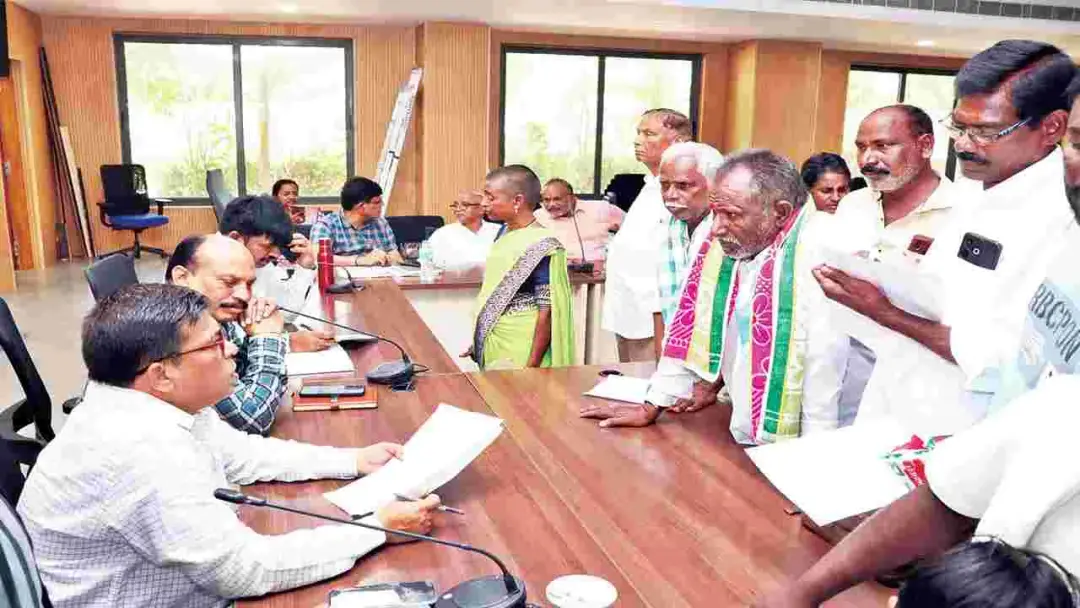
Do not keep Prajavani complaints pending: Additional Collector
Additional Collector Narsingarao directed officials not to keep complaints received at Prajavani pending. He received petitions on Monday at the Gadwal Collectorate along with Land Acquisition Deputy Collector Krishna and trainee Deputy Collectors Manoj Kumar Reddy and Raj Kumar. He ordered departmental officials to meet their staff every Wednesday to resolve Prajavani complaints, attend on time, and warned of action for negligence. Vacancy details of posts for the disabled and roster point registers must reach the welfare office by the 30th. Officials said 11 complaints were received at the SP office Prajavani, where SP Srinivasa Rao said public trust is vital for the police.
Source
Mahbubnagar — స్థానికం · read the original report ↗
Desk check · compared with the source
What the desk checked (5)
- Additional Collector Narsingarao said Prajavani complaints should not be kept pending. — Directly attributed to the named official in the source.
- He received petitions at Gadwal Collectorate on Monday with Land Acquisition Deputy Collector Krishna and trainee Deputy Collectors Manoj Kumar Reddy and Raj Kumar. — Named participants and venue appear in source; no further sourcing given.
- Departments must submit vacancy details of posts for persons with disabilities and roster point registers to the welfare office by the 30th of this month. — Stated as an instruction by the Additional Collector in the source.
- 11 complaints were received at the Prajavani held in the SP office. — Figure attributed to officials in the source.
- SP Srinivasa Rao said public trust is most important for the police department. — Quoted in paraphrase and attributed to the SP.
Analysts’ view opinion
Praja Vani is not merely an administrative ritual — it is the point where the state meets citizens face to face, which is why repeated warnings about pending complaints carry political weight. Additional Collector Narsingarao's insistence on mandatory Wednesday departmental reviews and his warning that negligence will invite action suggest that the pace of grievance redressal at the field level is itself becoming a source of public dissatisfaction. SP Srinivasarao's remark that public trust is paramount for the police points in the same direction. Notably, the story contains no reference to any political party; the voice here is entirely that of the administration.
- Pending Praja Vani complaints are a direct barometer of citizen frustration with government, so pressure on this front is administrative in form but political in consequence.
- Setting a deadline (the 30th of this month), weekly reviews and the threat of action pushes accountability downward to junior officials — results earn the government credit, failure lands on staff.
- The focus on vacancies reserved for persons with disabilities and roster point registers touches a welfare constituency that is politically sensitive and visible.
- The figure of 11 complaints at the SP's office is small, and the story does not clarify whether that reflects few grievances or reluctance to come forward — the two readings carry very different political meanings.
- Involving trainee deputy collectors in receiving petitions can be read as an attempt to build a public-facing culture within the bureaucracy.
What to watch — Watch whether the Wednesday reviews actually happen, whether the pendency count visibly falls, and whether any official is in fact penalised — that is the test of whether the warning had teeth.
The story does not establish how many complaints are pending, what the past disposal rate has been, or whether any higher-level pressure prompted these instructions, and it names no party or political leader.
Deep dive
Research brief · 8 facts · 4 dates · exam-readyThe brief
Context
"Prajavani" is a weekly public grievance redressal programme held at district collectorates and other offices in Telangana, where citizens hand over petitions directly to senior officials. At Jogulamba Gadwal district's collectorate, Additional Collector Narsingarao received petitions on Monday and instructed department officials not to let Prajavani complaints remain pending. A parallel Prajavani was held at the Superintendent of Police office, where 11 complaints were received.
Key facts
- Additional Collector Narsingarao directed that complaints received from the public at Prajavani must not be kept pending.
- He received petitions at the Gadwal Collectorate on Monday, September 28 (report published Sep 28, 2026, 11:49 PM).
- He was joined by Land Acquisition Deputy Collector Krishna and trainee Deputy Collectors Manoj Kumar Reddy and Raj Kumar.
- Officials of all departments were ordered to hold meetings with their staff every Wednesday to resolve Prajavani complaints.
- All officials were told to attend Prajavani on time; negligence would invite action.
- Department-wise vacancy details of posts meant for persons with disabilities and roster point registers must be submitted to the welfare department office by the 30th of the month.
- Officials said 11 complaints were received at the Prajavani held at the SP office.
- SP Srinivasa Rao said public trust is extremely important for the police department and people's problems must be resolved immediately.
Timeline
- Monday, September 28Additional Collector Narsingarao receives petitions at Gadwal Collectorate Prajavani along with Deputy Collector Krishna and two trainee Deputy Collectors.
- Same dayPrajavani at the SP office receives 11 complaints; SP Srinivasa Rao stresses speedy redressal.
- Every Wednesday (directive)Department officials to meet their staff and work out solutions to Prajavani complaints.
- By the 30th of the month (deadline)Department-wise vacancy details of posts for persons with disabilities and roster point registers to reach the welfare office.
Who has a stake
- Petitioners / general public of Gadwal — Timely redressal of grievances submitted at Prajavani instead of indefinite pendency.
- Additional Collector Narsingarao — Accountable for monitoring disposal of Prajavani complaints and enforcing official attendance.
- Department officials and staff — Required to attend Prajavani on time, hold Wednesday review meetings, and face action for negligence.
- Persons with disabilities — Vacancy details of posts reserved for them and roster point registers must be compiled and submitted by the 30th.
- Welfare department office — Nodal recipient of department-wise disability vacancy and roster point data.
- SP Srinivasa Rao and the police department — Handling 11 Prajavani complaints; maintaining public trust through immediate resolution of problems.
Why it matters
Prajavani is the most direct interface between citizens and the district administration, and its credibility rests entirely on whether petitions are actually disposed of rather than filed away. The directive to hold weekly departmental reviews and to warn of action for negligence signals an attempt to convert petition-receiving into measurable follow-up. The deadline on disability post vacancies and roster registers also touches statutory reservation compliance in government employment.
UPSC angle
Prelims pointers
- Prajavani: grievance redressal programme where citizens submit petitions directly to district officials, held at collectorates in Telangana.
- Gadwal Collectorate Prajavani was conducted by Additional Collector Narsingarao with Land Acquisition Deputy Collector Krishna.
- Trainee Deputy Collectors named in the source: Manoj Kumar Reddy and Raj Kumar.
- 11 complaints were received at the Prajavani held at the SP office; SP is Srinivasa Rao.
- Directive: departmental officials to meet staff every Wednesday to resolve Prajavani complaints.
- Deadline of the 30th for submitting disability post vacancy details and roster point registers to the welfare office.
Mains framing
Grievance redressal at the district level in India rests on a simple test: does a petition received translate into a decision communicated? The Gadwal instance shows both the strength and the weakness of the Prajavani model — it lowers the cost of access for citizens, who can hand a petition directly to an Additional Collector, a Deputy Collector or the Superintendent of Police, but disposal depends on downstream departments that may treat receipt as the end of the process. The corrective measures indicated in the source are procedural rather than legislative: a fixed weekly review (every Wednesday) between officials and their staff, mandatory and punctual attendance of officials at Prajavani, and an explicit warning of action for negligence. The parallel instruction to furnish department-wise vacancy details of posts for persons with disabilities and roster point registers to the welfare office by the 30th links grievance governance to reservation compliance, since unfilled reserved posts and poorly maintained rosters are themselves a source of citizen complaints. The way forward suggested by the story's logic is measurable follow-up — time-bound disposal, review of pendency, and visible accountability — reinforced by the SP's point that public trust is the core asset of the police and of the administration generally.
Key terms
- Prajavani
- Public grievance programme at which citizens submit petitions directly to district administration and police officials.
- Additional Collector
- Senior district revenue officer next to the Collector, here presiding over the Prajavani at Gadwal.
- Land Acquisition Deputy Collector
- Revenue officer handling land acquisition matters in the district; Krishna held this post at Gadwal.
- Roster point register
- Record maintained department-wise showing reservation points against posts, to be submitted to the welfare office by the 30th.
- Trainee Deputy Collector
- Probationary revenue officer under training, here Manoj Kumar Reddy and Raj Kumar, who assisted in receiving petitions.
Practice questions
- Programmes like Prajavani improve citizens' access to the administration but not necessarily the disposal of their grievances. Examine, with reference to measures that can ensure time-bound redressal at the district level.
- Discuss the role of the district Collector's office and the district police in grievance redressal. How does public trust affect the effectiveness of both?
- Why is the maintenance of roster point registers and reporting of vacancies in posts reserved for persons with disabilities important for equitable public employment?
Grounded only in the source report — figures and dates are the source's, not inferred.