
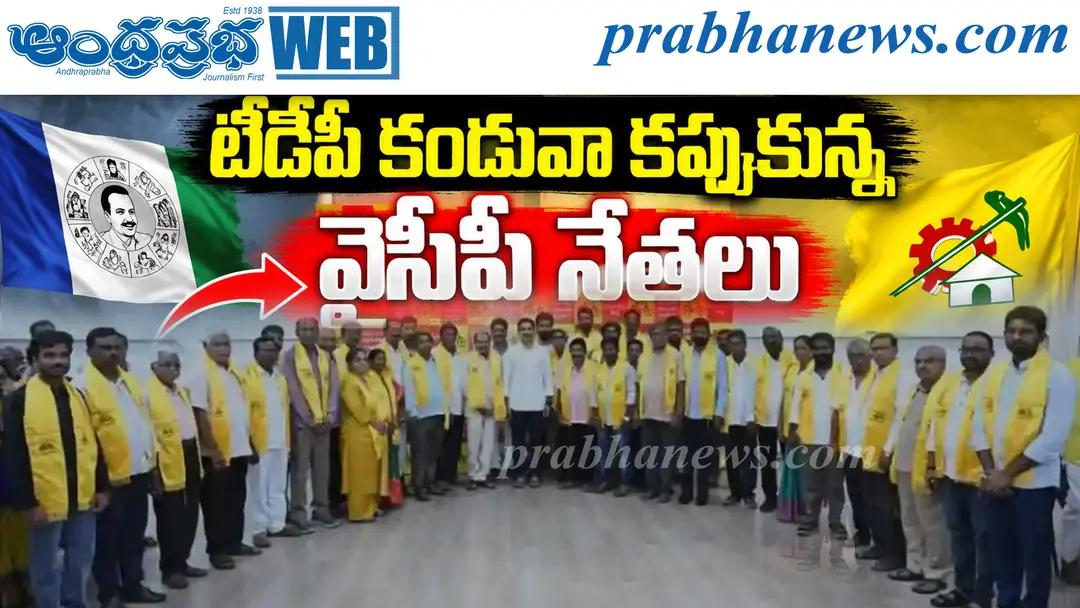
YSRCP leaders join TDP in Mangalagiri in Lokesh's presence
Several YSRCP leaders and workers in Mangalagiri constituency joined the TDP ahead of local body elections. At an event at Minister Nara Lokesh's residence in Undavalli, he draped yellow shawls on leaders from Mangalagiri, Tadepalli, Undavalli, Nidamarru and Yerrabalem. They included former municipal vice-chairman Munagala Malleswara Rao, former MPTC Kallam Sanjeev Reddy, Jakkireddy Prabhakar Reddy, Kattepogu Baburao and Vemavarapu Narayana. Lokesh said Mangalagiri's development was his only slogan and that he would honour the trust of voters who gave him a 91,000 majority.
Source
Mangalagiri — స్థానికం · read the original report ↗
Desk check · compared with the source
What the desk checked (5)
- Several YSRCP leaders and workers from Mangalagiri, Tadepalli, Undavalli, Nidamarru and Yerrabalem joined the TDP in the presence of Minister Nara Lokesh at his Undavalli residence — Reported as first-hand event coverage by the outlet; no independent confirmation in the source
- Former municipal vice-chairman and former town YSRCP president Munagala Malleswara Rao, his wife and a former market yard chairman joined the TDP — Names and designations appear in the source; no direct quotes or documents cited
- Six families with former MPTC Kallam Sanjeev Reddy, four families with Jakkireddy Prabhakar Reddy, two more families, six families with Kattepogu Baburao and five families with Vemavarapu Narayana joined — Figures appear in the source without attribution to any official party list
- Lokesh said Mangalagiri people elected him with a 91,000 majority — Attributed directly to Lokesh in the source; figure not independently verified
- Lokesh said underground drainage, drinking water and gas facilities would be provided and all works completed in two years — Attributed statement of intent by the minister
Analysts’ view opinion
Defections timed just before local body polls are rarely accidental — they are choreographed shows of strength. By personally receiving YSRCP figures with local electoral pedigree, including a former municipal vice-chairman and a former MPTC, at his own residence, Minister Nara Lokesh is attempting to hollow out the rival machine at ward and village level before the contest begins. The repeated invocation of a 91,000-vote margin and the framing of everything around "development" suggests a deliberate strategy to keep constituency politics on a winner-and-delivery narrative rather than an ideological one.
- Several entrants have hands-on local election experience — a former municipal vice-chairman, a former MPTC — signalling that the TDP is targeting networks that can actually move votes in a local body contest.
- Framing the switches in terms of "families" rather than individuals is classic local political messaging about transferable vote blocs at ward and hamlet level.
- Holding the event at the minister's residence, with a politburo member, a corporation chairman and a TTD board member present, reinforces personal leadership prestige as much as party organisation.
- Inflow towards the governing party is a normal cycle; the counter-argument from the YSRCP side will be that this reflects proximity to power rather than any shift in public opinion.
- The remark that once a decision is taken everyone must abide by it can be read as pre-emptive discipline against resentment among older cadre over ticket distribution.
What to watch — Watch whether these entrants are rewarded with municipal or mandal tickets, and how long-standing TDP workers react — that will decide whether the induction is a net gain or an internal headache.
The story establishes no verified headcount, no measurable impact on vote share and no official YSRCP response, so whether this shifts the constituency's real balance of power or is largely a publicity set-piece remains unestablished.
Deep dive
Research brief · 8 facts · 2 dates · exam-readyThe brief
Context
Ahead of local body elections in Andhra Pradesh, a batch of YSRCP leaders, workers and their families from the Mangalagiri assembly constituency switched to the ruling Telugu Desam Party. The defections were formalised at an event at the Undavalli residence of Nara Lokesh, Minister for Education and IT and the sitting MLA from Mangalagiri, who draped yellow shawls — the TDP's colour — on the entrants. Mangalagiri, which covers Tadepalli, Undavalli, Nidamarru and Yerrabalem areas near the Amaravati capital region, was won by Lokesh with a 91,000-vote majority.
Key facts
- Several YSRCP leaders, workers and their families from Mangalagiri, Tadepalli, Undavalli, Nidamarru and Yerrabalem joined the TDP at Nara Lokesh's Undavalli residence.
- Lokesh is Minister for Education and IT and the MLA for Mangalagiri; he personally draped yellow shawls on the joinees.
- Lokesh said he won Mangalagiri with a 91,000-vote majority and that this increased his responsibility to make no mistakes.
- Entrants included Munagala Malleswara Rao, former municipal vice-chairman and former town YSRCP president of Mangalagiri, along with his wife and a former market yard chairman.
- Former MPTC Kallam Sanjeev Reddy of Tadepalli Rural-Undavalli joined with Kallam Sambireddy, Kallam Srinivasa Reddy and others — six families in all.
- Jakkireddy Prabhakar Reddy, former special invitee of the Durga temple trust board and former director of the State Reddy Corporation, joined with four families.
- Kattepogu Baburao of Nidamarru joined with six families; Vemavarapu Narayana, secretary of the Guntur Brahmana Sangham of Yerrabalem, joined with five families.
- Lokesh promised underground drainage, drinking water and gas facilities and said all works in the constituency would be completed in two years.
Timeline
- Earlier (last assembly election, date not stated in the source)Nara Lokesh wins the Mangalagiri assembly seat with a 91,000-vote majority after promising to make it India's number-one constituency.
- Ahead of the local body elections (date not stated in the source)YSRCP leaders and workers from five areas of Mangalagiri constituency join the TDP at Lokesh's Undavalli residence, receiving yellow shawls.
Who has a stake
- Nara Lokesh, Minister for Education and IT, Mangalagiri MLA — Consolidating his hold on the constituency before local body polls and delivering on development promises made to voters.
- Telugu Desam Party (TDP) — Expanding its cadre base in the Amaravati-region constituency ahead of local body elections.
- YSRCP — Loss of senior local leaders, former office-bearers and multiple families in a constituency it already lost by 91,000 votes.
- Defecting leaders (Munagala Malleswara Rao, Kallam Sanjeev Reddy, Jakkireddy Prabhakar Reddy, Kattepogu Baburao, Vemavarapu Narayana and others) — Political relevance, ticket prospects and access to power in the ruling party.
- Voters of Mangalagiri, Tadepalli, Undavalli, Nidamarru, Yerrabalem — Promised civic works — hospitals, cremation grounds, underground drainage, drinking water and gas supply within two years.
Why it matters
Pre-election defections of this scale signal how ruling-party incumbency reshapes local political networks in the crucial Amaravati capital-region belt just before local body elections. For readers, the episode illustrates the mechanics of Indian grassroots politics — where former MPTCs, municipal office-bearers and caste-association functionaries move as family blocs — and how development promises are used as the currency of realignment.
UPSC angle
Prelims pointers
- Nara Lokesh is Andhra Pradesh's Minister for Education and IT and the MLA from Mangalagiri constituency.
- Lokesh's winning margin in Mangalagiri, as stated by him: 91,000 votes.
- Yellow shawl (pasupu kanduva) is the symbolic marker of joining the Telugu Desam Party.
- MPTC = Mandal Parishad Territorial Constituency member, the mandal-level rural local body representative.
- Areas named in Mangalagiri constituency: Mangalagiri, Tadepalli, Undavalli, Nidamarru, Yerrabalem.
- Others present: TDP politburo member Guttikonda Dhananjay, Padmashali Welfare and Development Corporation chairman Nandam Abaddayya, TTD board member Tammishetti Janakidevi.
Mains framing
Party-switching on the eve of local body elections, as seen in Mangalagiri, reflects structural features of competitive politics in India's states: local leaders derive influence largely from proximity to the party in power, since municipal and panchayat functioning depends on state-level patronage for works such as drainage, water supply and civic infrastructure. The source shows defections occurring as family and community blocs — former MPTCs, a former municipal vice-chairman, a temple trust board invitee, a corporation ex-director and a caste association secretary — indicating that grassroots politics is mediated by kinship and social networks rather than only by ideology. The implications are twofold: the ruling TDP strengthens its booth-level machinery in the Amaravati region, while the opposition YSRCP faces organisational erosion that can compound electoral defeat; for voters, accountability blurs when the same individuals represent successive parties. The way forward suggested by the minister's own framing is performance-based legitimacy — completing promised works within two years and remaining accessible — though the source records only promises, not outcomes. A fuller assessment would require attention to whether local bodies get devolved funds, functions and functionaries rather than depending on ministerial goodwill.
Key terms
- YSRCP
- Yuvajana Sramika Rythu Congress Party, the party whose local leaders in Mangalagiri quit to join the TDP.
- TDP
- Telugu Desam Party, the party Lokesh represents; new entrants are welcomed with yellow shawls.
- MPTC
- Mandal Parishad Territorial Constituency member — an elected rural local body representative at mandal level.
- Market yard chairman
- Head of an agricultural market committee body; one former holder joined the TDP at the event.
- TTD board
- Tirumala Tirupati Devasthanams board; member Tammishetti Janakidevi attended the joining event.
- Padmashali Welfare and Development Corporation
- A state welfare corporation for the Padmashali community; its chairman Nandam Abaddayya was present.
Practice questions
- Large-scale defections before local body elections weaken the accountability of elected representatives to voters. Discuss with reference to recent political realignments in Andhra Pradesh.
- Examine how dependence on state-level patronage undermines the autonomy of urban and rural local bodies envisaged by the 73rd and 74th Constitutional Amendments.
- To what extent do caste associations and kinship networks, rather than ideology, structure grassroots party politics in India? Illustrate with examples.
Grounded only in the source report — figures and dates are the source's, not inferred.