
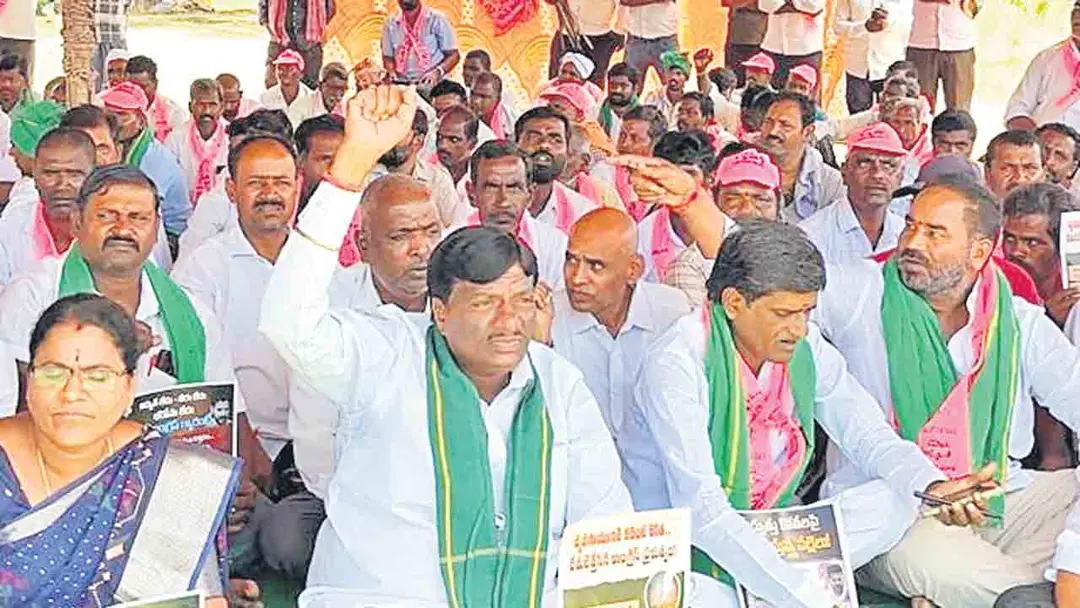
Farmers protest power cuts at several places in Telangana
Farmers' protests over power cuts continued in Telangana on Tuesday, with growers saying crops were drying up for want of supply. At Chandapur substation in Wanaparthy district, a community cooking protest was held under BRS district president Gattu Yadav. Former MLA Koppula Mahesh Reddy joined a dharna as farmers besieged Salkarpet substation in Gandeed mandal, Mahabubnagar. Hundreds sat on the road at Teegalapalli, Nagarkurnool. At Ootkur in Narayanpet, farmers said 12 hours of promised supply had not reached even five. In Khammam's Penuballi, farmers argued with staff over unavailable urea.
Source
Namasthe Telangana · read the original report ↗
Desk check · some claims need care
What the desk checked (5)
- Farmers protested on Tuesday at Chandapur substation in Wanaparthy district, with a 'vantavarpu' led by BRS district president Gattu Yadav — Reported by the source's own network with names and place; no independent confirmation available
- Farmers besieged Salkarpet substation in Gandeed mandal, Mahabubnagar district; former MLA Koppula Mahesh Reddy joined the dharna and criticised the government — Attributed to the source; the criticism is the leader's opinion, not verified fact
- Hundreds of farmers from Teegalapalli, Janumpalli and Bavaipalli in Koderu mandal, Nagarkurnool district sat on the road at Teegalapalli substation — Crowd size stated as 'hundreds' in source; no official estimate given
- The government promised 12 hours of power supply a day but does not supply even 5 hours continuously — Claim voiced by protesting farmers at Ootkur checkpost, Narayanpet district; no official data cited
- Farmers who booked urea via an app on Monday were told stock had run out at the Penuballi society, Khammam district — Attributed to the source; officials reportedly promised to inform farmers when stock arrives
Analysts’ view opinion
This is not merely a power problem — when irrigation stops mid-season, the yield loss is immediate and largely irreversible. In borewell-dependent dry-land belts, five hours of erratic supply against a promised twelve means the farmer has already sunk his costs on seed, fertiliser and labour but stands to lose the revenue. With urea stock shortages landing at the same time, the burden shifts entirely onto the cultivator through costlier private purchases, diesel workarounds and fresh borrowing.
- The cost of farm power cuts does not show up in a state budget line, but it eats directly into farm incomes as lost output.
- Supply interruptions are most expensive at precisely this stage, when input spending is already committed and the farmer has little room to limit damage.
- Lower yields compress local farm incomes, rural spending and demand for farm labour in the affected mandals.
- The gap between a 12-hour assurance and actual supply points to strain between demand estimates, power purchase costs and discom finances — though the story does not state the cause.
- The Penuballi episode, where app-booked urea was unavailable, signals a coordination gap in the supply chain that typically pushes farmers to higher-priced private channels.
What to watch — Watch actual supply hours delivered in the coming weeks, the arrival of urea stock, and yield estimates in the affected mandals — that is what will size the real loss.
The story does not establish how much acreage is affected, the value of the losses, the underlying reason for the cuts, or the government's and discoms' response.
Deep dive
Research brief · 8 facts · 3 dates · exam-readyThe brief
Context
Farmers across several districts of southern Telangana have been agitating for days over erratic agricultural power supply, saying standing crops are drying up for want of irrigation pumping hours. The protests continued on Tuesday, September 15, with substation sieges, dharnas and road blockades in Wanaparthy, Mahabubnagar, Nagarkurnool and Narayanpet districts, and were joined by BRS leaders who blamed the Congress government. A parallel grievance surfaced in Khammam district, where farmers who had booked urea on an app found no stock at the cooperative society.
Key facts
- Protests over power cuts continued on Tuesday, September 15, having run for several days, with farmers saying crops were drying up for lack of electricity.
- At Chandapur substation in Wanaparthy district, farmers from several villages protested and held a community cooking (vantavarpu) protest led by BRS district president Gattu Yadav.
- Farmers besieged Salkarpet substation in Gandeed mandal of Mahabubnagar district; former MLA Koppula Mahesh Reddy joined the dharna and attacked the government's stand.
- Hundreds of farmers from Teegalapalli, Janumpalli and Bavaipalli villages in Koderu mandal, Nagarkurnool district, sat on the road in front of Teegalapalli substation.
- At Ootkur checkpost in Narayanpet district, farmers blocked the main road, saying the promised 12 hours of daily supply was not being given even for 5 hours uninterrupted.
- In Penuballi mandal headquarters, Khammam district, farmers agitated at the cooperative society office over urea.
- Farmers had booked urea on an app on Monday; on Tuesday society staff said stock was exhausted, triggering an argument with officials.
- Officials pacified the Penuballi farmers by promising to inform them as soon as urea stock arrived.
Timeline
- Monday (September 14)Farmers in Penuballi, Khammam district, booked urea through the app.
- Tuesday, September 15Farmers reached Penuballi society for urea and were told stock was over; protests over power cuts also continued across districts.
- Tuesday, September 15Community cooking protest at Chandapur substation, siege of Salkarpet substation, road blockade at Teegalapalli and dharna at Ootkur checkpost.
Who has a stake
- Farmers of Wanaparthy, Mahabubnagar, Nagarkurnool, Narayanpet and Khammam districts — Standing crops drying up for want of pumping power, and delayed urea supply during the season.
- Telangana government (Congress) — Accused of failing to deliver the promised 12 hours of daily farm power supply and of fertiliser shortages.
- BRS (Bharat Rashtra Samithi) — Leading the agitation on the ground through district president Gattu Yadav and former MLA Koppula Mahesh Reddy.
- Electricity substation staff and DISCOM field officials — Face sieges, dharnas and direct confrontation with farmers at substations.
- Primary agricultural cooperative society, Penuballi — Handles app-based urea distribution; faced farmer anger over exhausted stock.
Why it matters
Free or subsidised power for irrigation pump sets and timely urea are the two most immediate inputs that decide whether a standing crop survives, which is why supply failures translate quickly into road blockades rather than paperwork. The protests show how a gap between a promised service level (12 hours of daily supply) and actual delivery (reportedly under five) becomes a political flashpoint in a farm-dependent state.
UPSC angle
Prelims pointers
- Districts named in the protests: Wanaparthy, Mahabubnagar, Nagarkurnool, Narayanpet and Khammam (Telangana).
- Chandapur, Salkarpet and Teegalapalli are the substations where farmers protested.
- Government's promised farm power supply as cited by protesting farmers: 12 hours a day; farmers allege under 5 hours uninterrupted.
- 'Vantavarpu' (community cooking) is a protest form used at Chandapur substation, led by BRS district president Gattu Yadav.
- Urea in Khammam's Penuballi was booked through an app on Monday but stock was reported exhausted the next day.
- Former MLA Koppula Mahesh Reddy joined the Salkarpet substation dharna.
Mains framing
The Telangana farm protests illustrate how agricultural distress is often triggered not by prices but by input delivery failures at the last mile: irrigation power and fertiliser. Farmers in Narayanpet allege that against a promised 12 hours of daily supply they receive less than five hours uninterrupted, which for pump-set irrigation means incomplete watering cycles and crop loss during a critical growth stage; in Khammam, app-based urea booking created an entitlement expectation that stock availability at the cooperative society could not honour. The immediate consequences are localised law-and-order incidents such as substation sieges, road blockades and arguments with staff, and the politicisation of the grievance, with BRS leaders framing erratic supply as a failure of Congress governance. The way forward suggested by the story's own facts is narrow but concrete: matching announced supply hours with actual scheduled and communicated feeder timings, aligning app-based fertiliser booking with real-time stock at society level so bookings are not accepted against unavailable stock, and giving farmers advance information on stock arrival, as officials at Penuballi finally promised.
Key terms
- Substation siege (muttadi)
- Protest form where farmers surround a power substation to press for restoration of supply.
- Vantavarpu
- Community cooking protest, where demonstrators cook and eat at the protest site to signal a prolonged sit-in.
- Dharna / rasta roko
- Sit-in protest and road blockade, both used by farmers at Salkarpet, Teegalapalli and Ootkur.
- BRS
- Bharat Rashtra Samithi, the opposition party whose district president and a former MLA led the protests in the story.
- Cooperative society (sosaiety)
- Village-level cooperative outlet through which fertiliser such as urea is distributed to farmers.
- App-based urea booking
- System under which farmers book urea online in advance and collect it from the society, as done in Penuballi.
Practice questions
- Erratic agricultural power supply and fertiliser shortages have repeatedly triggered farmer agitations in India. Examine the administrative reasons behind such last-mile input delivery failures and suggest remedies.
- Discuss how the promise of assured hours of free farm power interacts with the financial and operational capacity of state electricity distribution companies.
- Do app-based booking systems for subsidised fertiliser improve transparency, or do they raise expectations that physical stock cannot meet? Critically analyse with reference to recent farmer protests.
Grounded only in the source report — figures and dates are the source's, not inferred.