
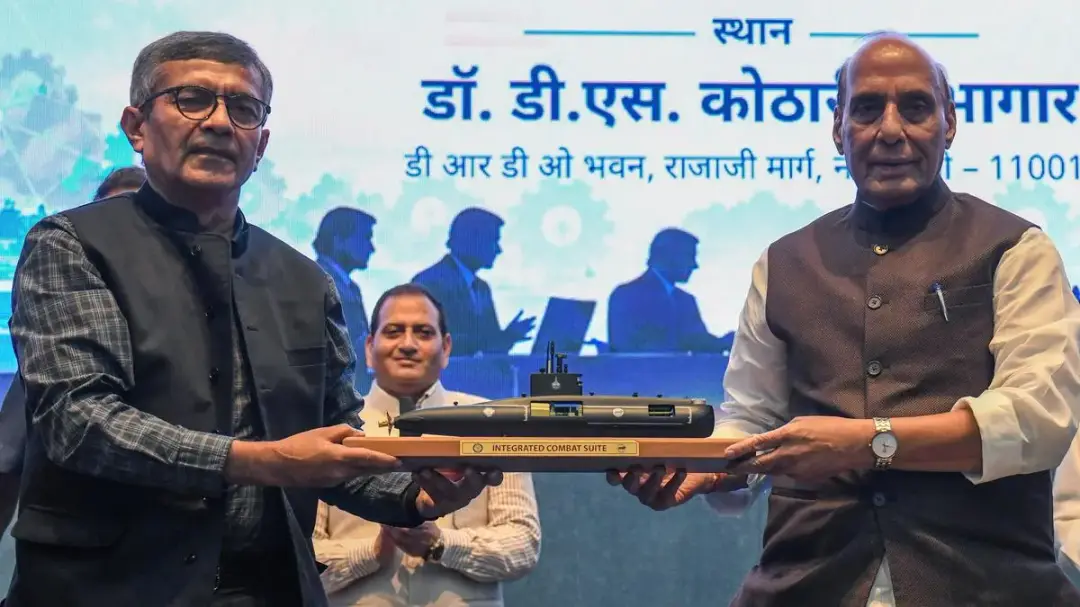
DRDO hands 9 technology transfer pacts to 13 partners at VIMARSH
Defence Minister Rajnath Singh on Tuesday handed over nine Licensing Agreements for Transfer of Technology to 13 manufacturing partners at the DRDO-Industry Synergy Meet 'VIMARSH' in New Delhi. The technologies include an advanced underwater naval mine, propellant for a short-range anti-ship missile, ZnTe single crystal growth and a Hydro Suit for submarine escape. Policy steps to lower entry barriers for MSMEs and deep-tech start-ups were also unveiled. Defence Secretary RK Singh said over 2,300 technology transfers have gone to more than 1,100 industries so far.
Source
DRDO · read the original report ↗
Desk check · compared with the source
What the desk checked (5)
- Nine Licensing Agreements for Transfer of Technology were handed over to 13 manufacturing partners on Tuesday. — Figure appears in source; handover attributed to Defence Minister Rajnath Singh at 'VIMARSH' and to a Ministry of Defence statement.
- Bharat Dynamics Ltd and Apollo Micro Systems Ltd will co-produce a multi-influence ground mine for the Navy. — Named in source; no separate company confirmation cited.
- Over 2,300 technology transfers have been made to more than 1,100 industries to date. — Attributed in source to Defence Secretary RK Singh.
- Technologies of about 50 DRDO-developed missiles have been made available to industry. — Attributed to Defence Secretary RK Singh; not independently verifiable here.
- By 2047 India must achieve Aatmanirbharta in critical technologies and multi-fold growth in defence exports. — Direct quote attributed to Rajnath Singh; a stated goal, not a verified outcome.
Analysts’ view opinion
On the surface this is a technology-transfer ceremony; politically it is another platform to reinforce the government's 'Aatmanirbhar Bharat' narrative. That Defence Minister Rajnath Singh personally handed over nine licensing agreements to 13 firms, and framed it around self-reliance in critical technologies by 2047, ties administrative output to a long-horizon national goal — a familiar and effective political frame. By pairing a State-owned firm like BDL with private players while also courting MSMEs and deep-tech start-ups, the government also pre-empts the charge that defence liberalisation only serves big private capital.
- Defence self-reliance is now politically low-risk territory for the government: the opposition can question pace and delivery, but rarely the goal itself.
- The announced framework to lower entry barriers for MSMEs and deep-tech start-ups is a targeted signal to small industry, answering criticism that defence contracts concentrate among a few large players.
- The presence of Hyderabad-based Apollo Micro Systems, Ananth Technologies and Premier Explosives among the partners has regional political value for Telangana as a defence-aerospace cluster.
- Pairing PSU BDL with a private partner on the naval mine is a balancing move that softens union and public-sector arguments that PSUs are being sidelined.
- The headline numbers — over 2,300 transfers to more than 1,100 industries — are ready-made talking points, but political credibility will rest on how many convert into actual production and orders.
What to watch — Watch whether the opposition presses in Parliament on conversion of transfers into orders, output and exports, and whether states hosting defence clusters push harder for a bigger share.
The story does not establish the financial value of these agreements, production timelines, employment impact, or any political reaction to the announcements.
Deep dive
Research brief · 8 facts · 3 dates · exam-readyThe brief
Context
The Defence Research and Development Organisation (DRDO) develops military systems in its labs but relies on Indian industry for commercial production, transferring know-how through Licensing Agreements for Transfer of Technology (LAToTs). At 'VIMARSH 2026', a DRDO-Industry Synergy Meet themed 'Varta se Vikas' held in New Delhi, Defence Minister Rajnath Singh handed over nine such agreements to 13 manufacturing partners, mostly private firms plus one defence PSU. The event also unveiled policy measures to ease entry for MSMEs and deep-tech start-ups, a framework for sharing DRDO software source codes, and a manufacturing maturity rating tie-up with the Quality Council of India.
Key facts
- Nine Licensing Agreements for Transfer of Technology (LAToTs) were handed over to 13 manufacturing partners on Tuesday at VIMARSH in New Delhi.
- Technologies transferred include an advanced underwater naval mine, propellant and igniter for a short-range anti-ship missile, ZnTe (Zinc Telluride) Single Crystal Growth, and a Hydro Suit for escape from submarines.
- Bharat Dynamics Ltd (BDL) and Hyderabad-based Apollo Micro Systems Ltd will co-produce a 'multi-influence ground mine' for the Navy to target modern ships and submarines.
- Solar Defence & Aerospace Ltd, Premier Explosives Pvt Ltd and Salvo Industries Pvt Ltd were selected for propellant and igniter for booster and sustainer motors of a short-range anti-ship missile.
- Ananth Technologies Pvt Ltd and Apollo Micro Systems Ltd were selected for the Semi Active Homing Laser System (SALHS) used in precision-guided munitions.
- Defence Secretary RK Singh, holding additional charge as DRDO Chairman, said over 2,300 technology transfers have gone to more than 1,100 industries till date, including technologies of about 50 DRDO-developed missiles.
- JCBL Private Ltd received transfer for the heavy drop system for C-130 Hercules and C-17 Globemaster aircraft; it had announced in February that the indigenous 20 tonne heavy drop system developed by DRDO's ADRDE lab was validated by the Army.
- DRDO signed a contract with the Quality Council of India for SAMAR version 2.0 to benchmark manufacturing maturity of domestic defence enterprises.
Timeline
- February (year as reported)JCBL Private Ltd announced that the indigenous 20 tonne heavy drop system, developed by DRDO's ADRDE lab, had been validated by the Army.
- Tuesday (story published September 15, 2026)Rajnath Singh hands over nine LAToTs to 13 partners at VIMARSH 2026; policy framework for MSMEs and start-ups, software source code sharing framework and SAMAR 2.0 contract launched.
- By 2047 (target)Rajnath Singh's stated goal of Aatmanirbharta in critical technologies, higher indigenous content, multi-fold export growth and a robust place in global supply chains.
Who has a stake
- DRDO — Transfers lab-developed technologies to industry for commercial production; its labs (e.g. ADRDE) and testing facilities anchor the ecosystem.
- Ministry of Defence / Defence Minister Rajnath Singh — Pushing DRDO-industry collaboration across research, design, testing, certification and manufacturing to make India a global defence manufacturing hub.
- Bharat Dynamics Ltd (defence PSU) — Will co-produce the multi-influence ground mine for the Navy; the only State-owned company among the recipients.
- Private firms (Apollo Micro Systems, Ananth Technologies, Solar Defence & Aerospace, Premier Explosives, Salvo Industries, JCBL, Autotec Systems, Accelor Microsystems, Billwin Industries, Uflow Automa — Gain licensed rights to manufacture DRDO systems, from mines and propellants to Hydro Suits and smart helmets.
- MSMEs and deep-tech start-ups — New framework promises direct funding, incubation support and dedicated access to DRDO testing facilities by lowering technical and financial entry barriers.
- Indian Navy, Army and Air Force — End users of the mine, heavy drop systems for C-130 and C-17 aircraft, submarine escape suits and precision-guided munitions guidance systems.
- Quality Council of India — Contracted to run SAMAR 2.0 to assess and rate the manufacturing maturity of domestic defence enterprises.
Why it matters
Technology transfer is the main bridge between DRDO's laboratory research and volume production by Indian firms, and this round pushes critical items such as naval mines, missile propulsion and submarine escape gear into private hands. With over 2,300 transfers to more than 1,100 industries so far and roughly 50 missile technologies opened up, the state is deliberately widening the defence industrial base beyond PSUs. The accompanying steps on MSME funding, source code sharing and manufacturing maturity ratings signal a shift from one-off licensing to building a whole ecosystem.
UPSC angle
Prelims pointers
- VIMARSH 2026 is the DRDO-Industry Synergy Meet, themed 'Varta se Vikas', held in New Delhi.
- LAToT stands for Licensing Agreement for Transfer of Technology; nine were handed to 13 partners.
- Bharat Dynamics Ltd is the only PSU recipient; it will co-produce the multi-influence ground mine with Apollo Micro Systems Ltd.
- SAMAR 2.0 (System for Advance Manufacturing Assessment and Rating) is being implemented with the Quality Council of India.
- ADRDE is the DRDO lab that developed the indigenous 20 tonne heavy drop system, for use with C-130 Hercules and C-17 Globemaster aircraft.
- Defence Secretary RK Singh currently holds additional charge as DRDO Chairman and Secretary, Department of Defence R&D.
Mains framing
India's defence indigenisation strategy has moved from state monopoly production to licensing DRDO-developed technologies widely across industry, and the VIMARSH 2026 transfers illustrate both the scope and the limits of that shift. Nine LAToTs to 13 partners spanning underwater mines, solid rocket propellants, laser homing seekers, heavy drop systems, terahertz crystal growth, submarine escape suits and smart helmets show private firms entering not just component supply but system-level manufacture; the cumulative figure of 2,300-plus transfers to over 1,100 industries and about 50 missile technologies offered indicates deliberate diffusion of know-how. The persistent bottlenecks lie elsewhere: MSMEs and deep-tech start-ups face technical and financial entry barriers, licensees lack access to software source codes for upgrades and obsolescence management, and manufacturing maturity varies widely, which is why the meet paired transfers with a funding-and-incubation framework, dedicated testing facility access, a secure source code sharing mechanism and SAMAR 2.0 benchmarking with the Quality Council of India. Rajnath Singh's framing that collaboration must span research, design, testing, certification and manufacturing, with 2047 targets of Aatmanirbharta in critical technologies, higher indigenous content and multi-fold export growth, sets the direction; realising it depends on absorptive capacity in industry, timely certification and integration of Indian firms into global supply chains.
Key terms
- LAToT (Licensing Agreement for Transfer of Technology)
- Legal instrument by which DRDO licenses a lab-developed technology to an industry partner for commercial production.
- Multi-influence ground mine
- Advanced underwater naval mine, to be co-produced by BDL and Apollo Micro Systems, for targeting modern ships and submarines.
- SALHS (Semi Active Homing Laser System)
- Guidance mechanism used in precision-guided munitions such as laser-guided bombs, missiles and artillery shells to hit high-value targets accurately.
- Heavy drop system
- Airdrop system, developed by DRDO's ADRDE lab, for delivering heavy loads from C-130 Hercules and C-17 Globemaster transport aircraft.
- SAMAR 2.0
- System for Advance Manufacturing Assessment and Rating, contracted with the Quality Council of India to benchmark defence firms' manufacturing maturity.
- ZnTe Single Crystal Growth
- Zinc Telluride crystal technology for broadband terahertz applications, used to detect concealed chemicals and explosives and for wireless communication.
Practice questions
- Examine how DRDO's technology transfer model has widened India's defence industrial base, using the VIMARSH 2026 transfers as an illustration.
- What are the barriers faced by MSMEs and deep-tech start-ups in defence manufacturing, and how do the initiatives announced at VIMARSH seek to address them?
- Discuss the significance of sharing DRDO software source codes with licensee industries and of manufacturing maturity ratings like SAMAR 2.0 for defence self-reliance by 2047.
Grounded only in the source report — figures and dates are the source's, not inferred.