
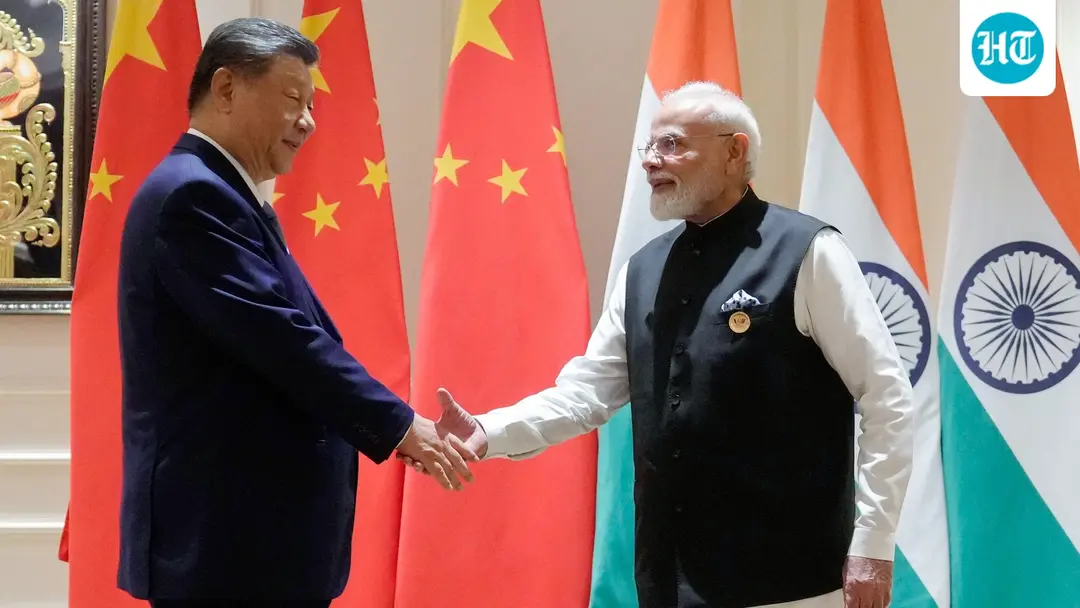
Modi told Xi both sides must respect each other's core concerns
Prime Minister Narendra Modi raised India's concerns with Chinese President Xi Jinping and said both sides should show sensitivity to each other's core concerns, the external affairs ministry said on Tuesday. Spokesperson Randhir Jaiswal said ties should be guided by three mutuals — mutual respect, mutual interest and mutual sensitivity. The leaders met on the margins of the BRICS Summit in New Delhi on September 12, Xi's first India visit in seven years. India said border peace remains the essential basis for developing relations.
Source
Hindustan Times — India · read the original report ↗
Desk check · compared with the source
What the desk checked (5)
- Modi told Xi both sides should show sensitivity to each other's core concerns and be guided by three mutuals — mutual respect, mutual interest, mutual sensitivity. — Directly quoted and attributed to MEA spokesperson Randhir Jaiswal at a media briefing.
- Modi and Xi met on the margins of the BRICS Summit in New Delhi on September 12, Xi's first India visit in seven years. — Date and detail appear in source; no independent verification possible.
- Fresh tensions occurred between Indian and Chinese troops in the Taksing region of Arunachal Pradesh, with reported face-offs in July and August. — Attributed in source to reports, without naming the reporting source.
- A Chinese readout said India's position on Taiwan and Tibet remains unchanged and India will not allow anti-China activities on its territory. — Attributed to a Chinese readout and acknowledged by the MEA spokesperson.
- Xi listed four points for promoting ties, including that China and India are partners, not rivals. — Figure and content appear in source, attributed to Xi; no direct quote for all points.
Analysts’ view opinion
The "three mutuals" formulation is a careful balancing act: it lets the government keep the normalisation track with Beijing alive while signalling at home that India has not conceded ground. The external affairs ministry's insistence that Modi "underlined Indian concerns" and that border peace remains the "essential basis" of ties reads as a direct answer to Congress's attack. But by not spelling out those concerns — and with the Chinese readout striking a different note on Taiwan and Tibet — the government has left the opposition room to keep pressing.
- Xi's first visit in seven years and a Brics summit hosted in New Delhi give the government diplomatic prestige that also works as domestic political messaging.
- Congress's core charge is that India softened on border transgressions while deepening economic dependence on China; the ministry's framing looks designed to rebut exactly that.
- The meeting took place against reported face-offs in Arunachal Pradesh's Taksing area in July and August, which raises the political cost of any perception of accommodation.
- The spokesperson's refusal to detail India's concerns invites transparency questions, and the gap in tone between the Indian and Chinese readouts gives critics space to fill in.
- Economic irritants — visa curbs, export restrictions on critical machinery and commodities, and the trade imbalance — could become the next politically potent front, including pressure from industry.
What to watch — Watch the next rounds of the Special Representatives, WMCC and military commander talks for concrete outcomes, whether any visible easing comes on visas and export curbs, and how hard the opposition pushes China in Parliament.
The story does not establish what India's specific concerns were, whether any understanding was reached on the border or economic issues, or how far India actually endorsed the points in the Chinese readout.
Deep dive
Research brief · 8 facts · 6 dates · exam-readyThe brief
Context
India and China have been working to normalise relations that collapsed after the military standoff in Ladakh, with an understanding reached in 2024. Prime Minister Narendra Modi and Chinese President Xi Jinping met on the margins of the BRICS Summit in New Delhi on September 12 — Xi's first visit to India in seven years. The external affairs ministry said on Tuesday that Modi raised India's concerns and pressed that both sides show sensitivity to each other's "core" issues, guided by "three mutuals". The meeting took place amid fresh troop tensions in the Taksing region of Arunachal Pradesh, with reported face-offs in July and August.
Key facts
- Modi and Xi met on the margins of the BRICS Summit in New Delhi on September 12; it was Xi's first visit to India in seven years.
- MEA spokesperson Randhir Jaiswal said ties should be guided by "three mutuals" — mutual respect, mutual interest and mutual sensitivity.
- India emphasised that peace and tranquillity in border areas "remains an essential basis for the continued development of bilateral relations".
- Jaiswal acknowledged that Taiwan and Tibet figured in the leaders' discussions, as stated in the Chinese readout.
- The Chinese readout said India's position on Taiwan and Tibet "remain unchanged" and that India "will not allow any force to engage in anti-China activities on its territories".
- Fresh India-China troop tensions were reported in the Taksing region of Arunachal Pradesh, with face-offs in July and August.
- India and China held the first round of military commander talks in the eastern sector in Arunachal Pradesh on September 6 and 7.
- The leaders welcomed "steady progress" in ties since their last meeting at Tianjin in August 2025 and said differences should not become disputes.
Timeline
- 2024India and China reach an understanding on the standoff in Ladakh; Xi says his two meetings with Modi since then guided ties from a "restart" to "further enhancement".
- July and August (year as reported)Reports of face-offs between Indian and Chinese troops in the remote Taksing region of Arunachal Pradesh.
- August 2025Modi and Xi meet at Tianjin — their previous meeting before the New Delhi talks.
- September 6-7India and China hold the first round of talks between military commanders in the eastern sector in Arunachal Pradesh.
- September 12Modi and Xi meet on the margins of the BRICS Summit in New Delhi; Xi's first India visit in seven years.
- Tuesday (following week)MEA spokesperson Randhir Jaiswal briefs media that Modi underlined Indian concerns and the "three mutuals".
Who has a stake
- Prime Minister Narendra Modi — Pushed India's concerns, the "three mutuals" and adherence to existing border agreements while managing normalisation of ties.
- Chinese President Xi Jinping — Framed ties via four points — partners not rivals, focus on development, parallel progress on ties and border issues, inclusive multilateral cooperation.
- Ministry of External Affairs / spokesperson Randhir Jaiswal — Explaining and defending India's negotiating position publicly; declined to detail India's specific concerns.
- Congress (opposition) — Contends India weakened its position on Chinese border transgressions while deepening economic dependence on Beijing.
- Indian and Chinese armed forces / border mechanisms — Special Representatives, WMCC and senior military commander talks manage de-escalation, including in Arunachal Pradesh's eastern sector.
- Indian industry and trade — Affected by China's visa curbs, export restrictions on critical machinery and commodities, and the two-way trade imbalance.
Why it matters
The exchange shows India tying any warming of relations to peace on the border and to reciprocity on "core concerns", even as Beijing publicly records India's positions on Taiwan and Tibet. With face-offs reported in Arunachal Pradesh's Taksing area and unresolved economic irritants like visa curbs, export restrictions and the trade imbalance, normalisation remains conditional and contested at home.
UPSC angle
Prelims pointers
- Modi-Xi meeting held on the margins of the BRICS Summit in New Delhi on September 12; Xi's first India visit in seven years.
- "Three mutuals" = mutual respect, mutual interest, mutual sensitivity.
- WMCC = Working Mechanism for Consultation and Coordination on India-China border affairs.
- Special Representatives mechanism handles the India-China boundary question.
- Taksing is in Arunachal Pradesh; first eastern-sector military commander talks held on September 6-7.
- Modi and Xi's previous meeting was at Tianjin in August 2025.
Mains framing
India-China normalisation since the 2024 understanding on the Ladakh standoff rests on a fragile bargain: Beijing seeks a \"partners, not rivals\" framing and reassurance on Taiwan and Tibet, while New Delhi insists that peace and tranquillity in border areas is the \"essential basis\" for developing ties and that existing agreements and understandings on border issues be observed. The reported face-offs in Arunachal Pradesh's Taksing region in July and August, alongside the first eastern-sector commander-level talks on September 6-7, show that dialogue mechanisms — Special Representatives, WMCC and military commanders — are managing rather than resolving the boundary question, which both leaders agreed to settle in a \"fair, reasonable and mutually acceptable\" manner from a political perspective. Economically, India's concerns include China's visa curbs, export restrictions on critical machinery and commodities, and the trade imbalance, which the opposition Congress links to growing dependence even as border transgressions continue. The way forward implied by the source is reciprocity through the \"three mutuals\", strict observance of border agreements, sustained institutional dialogue, and ensuring that differences do not become disputes.
Key terms
- Three mutuals
- Modi's formulation for India-China ties: mutual respect, mutual interest and mutual sensitivity.
- WMCC
- Working Mechanism for Consultation and Coordination, a diplomatic channel on India-China border affairs.
- Special Representatives
- Designated high-level envoys of India and China who hold rounds of talks on the boundary question.
- BRICS Summit
- Grouping summit hosted in New Delhi, on whose margins Modi and Xi held their September 12 bilateral.
- Taksing
- Remote area in Arunachal Pradesh where fresh India-China troop tensions and face-offs were reported in July and August.
- Xi's four points
- Partners not rivals; focus on development and friendly exchanges; parallel progress on ties and border issues; inclusive multilateral cooperation.
Practice questions
- Examine how the principle of "peace and tranquillity in border areas" shapes the trajectory of India-China relations, with reference to recent developments in the eastern sector.
- Discuss the utility and limits of institutional mechanisms such as the Special Representatives dialogue, WMCC and commander-level talks in managing the India-China boundary question.
- "Economic interdependence and strategic mistrust coexist in India-China relations." Critically analyse in light of China's visa curbs, export restrictions and the bilateral trade imbalance.
Grounded only in the source report — figures and dates are the source's, not inferred.