
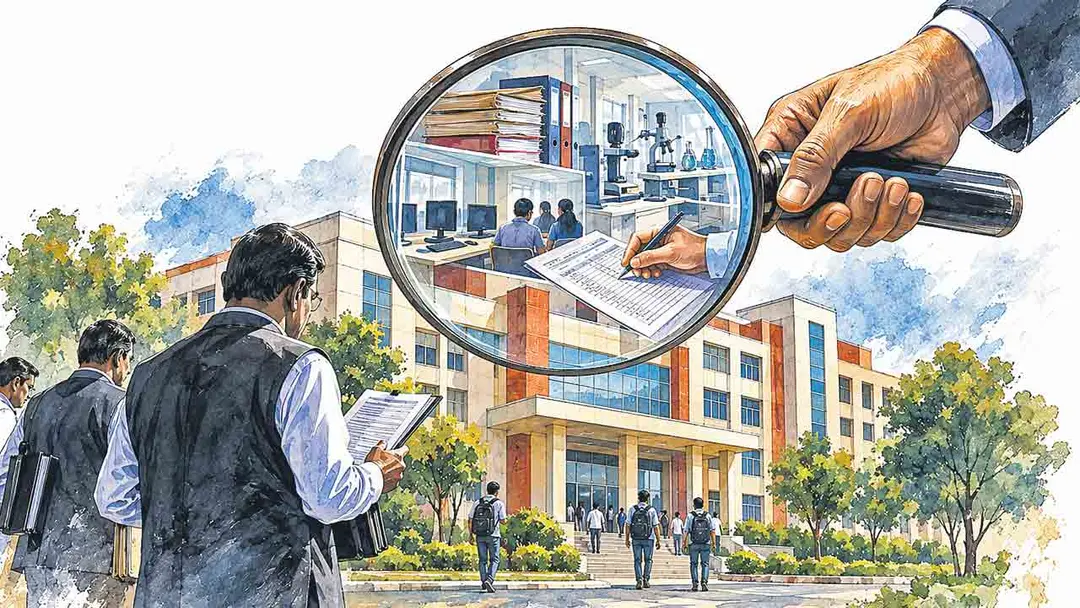
Vigilance inspections at Telangana private engineering colleges enter fourth day
Vigilance and Enforcement department inspections at private engineering colleges in Telangana, which began on the 16th of this month, continued for a fourth day on Saturday. Teams of 10-12 officials at each college are examining 67 parameters, including student attendance, faculty salaries and certificates, fee reimbursement, laboratories and financial transactions. The checks followed Chief Minister Revanth Reddy's announcement in the Assembly that irregularities in the fee reimbursement scheme would be investigated. Managements deny any scope for irregularities.
Source
Namasthe Telangana · read the original report ↗
Desk check · some claims need care
What the desk checked (5)
- Vigilance and Enforcement inspections of private engineering colleges began on the 16th and continued for a fourth day on Saturday. — Stated in the source as reporting; no official spokesperson quoted.
- Teams of 10-12 officials are examining 67 parameters including attendance, faculty salaries and certificates, fee reimbursement, labs and financial transactions. — Figures appear in the source; attributed to the reporting, not to a named official.
- CM Revanth Reddy recently announced in the Assembly that irregularities in the fee reimbursement scheme would be investigated. — Attributed to the Chief Minister's statement in the Assembly as per the source.
- Colleges were targeted for refusing B-category/management quota seats, with calls made from the CMO. — Presented as 'prachaaram' (circulating talk) and discussion among college managements; unattributed and unverified.
- College managements deny irregularities, saying convener quota reimbursement is processed online, and are preparing for protests over pending dues. — Attributed collectively to private engineering college owners; no individual named.
Analysts’ view opinion
Vigilance raids are a blunt instrument being used for what is essentially a regulatory data problem: whether fee-reimbursement claims match real students, real faculty and real labs. The state has a legitimate interest in protecting a large welfare subsidy that flows through private colleges, but the design here — 67 checkpoints, 10-12 member teams with police, days of inspection — looks more like enforcement theatre than a routine audit cycle, and it lands at a moment when managements say their own dues are unpaid. Both claims can be true: reimbursement is largely online and convenor-quota driven, yet attendance and faculty records are exactly where inflation has historically been alleged in such schemes.
- Fee reimbursement is a demand-side subsidy paid to institutions on the basis of enrolment records, so its integrity depends entirely on verification of attendance and faculty — the very items now being checked.
- The colleges' defence is a design argument, not a denial of wrongdoing in general: if convenor-quota admissions are filled online by the state, duplication is hard, but that does not cover attendance, ghost faculty or lab claims.
- There is an audit-overlap question worth taking seriously — managements say AICTE, JNTU and fact-finding committee inspections already happen annually, raising the issue of why a separate vigilance layer is needed rather than tightening existing ones.
- Sequencing matters politically: the inspections began after the Chief Minister's assembly announcement of a probe, which gives them legitimacy as follow-through but also exposes them to the charge of being targeted.
- The story also records unverified allegations circulating among managements about management-quota seat pressure, and a pending-dues dispute — both of which, if unaddressed, will muddy public confidence in whatever the inspections find.
What to watch — Watch whether the government publishes findings college-wise with a clear recovery or penalty framework, and whether the pending reimbursement arrears are settled alongside — that combination is the real test of whether this is governance or pressure.
The story establishes that inspections are under way and that allegations exist on both sides; it does not establish any proven irregularity, any figure of misused funds, or any official confirmation of the seat-pressure claims, which are reported only as talk among managements.
Deep dive
Research brief · 8 facts · 5 dates · exam-readyThe brief
Context
Telangana's Vigilance and Enforcement department began inspections of private engineering colleges in the state on the 16th of this month, and they continued for a fourth day on Saturday. The drive followed Chief Minister Revanth Reddy's announcement in the Assembly that some colleges had committed irregularities in the fee reimbursement scheme and would be investigated. Teams of 10-12 officials, accompanied by police, are scrutinising 67 parameters at each college, while managements reject the allegations and claim they are being targeted for other reasons.
Key facts
- Vigilance and Enforcement inspections at private engineering colleges in Telangana began on the 16th of this month and continued into a fourth day on Saturday.
- Each college is being inspected by a team of 10-12 officials, with police accompanying them for days at a stretch.
- Officials are examining 67 parameters in all during the inspections.
- Parameters include student attendance, faculty salaries, number of faculty working, their certificates, fee reimbursement irregularities, laboratories and financial transactions.
- The inspections started right after CM Revanth Reddy announced in the Assembly that some colleges had indulged in fee reimbursement irregularities and would be investigated.
- Managements say convener quota seats are filled by the government itself, reimbursement goes to those students, and the entire process is online, leaving no scope for irregularities.
- Managements claim it is impossible to draw reimbursement twice in the name of the same student.
- Colleges say AICTE, JNTU professors and fact-finding committees already inspect them every year, questioning the need for separate vigilance checks.
Timeline
- Dasara period last yearCollege managements called for a bandh demanding release of pending fee reimbursement dues.
- Recently (before the inspections)CM Revanth Reddy announced in the Assembly that fee reimbursement irregularities by some colleges would be investigated.
- 16th of this monthVigilance and Enforcement department inspections at private engineering colleges begin.
- Saturday (September 19, per dateline)Inspections continue for a fourth day; 67 parameters under scrutiny.
- NowManagements prepare for fresh agitations over pending reimbursement dues.
Who has a stake
- Vigilance and Enforcement department — Conducting the inspections with 10-12 member teams per college across 67 parameters.
- Private engineering college managements — Face days-long scrutiny of attendance, faculty, labs and finances; deny irregularities and allege targeting.
- CM Revanth Reddy / state government — Announced the probe in the Assembly into fee reimbursement irregularities; credibility of the drive.
- Students under fee reimbursement — Convener quota students whose fees the government reimburses; outcome affects their colleges' functioning.
- Faculty in private colleges — Salaries, employment numbers and certificates are being verified during inspections.
- AICTE, JNTU and fact-finding committees — Existing annual inspection bodies whose role managements cite while questioning duplicate vigilance checks.
- Chief Minister's Office (CMO) — Alleged in college circles to have phoned colleges seeking management quota CSE (BTech) seats.
Why it matters
The fee reimbursement scheme is the financial backbone of professional education for lakhs of students in Telangana, and allegations of its misuse touch both public money and college accountability. At the same time, managements' claim that inspections are retaliation for refusing seat requests and for demanding pending dues raises questions about the use of enforcement machinery in education regulation.
UPSC angle
Prelims pointers
- Vigilance and Enforcement department inspections of Telangana private engineering colleges began on the 16th of this month.
- 67 parameters are being examined; teams of 10-12 officials per college.
- Trigger: CM Revanth Reddy's Assembly announcement on fee reimbursement irregularities.
- Convener quota seats are filled by the government and carry fee reimbursement; B-category/management quota seats are filled by colleges.
- Existing inspecting bodies named: AICTE, JNTU professors and fact-finding committees.
- Managements called a bandh during Dasara last year over pending fee reimbursement dues.
Mains framing
The Telangana vigilance drive at private engineering colleges illustrates the tension between state oversight of publicly funded education subsidies and institutional autonomy. The proximate cause is the Chief Minister's Assembly statement on irregularities in the fee reimbursement scheme, which led to inspections covering 67 parameters, from student attendance and faculty strength and certificates to laboratories and financial transactions. Managements counter that convener quota admissions and reimbursement are handled online by the government itself, ruling out duplicate claims, and allege that the real trigger is their refusal of management quota CSE seat requests and their demand for release of old dues, for which they had called a bandh during Dasara last year. They also argue that AICTE, JNTU professors and fact-finding committees already inspect them annually, making vigilance raids duplicative. The implications run both ways: unverified subsidy claims would waste public money, but enforcement action perceived as coercive can chill institutions and disrupt teaching. A grounded way forward, as suggested by the facts in the source, is transparent disclosure of what the 67-parameter audit finds, timely settlement of admitted reimbursement dues, and harmonising vigilance checks with existing regulatory inspections instead of layering them.
Key terms
- Vigilance and Enforcement department
- State agency conducting the ongoing inspections at private engineering colleges with 10-12 member teams.
- Fee reimbursement scheme
- Government scheme under which fees of eligible students, filled through convener quota, are reimbursed to colleges.
- Convener quota
- Seats filled by the government through counselling; these students receive fee reimbursement, processed online.
- B-category / management quota seats
- Seats filled by college managements; colleges allege they were targeted for refusing such CSE (BTech) seat requests.
- AICTE
- All India Council for Technical Education, cited by colleges as already inspecting them annually.
- JNTU / fact-finding committees
- University professors and committees that carry out yearly affiliation-related inspections of engineering colleges.
Practice questions
- Examine the regulatory architecture governing private professional colleges in India. Does layering vigilance inspections over AICTE and university checks strengthen or dilute accountability?
- Fee reimbursement schemes expand access to professional education but create scope for leakage. Discuss with reference to the ongoing Telangana inspections.
- Critically assess the argument that online, government-run admission and reimbursement processes eliminate the scope for irregularities in professional education.
Grounded only in the source report — figures and dates are the source's, not inferred.