
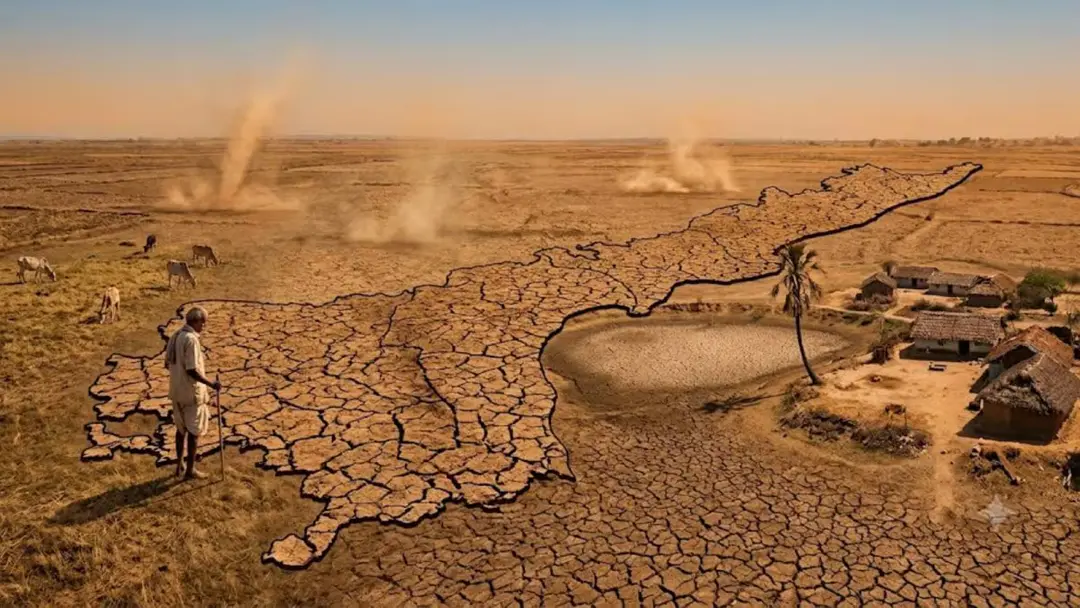
Andhra Pradesh emerging as severe drought hotspot, study warns
A 52-year study (1971-2022) by IMD, NCMRWF and Austrian university researchers warns that Andhra Pradesh is becoming one of India's most drought-affected regions. Published in the International Journal of Climatology, the report says drought conditions covered 10% of south India before 1990 but expanded to 40% after 2000. The east coast stretch covering Andhra Pradesh, Tamil Nadu and Odisha has turned into a drought hotspot, lead researcher Thota Mohan said.
Source
ఆంధ్రప్రదేశ్ వార్తలు — Andhra Pradesh · read the original report ↗
Desk check · compared with the source
What the desk checked (5)
- A 52-year (1971-2022) study by IMD, NCMRWF and Austrian university researchers found Andhra Pradesh turning into a severe drought hotspot. — Attributed in source to the named institutions; study said to be published in the International Journal of Climatology.
- Drought conditions covered only 10% of south India before 1990 and expanded to 40% after 2000. — Figures appear in the source, cited to the report; no page or data table reference given.
- Drought severity area rose from 20% in the 1980s to 30% by 2011-2021. — Figure appears in the source as a report finding; internally consistent with the expansion claim.
- Lead researcher Thota Mohan said drought is the fastest-spreading climate extreme; former Earth Sciences Ministry secretary M. Rajeevan said Andhra Pradesh has faced severe drought in recent years. — Directly attributed to named individuals; quotes paraphrased in source.
- Urbanisation, emissions and the urban heat index are eliminating night-time cooling, affecting crops and health. — Presented as a report finding; no supporting figures given in the source.
Analysts’ view opinion
This is a climate science report, but its political consequences in Andhra Pradesh run deep. Drought means water, crops, farm loans, jobs and migration — precisely the issues that decide state electoral politics. Because the study tracks a long arc from 1971 to 2022, it is hard to pin on any single government; yet both the ruling side and the opposition are likely to try to turn it to advantage, pushing irrigation projects, river water disputes and water-management promises back to the centre of debate.
- Labelling the east coast — Andhra Pradesh, Tamil Nadu and Odisha — a drought hotspot could give southern states a shared scientific basis for joint demands and for seeking central assistance.
- Since the findings span decades, every party can argue the problem did not begin on its watch, which risks diluting political accountability.
- For the opposition it becomes a stick to question delays in irrigation projects and water-management lapses; for the government it becomes an argument for more central funds and relief packages.
- The report's focus on urbanisation, emissions and rising night temperatures could feed criticism of urban and capital-development models, and push green planning into manifesto territory.
- Declaring drought-hit mandals, compensation and allocation of rural employment works touch voters directly, making these politically sensitive levers.
What to watch — Watch whether the state government and opposition formally invoke this study, and whether demands emerge for dedicated drought funding or a long-term water policy from the Centre.
The story reports the findings of a scientific study only; it does not establish any specific policy failure, political reaction or electoral impact.
Deep dive
Research brief · 8 facts · 5 dates · exam-readyThe brief
Context
A 52-year joint study (1971-2022) by the India Meteorological Department (IMD), the National Centre for Medium Range Weather Forecasting (NCMRWF) and researchers from an Austrian university has found that Andhra Pradesh and neighbouring southern states are facing unprecedented drought stress. Titled on the evolution of weather extremes over the Indian subcontinent, the report has been published in the International Journal of Climatology. It concludes that the east coast belt of Andhra Pradesh, Tamil Nadu and Odisha has turned into India's most severe drought hotspot, driven by rainfall deficits, rising temperatures and faster loss of soil moisture.
Key facts
- The study spans 52 years, from 1971 to 2022, and was carried out jointly by IMD, NCMRWF and researchers of an Austrian university.
- Findings were published in the International Journal of Climatology under a report on the evolution of weather extremes over the Indian subcontinent.
- Before 1990, drought conditions affected only about 10% of south India's area; after 2000 this expanded to 40%.
- Compared with the 1980s, the area under severe drought intensity rose from 20% to 30% by 2011-2021.
- The east coast stretch covering Andhra Pradesh, Tamil Nadu and Odisha has become the most severe drought hotspot.
- Lead researcher Thota Mohan said drought is the fastest expanding and most impactful of climate extremes.
- M. Rajeevan, former Secretary of the Union Ministry of Earth Sciences, said Andhra Pradesh has been facing severe drought conditions in recent years.
- The report says both maximum and minimum temperatures are rising abnormally, with cool nights disappearing due to rapid urbanisation, rising emissions and the urban heat index effect.
Timeline
- Before 1990Drought conditions covered only about 10% of the area of south India.
- 1980sArea under severe drought intensity stood at about 20%, the baseline for later comparison.
- After 2000Drought-affected area in south India expanded to 40%.
- 2011-2021Severe drought intensity area rose to 30% compared with the 1980s.
- 1971-2022Period covered by the 52-year IMD-NCMRWF-Austrian university study, now published in the International Journal of Climatology.
Who has a stake
- Andhra Pradesh, Tamil Nadu and Odisha — Form the east coast drought hotspot; face long-term water scarcity, rainfall deficit and rising heat stress.
- Farmers and the agriculture sector — Rising night temperatures are hurting crop growth; rainfall deficits threaten cropping and irrigation.
- IMD and NCMRWF — Indian agencies behind the study; responsible for monitoring, forecasting and flagging climate extremes.
- Urban residents — Loss of cool nights due to urbanisation, emissions and urban heat index, plus severe humidity near the Bay of Bengal, causing health problems.
- State and Central governments — Expected to act on integrated water management, rainwater harvesting, urban greening and rural drinking water planning.
- Rural communities — Face drinking water shortages unless advance planning is done, experts warn.
Why it matters
Drought is emerging as the fastest expanding climate extreme in India, and a four-fold jump in the area affected in south India, from 10% before 1990 to 40% after 2000, points to a structural shift rather than a bad year. For Andhra Pradesh, which depends heavily on agriculture, shrinking rainfall combined with hotter nights threatens crop yields, drinking water security and public health. The findings make water management, rainwater harvesting and urban cooling immediate policy priorities rather than long-term goals.
UPSC angle
Prelims pointers
- IMD = India Meteorological Department; NCMRWF = National Centre for Medium Range Weather Forecasting, both involved in the 1971-2022 study.
- Study published in the International Journal of Climatology; lead researcher Thota Mohan.
- M. Rajeevan is former Secretary, Union Ministry of Earth Sciences.
- Drought area in south India: 10% before 1990, 40% after 2000; severe drought area 20% (1980s) to 30% (2011-2021).
- Drought hotspot identified: east coast belt of Andhra Pradesh, Tamil Nadu and Odisha.
- Reduced inland penetration of Bay of Bengal low-pressure systems and depressions is cited as a major cause of rainfall deficit.
Mains framing
The study's finding that drought-affected area in south India quadrupled from 10% before 1990 to 40% after 2000 frames drought not as a cyclical agrarian shock but as a deepening climate trend along India's east coast. The identified causes are layered: a sharp deficit in normal rainfall, high heat accelerating evaporation of soil moisture, reduced inland movement of low-pressure systems and depressions forming over the Bay of Bengal, and, in towns and cities, rapid urbanisation, rising emissions and the urban heat index effect that has erased the cooling of nights. The implications cut across sectors: warmer nights damage crop growth, humidity combined with high surface temperatures near the Bay of Bengal produces oppressive heat and health problems, and long-term water stress looms for both irrigation and drinking water. The way forward suggested by experts in the report is integrated water management policies, top priority to rainwater harvesting, large-scale urban green plans to blunt heat, and advance planning to prevent rural drinking water shortages. Answers should stress that adaptation must combine meteorological monitoring by bodies such as IMD and NCMRWF with local water and land-use governance.
Key terms
- IMD
- India Meteorological Department, the national agency for weather observation and forecasting; a co-author of the study.
- NCMRWF
- National Centre for Medium Range Weather Forecasting, an Indian institution for medium-range weather prediction, co-author of the study.
- Drought hotspot
- A region showing persistent and intensifying drought conditions; here, the Andhra Pradesh-Tamil Nadu-Odisha east coast belt.
- Urban heat index
- The effect by which urbanisation and emissions raise city temperatures, here blamed for the loss of cool nights.
- International Journal of Climatology
- The international research journal in which the 52-year study on Indian subcontinent weather extremes was published.
- Soil moisture loss
- Rapid evaporation of moisture from the soil due to high heat, worsening drought and long-term water stress.
Practice questions
- Discuss the findings of the IMD-NCMRWF study (1971-2022) on the expansion of drought in south India and examine the factors behind the emergence of the east coast as a drought hotspot.
- How does the rise in night-time minimum temperatures affect agriculture and public health? Suggest measures to reduce urban heat in Indian cities.
- Critically evaluate integrated water management and rainwater harvesting as responses to recurring drought in Andhra Pradesh and the eastern coastal belt.
Grounded only in the source report — figures and dates are the source's, not inferred.