
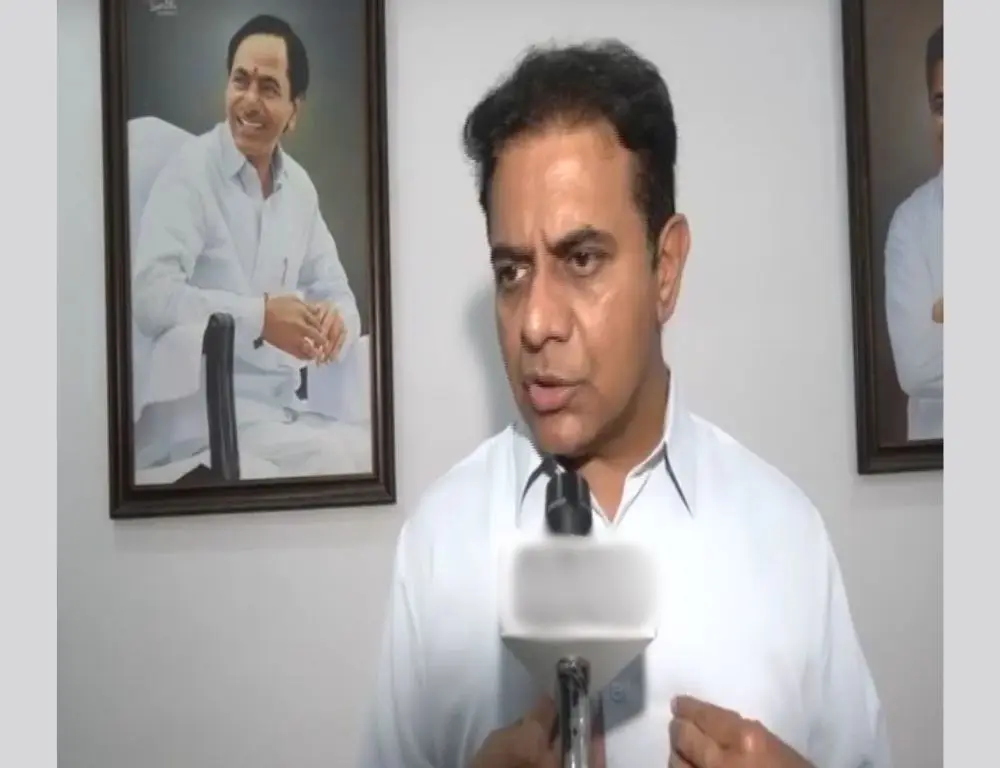
KTR seeks Supreme Court probe into SIR objections
BRS working president K T Rama Rao has sought a Supreme Court inquiry into objections reportedly raised by two Election Commissioners over the Special Intensive Revision (SIR) of electoral rolls. He said the objections raised several questions about the Election Commission's functioning and that there was a serious crisis of confidence in it, urging the court to take suo motu cognisance. The Commission said concerns by S S Sandhu and Vivek Joshi were part of the deliberative process and full Commission decisions, including on SIR, were unanimous.
Source
KTR (BRS) · read the original report ↗
Desk check · some claims need care
What the desk checked (4)
- BRS working president K T Rama Rao sought a Supreme Court inquiry, including suo motu cognisance, into objections over the SIR of electoral rolls. — Directly attributed to Rama Rao in the source, with quotes.
- Two Election Commissioners raised objections over the SIR process. — Described in the source as 'reportedly raised'; no originating source or document cited.
- Rama Rao said there is a serious crisis of confidence in the functioning of the Election Commission. — Direct quote attributed to Rama Rao.
- The Election Commission said concerns raised by S S Sandhu and Vivek Joshi were part of the deliberative process and that full Commission decisions, including on SIR, were unanimous. — Attributed to the Election Commission; figure/names appear in source.
Analysts’ view opinion
By seizing on reports of internal dissent within the Election Commission over the SIR, KTR is converting a procedural story into a question about the credibility of a constitutional institution — a deliberate political play. Out of power in Telangana, the BRS gains by inserting itself into a national argument that several opposition parties are already making about electoral rolls. The ECI, for its part, is trying to defuse it by framing the commissioners' concerns as normal deliberation with unanimous final decisions. Even if the court does not act suo motu, the demand itself carries little political downside for the BRS.
- Asking for suo motu judicial intervention lets KTR shift the fight to a national and legal stage, well beyond his party's current legislative strength.
- Because roll revision is already a shared opposition grievance, the BRS can align with a broader chorus rather than campaign alone.
- The ECI's 'unanimous decisions' formulation is designed to recast internal debate as routine process and blunt the charge of institutional crisis.
- KTR's argument that no agency has examined the Commission's conduct works more as political messaging than as an established legal ground.
- For a BRS squeezed between the ruling Congress and the BJP in Telangana, voter-roll anxiety is an issue that can reconnect it with ordinary voters.
What to watch — Watch whether the Supreme Court takes up the matter, whether other opposition parties echo KTR's demand, and whether the ECI offers any fuller explanation.
The story does not establish what the two commissioners actually objected to or how substantive those objections were, nor does it indicate any judicial willingness to intervene.
Deep dive
Research brief · 8 facts · 3 dates · exam-readyThe brief
Context
The Election Commission of India has been carrying out a Special Intensive Revision (SIR) of electoral rolls, a process that has drawn political scrutiny. Reports of objections raised by two Election Commissioners, S S Sandhu and Vivek Joshi, over the SIR have triggered demands for an external examination of how the ECI functions. BRS working president K T Rama Rao has now asked the Supreme Court to take suo motu cognisance and inquire into the matter, while the Commission maintains that such internal concerns were part of its deliberative process and that its full-Commission decisions on SIR were unanimous.
Key facts
- BRS working president K T Rama Rao has demanded a Supreme Court inquiry into objections reportedly raised by two Election Commissioners over the Special Intensive Revision (SIR) of electoral rolls.
- Rama Rao said the objections raised several questions and doubts over the functioning of the Election Commission of India (ECI).
- He stated: 'There is now a serious crisis of confidence in the functioning of the Election Commission.'
- Rama Rao urged the Supreme Court to take suo motu cognisance of the matter and conduct an inquiry.
- He argued the Supreme Court should take special note because no other government agency had conducted an inquiry into the ECI's functioning in this case.
- He noted that the Election Commission is a constitutional body.
- The ECI said the concerns raised by Election Commissioners S S Sandhu and Vivek Joshi were part of the deliberative process.
- The ECI said decisions taken by the full Commission, including those related to SIR, were unanimous.
Timeline
- Not dated in the sourceTwo Election Commissioners, S S Sandhu and Vivek Joshi, reportedly raise objections over the Special Intensive Revision (SIR) of electoral rolls.
- Not dated in the sourceBRS working president K T Rama Rao, speaking in Hyderabad, calls for a Supreme Court inquiry and suo motu cognisance of the matter.
- Not dated in the sourceThe Election Commission responds that the Commissioners' concerns were part of the deliberative process and that full Commission decisions, including on SIR, were unanimous.
Who has a stake
- Election Commission of India (ECI) — Its credibility and internal decision-making process are under question; it asserts its full-Commission decisions on SIR were unanimous.
- Election Commissioners S S Sandhu and Vivek Joshi — Their reported objections over SIR are at the centre of the controversy; the ECI frames these as part of normal deliberation.
- K T Rama Rao, BRS working president — Leading the demand for judicial scrutiny, alleging a crisis of confidence in the poll body.
- Supreme Court of India — Being asked to take suo motu cognisance and inquire into the functioning of a constitutional body.
- Voters and electors — The accuracy and integrity of electoral rolls revised under SIR directly affect their right to vote.
Why it matters
The electoral roll is the foundation of a credible election, so any doubt over how a nationwide revision exercise was decided upon strikes at public trust in the voting process. The episode also raises the question of who scrutinises a constitutional body like the ECI when internal disagreement surfaces, since, as Rama Rao noted, no other government agency has inquired into its functioning in this case.
UPSC angle
Prelims pointers
- Special Intensive Revision (SIR) is an exercise of revising electoral rolls conducted by the Election Commission of India.
- The Election Commission of India is a constitutional body; it currently functions as a multi-member 'full Commission'.
- Election Commissioners named in the story: S S Sandhu and Vivek Joshi.
- Suo motu cognisance means a court taking up a matter on its own, without a petition being filed before it.
- K T Rama Rao is the working president of the Bharat Rashtra Samithi (BRS); the statement was made in Hyderabad.
- The ECI's stated position: internal concerns were part of the deliberative process and decisions on SIR were unanimous.
Mains framing
The demand for a Supreme Court inquiry into reported internal objections over the Special Intensive Revision of electoral rolls highlights a structural tension in India's electoral architecture: the Election Commission of India is a constitutional body with wide autonomy over roll revision, yet there is no routine external mechanism to examine how its collegial decisions are arrived at. The immediate trigger is the reported dissent of Election Commissioners S S Sandhu and Vivek Joshi, which the ECI characterises as part of its deliberative process, insisting that full-Commission decisions including those on SIR were unanimous; the opposition BRS reads the same facts as evidence of a 'serious crisis of confidence'. The implications are significant because the electoral roll determines who may vote, so perceived opacity in the process can erode legitimacy irrespective of the substantive merits of SIR. A way forward, consistent with what the source supports, lies in greater transparency about how the full Commission deliberates and records differences, and in clarity on whether judicial scrutiny, including suo motu cognisance as sought here, is the appropriate route when no other agency examines the poll body's functioning.
Key terms
- Special Intensive Revision (SIR)
- An intensive exercise by the Election Commission to revise and update electoral rolls, the subject of the reported objections.
- Election Commission of India (ECI)
- The constitutional body that superintends and conducts elections and maintains electoral rolls in India.
- Full Commission
- The ECI sitting as a collective body of the Chief Election Commissioner and Election Commissioners to take decisions; here said to have decided on SIR unanimously.
- Suo motu cognisance
- A court's power to take up an issue on its own initiative rather than on a petition; sought here from the Supreme Court.
- Bharat Rashtra Samithi (BRS)
- The Telangana-based party whose working president, K T Rama Rao, is demanding the inquiry.
Practice questions
- The Election Commission of India is a constitutional body with wide autonomy. In the light of reported internal objections over the Special Intensive Revision of electoral rolls, discuss the mechanisms available for scrutinising its functioning.
- Critically examine the argument that judicial suo motu intervention is necessary where no other government agency inquires into the functioning of a constitutional body.
- How does the integrity of electoral roll revision affect public confidence in elections? Discuss with reference to the SIR controversy.
Grounded only in the source report — figures and dates are the source's, not inferred.