
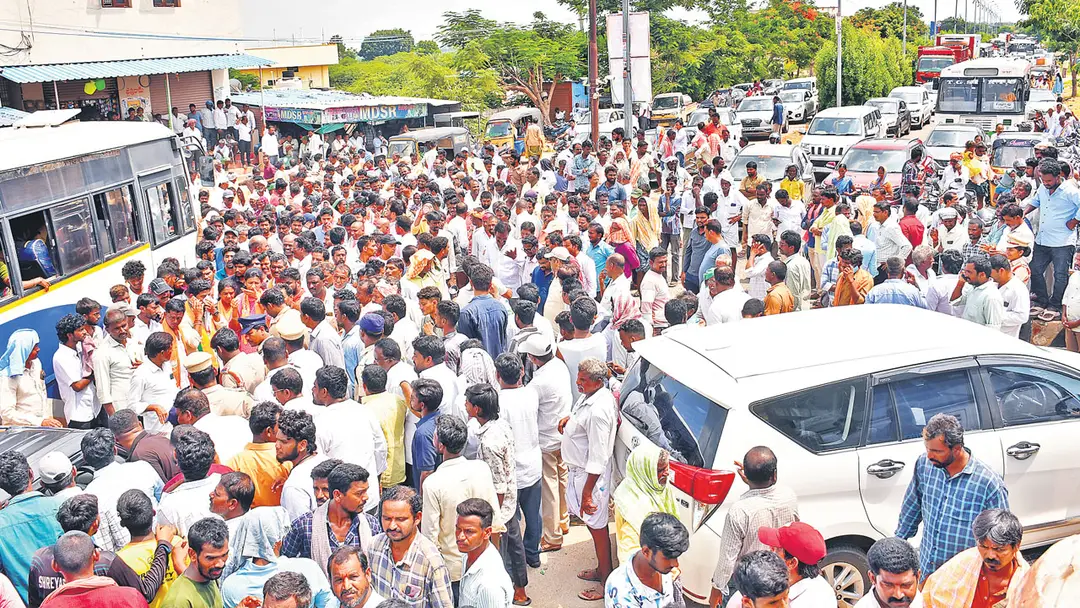
Gadwal farmers stage six-hour protest seeking Jurala water release
Farmers in Jogulamba-Gadwal district protested on Monday demanding release of irrigation water to the Jurala project ayacut. After police diverted traffic from their road blockade at the collectorate, they walked about two kilometres and held a dharna at Jammichedu from 10:30 am to 4:30 pm. Women farmers fell at the feet of Additional Collector Madhu Mohan. Irrigation EE Kesava Rao said there was no water in the project. Farmers set a 24-hour deadline for the government. BRS and BJP leaders backed them.
Source
Namasthe Telangana · read the original report ↗
Desk check · some claims need care
What the desk checked (6)
- Farmers held a six-hour protest at Jammichedu in Jogulamba-Gadwal district on Monday, from 10:30 am to 4:30 pm, demanding water release from the Jurala project. — Timings and location appear in the source as reported detail; no official statement cited.
- Women farmers fell at the feet of Additional Collector Madhu Mohan pleading for irrigation water; he promised to take the issue to the government. — Named official and action described directly in source; not independently confirmed.
- Irrigation EE Kesava Rao told farmers there was no water in the project. — Attributed to a named official in the source.
- Officials sent ambulances without patients every half hour to break the blockade. — Unattributed claim presented as the reporter's/farmers' observation; requires verification.
- No farmers' protest has lasted this long in the 13 years since Telangana was formed. — Comparative claim with no source or data given in the text.
- Farmers set a 24-hour deadline for the government; BRS and BJP leaders extended support. — Figure and political support appear in source; no direct quotes from those parties.
Analysts’ view opinion
This is less a protest story than an early warning about capital about to be written off. Farmers say they have already spent lakhs of rupees on seed, fertiliser, labour and power — money that is sunk and unrecoverable if the crop dries before harvest. But the irrigation engineer's statement that there is no water in the project shifts the problem from allocation to availability, which means the only thing the state can release quickly is an assurance, not water.
- If standing crops fail this late in the cycle, the loss lands almost entirely on farm households in the form of debt, interest and no capital left to replant.
- Damage in a canal command area never stops at the farmer — labour workdays, transport, handling, milling and local retail spending all shrink with it.
- Six hours of blocked traffic over roughly two kilometres on the Gadwal–Kurnool stretch is a smaller but real cost to freight and daily movement.
- If the official position that the reservoir is empty holds, the government's remaining economic levers are compensation, loan rescheduling or input support — all of which are charges on the exchequer rather than on water.
- With BRS and BJP backing the agitation, the political cost of inaction rises, and so does pressure for expensive relief announcements.
What to watch — Watch whether the 24-hour deadline produces clarity on water release or a pivot to compensation and input support — that choice decides who absorbs this season's losses.
The story does not establish how many acres are affected, the scale of crop loss in value terms, or the actual storage level in the project, so the size of the economic hit cannot be quantified.
Deep dive
Research brief · 8 facts · 7 dates · exam-readyThe brief
Context
Farmers in Jogulamba-Gadwal district of Telangana depend on irrigation releases from the Jurala project for their standing crops. With water not reaching the Jurala ayacut and crops drying up, a large body of farmers gathered at the district collectorate on Monday, September 21, demanding immediate release of irrigation water. After police diverted traffic away from their rasta roko, the farmers marched about two kilometres and held a six-hour dharna at Jammichedu, blocking the Gadwal-Kurnool road. Officials, including the Irrigation Executive Engineer, told them there was no water in the project, and no firm assurance was given on release.
Key facts
- Farmers' agitation at Jammichedu in Jogulamba-Gadwal district ran from 10:30 am to 4:30 pm on Monday, September 21 - about six hours.
- Their central demand was release of irrigation water to the Jurala project ayacut.
- After police diverted vehicles from their rasta roko at the collectorate, farmers walked about 2 km from the collectorate to Jammichedu.
- The blockade left vehicles stranded for about 2 km each on the Gadwal side and the Kurnool side.
- The report says no farmers' protest had continued this long in the 13 years since Telangana state was formed.
- Women farmers fell at the feet of Additional Collector Madhu Mohan, pleading for water; he promised to take the issue to the government's notice and left.
- Irrigation department Executive Engineer Kesava Rao told farmers there was no water in the project, triggering anger; he too left the spot.
- As no one assured water release, farmers set a 24-hour deadline for the government, warning officials and elected representatives of consequences.
Timeline
- Monday morning, September 21Farmers gather in large numbers at the Jogulamba-Gadwal collectorate and launch a rasta roko demanding Jurala water.
- Soon afterPolice divert vehicles to an alternate route; angered farmers walk about 2 km to Jammichedu.
- 10:30 amDharna begins at Jammichedu, blocking traffic on both the Gadwal and Kurnool sides.
- During the dharnaAdditional Collector Madhu Mohan arrives; women farmers fall at his feet; he promises to convey the issue to the government.
- After thatIrrigation EE Kesava Rao tells farmers there is no water in the project, provoking protest; he leaves.
- Through the dayOfficials reportedly run empty ambulances at half-hour intervals to break the blockade; farmers block them, leading to jostling with police.
- 4:30 pmDharna concludes after about six hours; farmers set a 24-hour deadline for the government.
Who has a stake
- Jurala ayacut farmers — Crops raised at a cost of lakhs of rupees are drying up for want of irrigation water; they say death is the only option left if water is not released.
- Women farmers — Fell at the Additional Collector's feet pleading for water, signalling the depth of distress in the ayacut.
- Additional Collector Madhu Mohan — District administration's face at the protest; promised only to take the matter to the government.
- Irrigation department (EE Kesava Rao, Jurala SE) — Must explain water availability; EE said there is no water in the project and the SE asked farmers to understand the situation.
- Chief Minister, ministers and the Gadwal MLA — Targets of farmers' slogans and anger over failure to release irrigation water.
- Police — Managed the blockade, diverted traffic and clashed with farmers while trying to clear the road.
- BRS and BJP leaders — Extended solidarity to the farmers, turning the local water demand into a political flashpoint.
- Road users on the Gadwal-Kurnool route — Stranded for about 2 km on either side during the six-hour blockade.
Why it matters
The protest shows how mid-season shortfalls in canal releases can push ayacut farmers who have already invested lakhs in a crop to the brink, turning an irrigation shortfall into a law-and-order and political issue. The administration's position that there is simply no water in the project, against farmers' demand for immediate release, captures the core tension of supply-based irrigation planning. With a 24-hour deadline set and opposition parties backing the farmers, the episode tests the district administration's crisis response.
UPSC angle
Prelims pointers
- Jurala project is an irrigation project serving an ayacut in Jogulamba-Gadwal district, Telangana.
- The six-hour farmers' dharna on September 21 was held at Jammichedu, about 2 km from the Gadwal collectorate.
- Additional Collector of Jogulamba-Gadwal named in the story: Madhu Mohan; Irrigation EE: Kesava Rao.
- Farmers set a 24-hour deadline on the government for release of irrigation water.
- The blockade stalled traffic for about 2 km each towards Gadwal and Kurnool.
- BRS and BJP leaders supported the agitating farmers; the story notes this was the longest farmer protest in 13 years of Telangana state.
Mains framing
The Gadwal agitation illustrates the fragility of assured irrigation in ayacut areas dependent on a single project. Farmers had already spent lakhs on the crop, and once water did not arrive at the tail end of the season, standing crops began to dry, leaving them with no fallback and pushing them to a six-hour road blockade, a 24-hour ultimatum and expressions of suicidal despair. The administration's reply, that the project simply has no water, points to a gap between cropping decisions on the ground and realistic communication of water availability; the irrigation SE's appeal that farmers 'understand the situation' underlines that the shortfall was known to officials but not resolved for farmers. The use of empty ambulances to break the dharna and the jostling with police show how quickly an irrigation grievance becomes a policing problem, while BRS and BJP support shows its political charge. A grounded way forward, on the evidence of this story, lies in early and transparent advisories on likely releases before sowing, a credible grievance mechanism at the district level that gives farmers a definite answer rather than a promise to convey the matter upward, and escalation of the water availability question to the state government within the deadline farmers have set.
Key terms
- Ayacut
- The command area of an irrigation project, that is, the land meant to receive water from it - here the Jurala project's ayacut.
- Jurala project
- The irrigation project in Jogulamba-Gadwal district from which farmers are demanding water release.
- Rasta roko
- A protest form in which demonstrators block a road to press their demand; attempted by farmers at the collectorate.
- Dharna
- A sit-in protest; farmers held one at Jammichedu from 10:30 am to 4:30 pm.
- Executive Engineer (EE)
- Irrigation department officer at project level; EE Kesava Rao told farmers there was no water in the project.
- Superintending Engineer (SE)
- Senior irrigation officer above the EE; the Jurala SE said farmers should understand the situation.
Practice questions
- Examine how dependence on a single irrigation project for a command area shapes farmer distress, using the Jurala ayacut protest as an illustration.
- Discuss the role of district administration in managing irrigation-related agitations. What mechanisms can give farmers definite answers rather than assurances?
- Mid-season water shortfalls turn agricultural grievances into law-and-order situations. Critically analyse with reference to the Gadwal farmers' six-hour dharna.
Grounded only in the source report — figures and dates are the source's, not inferred.