
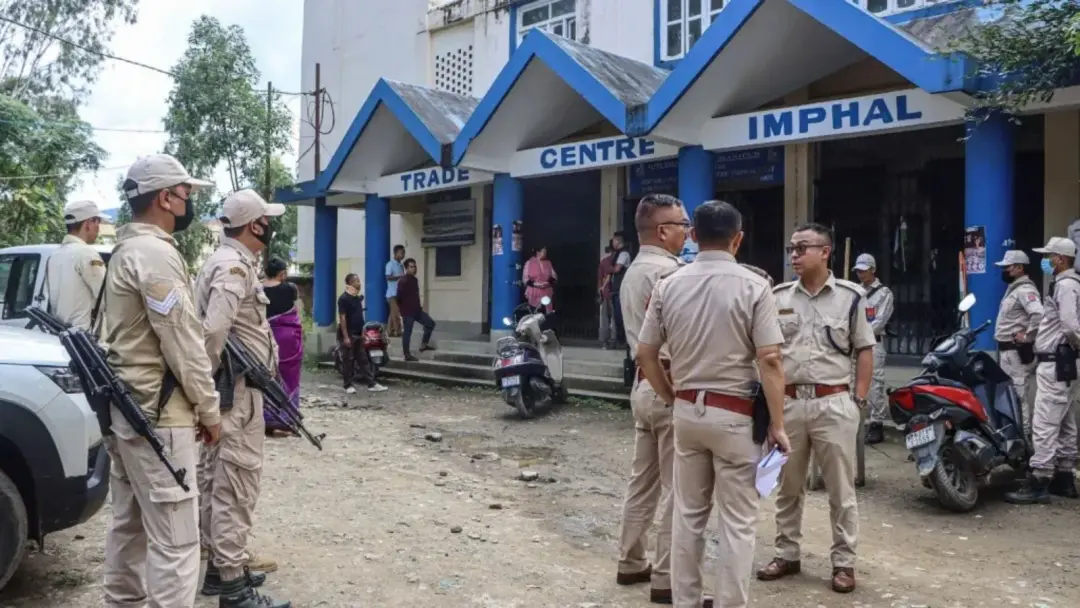
Two Kuki-Zo women shot dead in Manipur's Tamenglong district
Two Kuki-Zo women were shot dead by unidentified armed assailants around 3 pm Tuesday at Leijangphai near Muktokhal in Manipur's Tamenglong district, sources said. The deceased are Phalneichong Sitlhou, 76, and Kimjalhing Singson, 30, who were working on a farm. Officials, quoting locals, said kutcha farmhouses were set on fire and several villagers could not be traced. Four people were killed in two attacks on Sunday. The Kuki-Zo Council condemned the attacks.
Source
Indian Express — India · read the original report ↗
Desk check · some claims need care
What the desk checked (5)
- Two Kuki-Zo women, aged 76 and 30, were shot dead around 3 pm Tuesday at Leijangphai near Muktokhal, Tamenglong district. — Attributed to unnamed sources; names, ages and time appear in the source text.
- Kutcha farmhouses were set on fire and several villagers could not be traced after the attack. — Attributed to officials quoting locals; no independent confirmation in source.
- Four Kuki-Zo civilians, including two women, were killed on Sunday in two attacks at Longpi and Tollen. — Figure appears in source; no named official attribution given.
- The Kuki-Zo Council directed that no Kuki-Zo killed by armed Naga groups be buried, with bodies preserved in cold storage. — Direct quote attributed to the Kuki-Zo Council statement.
- Manipur's ethnic conflict since May 2023 has claimed hundreds of lives and left thousands homeless. — Background claim in source; no source or exact figures given.
Analysts’ view opinion
Stripped of the ethnic framing, this is a homicide investigation problem first: two civilians shot dead on farmland, houses burnt, and villagers unaccounted for, with the assailants described only as unidentified. The legal difficulty is compounded by the story's own detail that Leijangphai is territory contested between Jiribam and Tamenglong for jurisdiction — police jurisdiction is the threshold question that decides who registers the FIR, secures the scene and files the chargesheet. The state's constitutional obligation to protect life under Article 21 does not pause because a boundary is disputed, and the Kuki-Zo Council's demand for lawful action against armed groups is, in legal terms, a demand for ordinary criminal process to function.
- With assailants unidentified, the case turns entirely on investigation quality — scene preservation, ballistic and forensic evidence, and post-mortem findings, all of which degrade fast.
- The jurisdictional contest between Jiribam and Tamenglong over Leijangphai creates a real risk of delay or duplication in registering and investigating the case, a recurring weakness in border-area crime.
- Arson of dwellings and untraced villagers are separate offences and separate legal duties — missing persons in a conflict zone trigger obligations of search and accounting, not just a homicide file.
- The Council's directive that bodies not be buried but preserved sits in tension with the legal position that mortal remains are within the control of the investigating agency and next of kin after post-mortem; using remains as a form of protest can also complicate evidentiary and dignity-of-the-dead concerns recognised by Indian courts.
- Attribution matters legally: the Council names armed Naga groups while the neighbouring Naga village authority calls the perpetrators unidentified — until an investigation establishes identity, public attribution remains an allegation, not a finding.
What to watch — Watch which police station finally registers the FIR and whether the state moves the probe to a specialised or central agency, and whether any judicial or magisterial inquiry is ordered given the cluster of three attacks in one week.
The story does not establish who carried out the killings, any motive, whether arrests or an FIR have followed, or the fate of the villagers reported untraced.
Deep dive
Research brief · 8 facts · 5 dates · exam-readyThe brief
Context
Two Kuki-Zo women were shot dead by unidentified armed assailants in Leijangphai near Muktokhal in Manipur's Tamenglong district on Tuesday afternoon, two days after four Kuki-Zo civilians were killed in two separate attacks on the Kuki settlements of Longpi and Tollen in the same district. The Jiribam-Tamenglong region has seen three attacks in one week. The killings come against the backdrop of the ethnic conflict that erupted in Manipur in May 2023, which has claimed hundreds of lives and left thousands homeless. The Kuki-Zo Council has blamed armed Naga groups, while a Naga Village Authority has described the attackers as an unidentified group.
Key facts
- Two Kuki-Zo women were shot dead around 3 pm on Tuesday at Leijangphai near Muktokhal, Tamenglong district, Manipur.
- The deceased are Phalneichong (Chonga) Sitlhou, 76, wife of late Seidou Sitlhou, and Kimjalhing (Kimboi) Singson, 30, daughter of Paosei Singson.
- Both women were engaged in routine farm activities when they were ambushed by unidentified armed assailants.
- Singson had recently returned home after completing a nursing course to assist her parents in farming.
- Officials, quoting locals, said a few kutcha farmhouses were set on fire and several villagers could not be traced after the attack.
- On Sunday, four people, including two women, were killed and a few others injured in two separate attacks on the Kuki settlements of Longpi and Tollen in Tamenglong district.
- The Kuki-Zo Council directed that no Kuki-Zo killed by armed Naga groups shall be buried; remains are to be preserved in the nearest cold-storage facility until further directions.
- Leijangphai settlement has been contested between Jiribam and Tamenglong for jurisdiction; the conflict that began in May 2023 has claimed hundreds of lives.
Timeline
- May 2023Ethnic conflict erupts in Manipur, eventually claiming hundreds of lives and leaving thousands homeless.
- Sunday (this week)Four Kuki-Zo civilians, including two women, killed and a few injured in two separate attacks on Longpi and Tollen settlements in Tamenglong district.
- After Sunday's incidentNaga Village Authority of neighbouring Kaimai settlement calls the perpetrators an unidentified group and urges restraint and peace.
- Tuesday, around 3 pmTwo Kuki-Zo women shot dead at Leijangphai near Muktokhal; kutcha farmhouses burnt and several villagers untraceable.
- After Tuesday's attackKuki-Zo Council condemns the killings, seeks action from the Manipur government and the Centre, and bars burial of victims.
Who has a stake
- Kuki-Zo community of Tamenglong and Jiribam — Civilians in small remote settlements face repeated targeted killings, arson of farmhouses and displacement; several villagers untraced.
- Kuki-Zo Council (KZC) — Condemned the attacks as an 'alarming pattern' and issued a directive against burial of victims allegedly killed by armed Naga groups.
- Naga Village Authority, Kaimai settlement — Fears the attacks by an 'unidentified group' will create suspicion and division; urged restraint and reaffirmation of peace.
- Manipur government and the Centre — Urged by the KZC to protect vulnerable communities, bring perpetrators to justice and act firmly against armed groups attacking civilians.
- Families of the victims — Phalneichong Sitlhou's and Kimjalhing Singson's families lose members; remains to be kept in cold storage instead of being buried.
- Civil Society Organisations of the Kuki-Zo community — Directed by the KZC not to bury victims until further notice, making them instruments of the protest strategy.
Why it matters
The killing of a 76-year-old woman and a 30-year-old nursing graduate while farming shows that Manipur's conflict has spread beyond the Meitei-Kuki axis into Kuki-Naga friction in the Jiribam-Tamenglong belt, where even jurisdiction over settlements like Leijangphai is contested. Three attacks in a single week, arson of farmhouses and untraced villagers point to a breakdown of civilian security and the risk of fresh displacement. The Kuki-Zo Council's refusal to bury the dead signals that mortal remains are again becoming a bargaining tool with the state and the Centre.
UPSC angle
Prelims pointers
- Tamenglong and Jiribam are districts of Manipur; the Leijangphai settlement is contested between them for jurisdiction.
- Manipur's ethnic conflict erupted in May 2023 and has claimed hundreds of lives and left thousands homeless.
- Kuki-Zo Council (KZC) is the apex body that condemned the attacks and issued the no-burial directive.
- Longpi and Tollen are the Kuki settlements in Tamenglong district attacked on Sunday, killing four including two women.
- Victims of the Tuesday attack: Phalneichong Sitlhou (76) and Kimjalhing Singson (30), killed around 3 pm at Leijangphai near Muktokhal.
- Kaimai's Naga Village Authority termed the Sunday attackers an 'unidentified group' and appealed for restraint.
Mains framing
The killing of two Kuki-Zo women at Leijangphai, coming two days after four civilians were shot dead at Longpi and Tollen, illustrates how Manipur's ethnic conflict since May 2023 has widened into new fault lines in the Jiribam-Tamenglong belt, where unresolved questions of territorial jurisdiction over settlements overlap with community-based mistrust. The pattern described by the Kuki-Zo Council - civilians ambushed while farming, kutcha farmhouses burnt, villagers untraceable - suggests attempts to terrorise and drive communities from their settlements, while the Naga Village Authority of Kaimai's insistence that the perpetrators are an 'unidentified group' shows how easily attributions of blame can harden into inter-community suspicion. The Council's directive to preserve mortal remains in cold storage rather than bury them signals distrust of the state's response and converts grief into a form of protest. The way forward lies in prompt, impartial investigation and prosecution of the armed perpetrators, visible protection for small remote settlements and farmers, clarity on contested administrative jurisdiction, and confidence-building through community leaders and civil society organisations on both sides, as urged by the Naga Village Authority itself.
Key terms
- Kuki-Zo Council (KZC)
- Apex Kuki-Zo body that condemned the attacks, sought central and state action, and directed that victims not be buried.
- Kutcha farmhouse
- A temporary structure of non-permanent material used by farmers; several were set on fire by the assailants.
- Naga Village Authority
- Village-level Naga governing body; the Kaimai settlement's authority called the attackers unidentified and appealed for restraint.
- Civil Society Organisations (CSOs)
- Community-based bodies; Kuki-Zo CSOs were directed by the KZC not to bury victims until further notice.
- Leijangphai
- Remote Kuki settlement near Muktokhal where the two women were shot; its jurisdiction is contested by Jiribam and Tamenglong.
Practice questions
- Examine how contested administrative jurisdiction over settlements can aggravate ethnic violence, with reference to the recent killings in Manipur's Tamenglong-Jiribam region.
- Repeated targeting of unarmed civilians in Manipur raises questions about the state's obligation to protect vulnerable communities. Discuss the institutional and law-enforcement measures needed.
- What role can civil society organisations and traditional village authorities play in preventing the escalation of inter-community suspicion in Manipur? Illustrate with recent developments.
Grounded only in the source report — figures and dates are the source's, not inferred.