
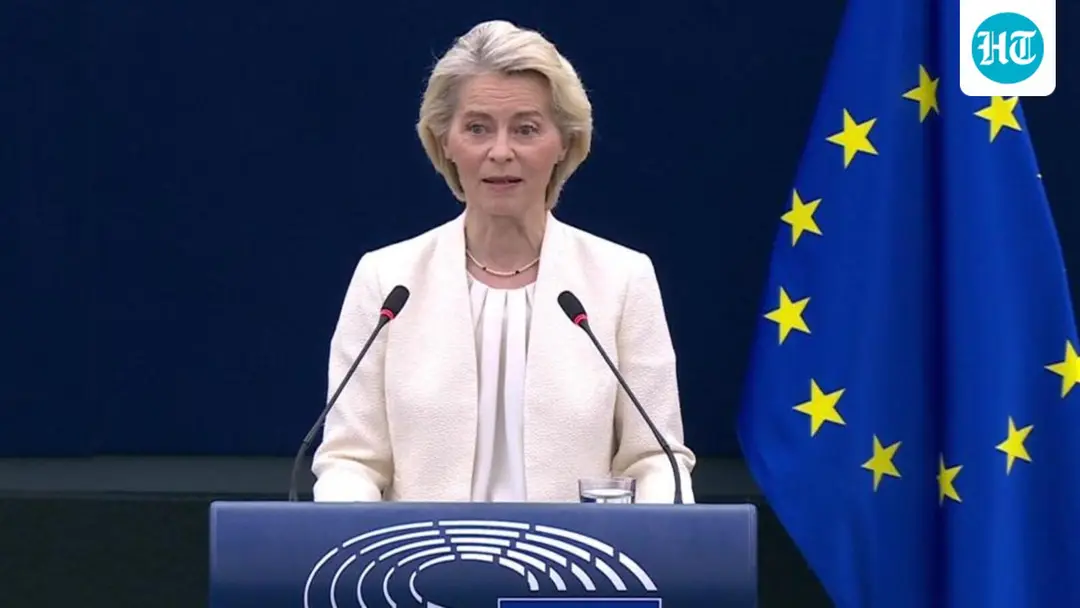
Von der Leyen flags AI, climate, China dependency in EU speech
European Commission president Ursula von der Leyen on Wednesday called it the "age of tipping points" in her State of the Union address, citing risks from artificial intelligence, climate change, social media and dependence on China. She proposed an EU Kids Act banning social media for under-13s, a European Security Council and a European Heatwave Plan. She said the trade deficit with China had reached €1 billion a day, and invited Canada to become the EU's first "associate member".
Source
Hindustan Times — India · read the original report ↗
Desk check · compared with the source
What the desk checked (5)
- Von der Leyen called the present time the "age of tipping points" and flagged AI, climate change, social media and dependence on China. — Directly attributed to her State of the Union address in the source.
- The proposed EU Kids Act would ban social media for children under 13, restrict personal accounts until 15 and require safe designs for ages 15-18. — Attributed to von der Leyen; source notes it still needs European Parliament and member state approval.
- EU's trade deficit with China is €1 billion a day; Europe is over 80% dependent on China for many critical raw materials and 90% for some rare earths. — Figures quoted from von der Leyen in the source; not independently verified here.
- Wildfires burnt 660,000 hectares and destroyed about 12 million tonnes of crops this year. — Figures appear in the source, attributed to von der Leyen.
- Von der Leyen invited Canada to become the EU's first "associate member". — Attributed to her speech; source states the practical meaning was not immediately clear.
Analysts’ view opinion
Von der Leyen's address reads less like an economic agenda and more like a security document — an attempt to fold hybrid attacks, energy and raw-material dependence and digital harms into a single strategic frame. By attributing the Leipzig drone incident to Russia and proposing an Article 4-style protocol of Europe's own plus a European Security Council, she is signalling that Europe wants greater autonomous decision-making capacity at a time of doubt over American guarantees. Putting the €1 billion-a-day China trade deficit and the 80-90% dependence on critical raw materials at the centre of the speech openly reframes economic dependence as a national-security problem.
- Europe's own "Article 4" is best read not as a rival to NATO but as an attempt to fill the gap on threats that fall below armed aggression — though it remains only a proposal needing member-state buy-in.
- The reference to a leaders' format including Ukraine, the UK, Norway and Canada points to security partnerships stretching beyond formal EU membership boundaries.
- The offer of "associate member" status to Canada lands amid Ottawa's trade conflict with Washington; framed as "not against anyone", it still reads as diversification of partnerships, with its legal shape left undefined.
- Listing defence and space alongside health, transport, agri-food and manufacturing as priority AI sectors shows technology policy and military capability-building converging.
- A new European Corporation on Critical Raw Materials and stockpiling is aimed squarely at reducing Chinese leverage, and a response or counter-move from Beijing cannot be ruled out.
What to watch — Watch how fast and in what form these proposals — the security council, the Kids Act, the raw-materials corporation — move through member states and the European Parliament, and whether the "rebalancing" talks with China produce results.
This is a statement of intent delivered in a speech, not adopted policy: the story does not establish funding, timelines, legal form, what Canadian "associate membership" would actually mean, or independent verification of the attribution of the Leipzig incident.
Deep dive
Research brief · 8 facts · 8 dates · exam-readyThe brief
Context
The European Commission president delivers a State of the Union (SoTU) address during the European Parliament's first plenary session in September, setting out the bloc's agenda for the year ahead. Modelled on the American practice, it is not mandated but works as a key communication tool. On Wednesday, Ursula von der Leyen used her nearly 90-minute speech — her fifth as EU chief and second since her 2024 re-election — to describe an "age of tipping points" driven by AI, climate change, social media harms, Russia's war on Ukraine and dependence on China. She announced or trailed an EU Kids Act, a European Security Council, a European Heatwave Plan and closer ties with Canada.
Key facts
- Von der Leyen said the EU's trade deficit with China has reached €1 billion a day, calling it a "tipping point".
- Europe is more than 80% dependent on China for many critical raw materials and 90% for some rare earths, she said.
- The proposed EU Kids Act would ban social media for children under 13, restrict personal accounts until 15, and require "safe designs" for ages 15-18, with the burden of proof on Big Tech.
- She said Europe is warming at double the global rate; this year's wildfires burnt 660,000 hectares and destroyed some 12 million tonnes of crops.
- The EU goal is to double the share of electricity by 2040 to cut energy dependence and high structural energy prices.
- She called for Europe's own "Article 4" — modelled on NATO's mechanism letting any of its 32 members call an emergency security meeting — and for a European Security Council to become reality.
- Industrial AI focus will be on five high-value sectors: health, transport, agri-food, advanced manufacturing, and defence and space, with initiatives announced in November.
- Canada was invited to become the EU's first "associate member"; Prime Minister Mark Carney attended as guest of honour.
Timeline
- 1980s onwardsIdea of a European Security Council proposed in various forms; revived by Russia's war on Ukraine and Trump's criticism of NATO.
- 2024Von der Leyen re-elected as European Commission president.
- August (this year)Attempted drone attack at Leipzig airport, Germany, which von der Leyen blamed on Russia as "latest proof" of mounting threats.
- Summer (this year)"Summer of truth": massive wildfires across several EU countries burn 660,000 hectares and destroy about 12 million tonnes of crops.
- WednesdayVon der Leyen delivers her fifth State of the Union address, flagging AI, climate, social media and China dependence.
- Thursday (day after speech)Commission to put forward the EU Kids Act with age-tailored online protections.
- OctoberNew framework for climate resilience to be presented, identifying 100 of Europe's most vulnerable territories.
- November"Game-changing" industrial AI initiatives to be announced across five priority sectors.
Who has a stake
- European Commission / Ursula von der Leyen — Must convert speech pledges — EU Kids Act, heatwave plan, raw materials corporation — into legislation and secure political backing.
- European Parliament and EU member states — The social media ban and other proposals must clear them; entry into force is not expected in the near future.
- Big Tech platforms — Would bear the burden of proof to show their services are safe for children; wider Digital Services Act framework due in autumn.
- China — Target of EU efforts to rebalance a €1 billion-a-day trade deficit and to cut dependence on critical raw materials and rare earths.
- Canada (PM Mark Carney) — Offered first-ever EU "associate member" status as it diversifies partnerships amid its trade war with the US.
- Russia and Ukraine — Russia blamed for hybrid threats such as the Leipzig drone incident; Ukraine named among partners for a European security format.
- European children and families — Age-based social media limits aimed at addictive features, extreme content and AI-generated sexualised images of girls.
Why it matters
The speech signals a shift in the EU's self-definition: from a trading bloc to one seeking security autonomy, digital sovereignty over Big Tech, and de-risking from China on critical raw materials. For India and other partners, an EU that wants to stockpile rare earths, electrify by 2040 and build new "associate" partnerships like the one offered to Canada reshapes global supply chains and diplomatic alignments. The child social media ban, if enacted, could set a global regulatory template much as EU privacy and platform rules have.
UPSC angle
Prelims pointers
- The EU State of the Union address is delivered by the European Commission president at the first September plenary session; not mandated, modelled on US practice.
- NATO Article 4 allows any of its 32 members to call an emergency meeting on security threats; Article 5 treats an attack on one as an attack on all.
- Proposed EU Kids Act: social media ban under 13, restricted personal accounts till 15, "safe design" rules for 15-18.
- EU trade deficit with China: €1 billion a day; EU is over 80% dependent on China for many critical raw materials, 90% for some rare earths.
- Announced bodies/plans: European Security Council, European Corporation on Critical Raw Materials, European Heatwave Plan, European Firefighting Fleet.
- EU target: double the share of electricity by 2040; climate resilience framework in October to identify 100 most vulnerable territories.
Mains framing
Von der Leyen's \"age of tipping points\" framing bundles four structural vulnerabilities of the European Union: hybrid security threats below the threshold of armed aggression (illustrated by the Leipzig drone incident blamed on Russia), climate exposure as Europe warms at twice the global rate, the societal costs of unregulated digital platforms and AI, and economic over-dependence on China. The proposed responses are institutional rather than merely regulatory — a European Security Council and a Europe-specific "Article 4" protocol, a European Corporation on Critical Raw Materials for stockpiling inputs for chips, batteries, EVs and defence, a European Heatwave Plan and firefighting fleet, and an October climate resilience framework mapping 100 vulnerable territories. The constraints are equally clear: the EU Kids Act must still pass the European Parliament and member states and will not take effect soon; rebalancing a €1 billion-a-day deficit with China depends on Beijing's cooperation; and the offer of "associate membership" to Canada remains undefined. The way forward the speech implies is de-risking through diversification and electrification (doubling the electricity share by 2040), shifting the burden of proof onto Big Tech, and channelling industrial AI into five high-value sectors — but delivery, not announcement, will be the test.
Key terms
- State of the Union (SoTU) address
- Annual speech by the European Commission president at the first September plenary, setting the bloc's agenda; not legally mandated.
- NATO Article 4
- Provision letting any of NATO's 32 members convene an emergency consultation when its security is threatened; precedes Article 5's collective defence clause.
- EU Kids Act
- Proposed Commission law with age-tailored online protections: no social media under 13, restricted accounts to 15, safe design for 15-18.
- Digital Services Act (DSA)
- EU platform regulation framework; a wider framework under it was promised for autumn.
- European Corporation on Critical Raw Materials
- Proposed EU body to obtain and stockpile critical raw materials for EVs, chips, batteries, clean tech and defence.
- Associate member
- New, undefined status offered to Canada, which cannot join the EU, to signal the highest possible level of partnership.
Practice questions
- Examine how hybrid threats that fall "below armed aggression" challenge existing collective security mechanisms, with reference to the EU's proposed European Security Council and its own "Article 4".
- "De-risking is not decoupling." Critically assess the EU's strategy to reduce dependence on China for critical raw materials and rare earths, and its implications for countries like India.
- Should states impose age-based bans on children's access to social media? Discuss with reference to the proposed EU Kids Act and the shifting of the burden of proof onto platforms.
Grounded only in the source report — figures and dates are the source's, not inferred.