
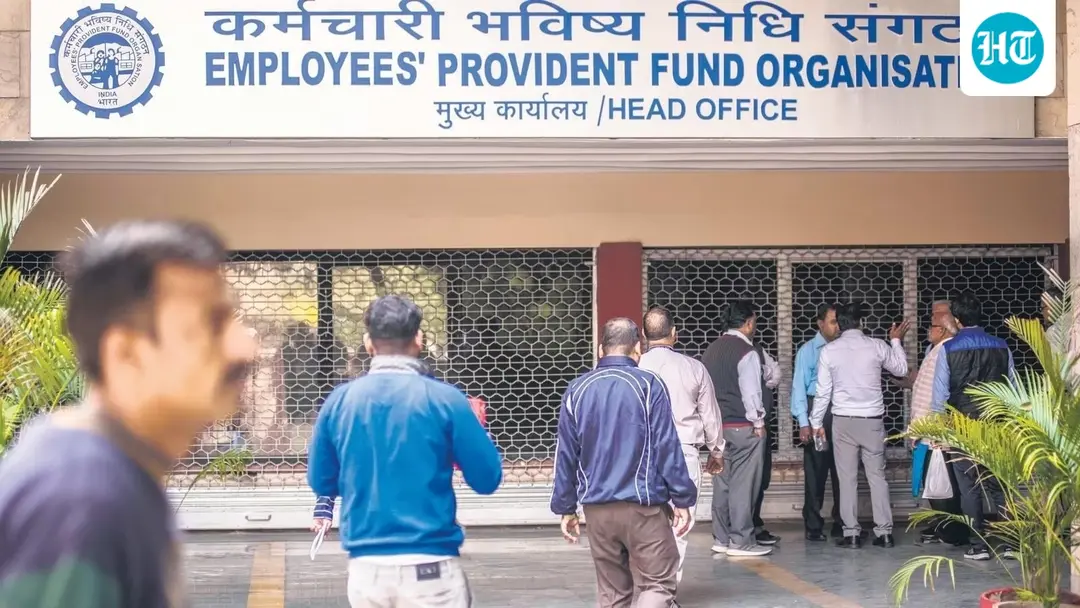
EPFO wage ceiling raised to ₹25,000 from ₹15,000
The government on Wednesday approved a proposal to raise the wage ceiling for mandatory Employees' Provident Fund Organisation coverage from ₹15,000 to ₹25,000 a month. More than 51 lakh additional employees are expected to come under mandatory coverage, gaining provident fund savings, pension under EPS and insurance under EDLI, a government release said. The ceiling was unchanged from 2004 to 2014 before being set at ₹15,000 in September 2014. Annual outgo is estimated at about ₹11,339 crore, and ₹56,696 crore over five years.
Source
Hindustan Times — India · read the original report ↗
Desk check · compared with the source
What the desk checked (4)
- Government approved raising the EPFO mandatory coverage wage ceiling from ₹15,000 to ₹25,000 a month on Wednesday. — Attributed to a government release in the source; date given only as 'Wednesday', no calendar date provided.
- More than 51 lakh additional employees are expected to come under mandatory EPFO coverage. — Figure appears in the source and is attributed to the government release; it is an estimate, not an actual count.
- The ceiling stayed unchanged between 2004 and 2014 before being raised to ₹15,000 in September 2014. — Stated in the source without separate sourcing; internally consistent with the rest of the report.
- Annual government outgo estimated at about ₹11,339 crore against existing budgetary support of around ₹10,250 crore; about ₹56,696 crore over five years. — Figures appear in the source, attributed to the government release; presented as estimates.
Analysts’ view opinion
Raising the EPFO wage ceiling after eleven years is not merely an administrative or fiscal decision — it is a clear political signal aimed at lower-middle-income, newly formalised urban and semi-urban workers. By framing the move as extending provident fund, pension and insurance cover to over 51 lakh additional employees, the government is reinforcing its 'welfare plus formalisation' narrative. The release's pointed reminder that the ceiling stayed unchanged between 2004 and 2014 is not incidental; it hands the ruling side a ready-made comparison with the previous dispensation.
- The explicit mention of a decade of no change before 2014 is politically useful framing that invites contrast with the earlier government.
- The beneficiaries are salaried and largely urban voters, allowing the measure to be sold as an entitlement-based social security gain rather than a giveaway.
- The estimated ₹11,339 crore annual and ₹56,696 crore five-year outgo gives the opposition an opening to raise fiscal-prudence questions.
- Conversely, a higher mandatory deduction and added employer cost could fuel a 'lower take-home pay' critique that has political traction among salaried voters.
- Trade unions are likely to treat this as a partial win while continuing to press for wider coverage and higher benefits.
What to watch — Watch the effective date and any clarity on employer contributions — the government's messaging push and the response from opposition parties and industry bodies will hinge on those details.
The story does not establish the implementation date, changes to employee-employer contribution shares, state-wise beneficiary spread, or reactions from any political party; this is analysis, not reporting.
Deep dive
Research brief · 8 facts · 3 dates · exam-readyThe brief
Context
The Employees' Provident Fund Organisation (EPFO) administers statutory social security for organised-sector workers, with mandatory coverage applying to employees earning up to a notified monthly wage ceiling. That ceiling stood unchanged between 2004 and 2014, and was raised to ₹15,000 in September 2014. On Wednesday the government approved raising it to ₹25,000 a month, citing sustained wage growth, rising incomes and the expansion of formal employment since then. The change brings workers earning between ₹15,000 and ₹25,000 a month into the statutory framework covering provident fund, pension and insurance benefits.
Key facts
- Government approved raising the EPFO wage ceiling for mandatory coverage from ₹15,000 to ₹25,000 per month on Wednesday.
- More than 51 lakh additional employees are expected to come under mandatory EPFO coverage as a result.
- The wage ceiling remained unchanged between 2004 and 2014 before being raised to ₹15,000 in September 2014.
- Newly covered employees get provident fund savings, pension under the Employees' Pension Scheme (EPS) and insurance under the Employees' Deposit Linked Insurance Scheme (EDLI), subject to applicable provisions.
- Annual government outgo after the enhancement is estimated at about ₹11,339 crore.
- Existing annual budgetary support is around ₹10,250 crore.
- Estimated expenditure over five years is about ₹56,696 crore, per the government release.
- The government cited sustained wage growth, rising incomes and expansion of formal employment as reasons for the revision.
Timeline
- 2004 to 2014EPFO wage ceiling for mandatory coverage remained unchanged.
- September 2014Wage ceiling raised to ₹15,000 per month.
- Wednesday (date not stated in the source)Government approves raising the ceiling to ₹25,000 per month, expected to cover over 51 lakh additional employees.
Who has a stake
- Employees earning ₹15,000–₹25,000 a month — Over 51 lakh workers gain mandatory access to provident fund savings, EPS pension and EDLI insurance.
- EPFO — Wider membership base and larger administrative and compliance responsibility under the revised ceiling.
- Central government / exchequer — Annual outgo rises to about ₹11,339 crore from around ₹10,250 crore; about ₹56,696 crore over five years.
- Employers of newly covered workers — Statutory contribution obligations extend to employees in the ₹15,000–₹25,000 wage band.
Why it matters
Raising the ceiling after more than a decade extends statutory retirement, pension and insurance cover to over 51 lakh workers who were previously outside mandatory EPFO protection. The government frames it as a push towards formalisation of employment and portable social security, but it also increases budgetary support from about ₹10,250 crore to roughly ₹11,339 crore a year.
UPSC angle
Prelims pointers
- EPFO wage ceiling for mandatory coverage raised from ₹15,000 to ₹25,000 per month.
- Previous revision: ceiling set at ₹15,000 in September 2014; unchanged from 2004 to 2014.
- Over 51 lakh additional employees expected to be covered.
- Benefits covered: provident fund, pension under EPS, insurance under EDLI.
- Annual outgo estimated at about ₹11,339 crore against existing support of around ₹10,250 crore.
- Five-year estimated expenditure: about ₹56,696 crore.
Mains framing
India's organised-sector social security architecture rests on a statutory wage ceiling that determines which employees must be enrolled with the EPFO; because the ceiling was last revised in September 2014 (and was static from 2004 to 2014), nominal wage growth progressively pushed workers out of mandatory coverage even as formal employment expanded. The government's decision to raise the ceiling to ₹25,000 a month responds to this drift, bringing more than 51 lakh employees in the ₹15,000–₹25,000 band into the statutory framework with provident fund savings, EPS pension and EDLI insurance, and is presented as a step towards formalisation, better long-term retirement security and portable statutory benefits. The trade-offs are fiscal and administrative: annual government outgo is estimated to rise to about ₹11,339 crore from around ₹10,250 crore, with about ₹56,696 crore over five years, alongside larger compliance obligations for employers and a bigger membership base for the EPFO to service. The way forward, on the government's own stated logic, lies in periodic and predictable review of the ceiling in line with wage growth, along with efficient delivery so that expanded coverage translates into actual, portable benefits for newly enrolled workers.
Key terms
- EPFO
- Employees' Provident Fund Organisation, the body administering statutory provident fund, pension and insurance benefits for covered employees.
- Wage ceiling
- The monthly wage threshold up to which EPFO coverage is mandatory for an employee; now raised to ₹25,000 from ₹15,000.
- EPS
- Employees' Pension Scheme, which provides pension benefits to employees covered under the EPFO framework.
- EDLI
- Employees' Deposit Linked Insurance Scheme, which gives insurance protection to EPFO-covered employees.
- Formalisation of employment
- Bringing more workers within statutory frameworks such as EPFO so they receive recorded, portable social security benefits.
Practice questions
- Discuss how periodic revision of the statutory wage ceiling under the EPFO affects the coverage of social security in India's organised sector.
- The EPFO wage ceiling has been raised from ₹15,000 to ₹25,000 a month. Examine the fiscal and administrative implications of this decision.
- To what extent can expanding mandatory EPFO coverage drive formalisation of employment in India? Substantiate with the recent revision.
Grounded only in the source report — figures and dates are the source's, not inferred.