
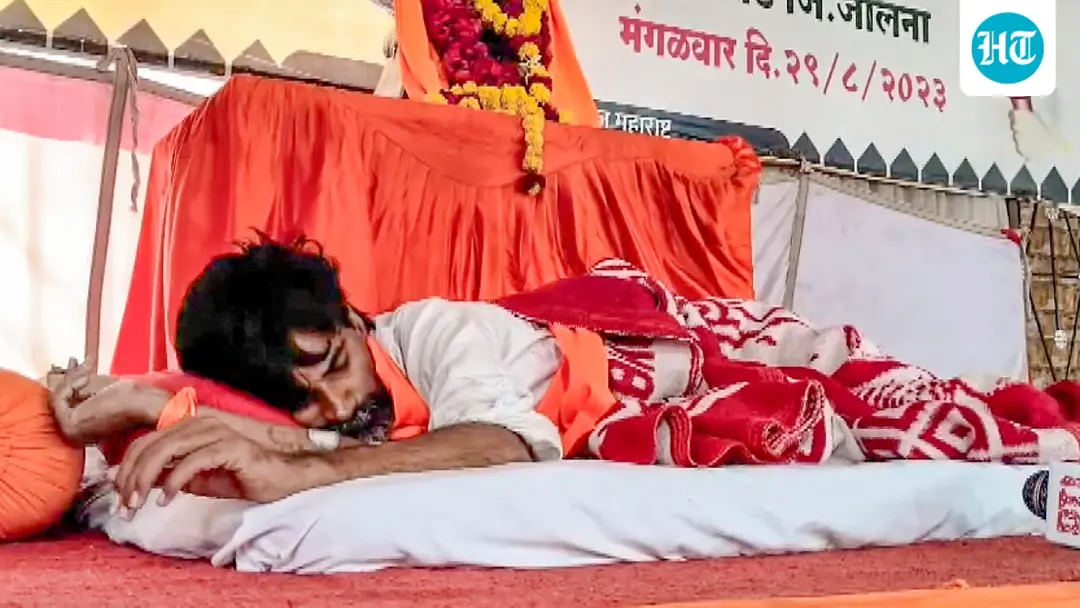
Jarange says Mumbai march may be called off over health
Maratha quota activist Manoj Jarange said on Wednesday, the 19th day of his hunger strike, that his march to Mumbai might be cancelled due to deteriorating health. He reached Patoda in Beed district about 14 hours after leaving Antarwali Sarati village in Jalna district. Beed District Civil Surgeon Dr Satishkumar Solanke said Jarange's blood pressure and sugar levels had plummeted, he had acute dehydration and urgently needed ICU hospitalisation. Mumbai Police denied permission for an Azad Maidan protest, citing law and order during the Ganesh festival.
Source
Hindustan Times — India · read the original report ↗
Desk check · compared with the source
What the desk checked (5)
- Jarange's hunger strike entered its 19th day on Wednesday and he reached Patoda in Beed district around 11 am. — Stated in source as reported fact; timeline appears internally consistent with the described 14-hour journey from Antarwali Sarati.
- His blood pressure and blood sugar have plummeted, he has acute dehydration, is minimally responsive and needs urgent ICU hospitalisation. — Attributed to Beed District Civil Surgeon Dr Satishkumar Solanke, who examined him in Patoda.
- Mumbai Police denied permission for the Azad Maidan protest citing law and order concerns during the Ganesh festival. — Attributed to police in the source; no order document cited.
- The government accepted 12 of 13 'legally valid' demands raised by Maratha protesters. — Attributed to Chief Minister Devendra Fadnavis; figure appears in source without independent detail.
- Last year's Azad Maidan stir was called off on September 2, 2025 after six of eight demands were accepted. — Background figure and date appear in the source; no separate sourcing given.
Analysts’ view opinion
Jarange's deteriorating health turns the Maratha quota agitation into its most politically delicate phase yet. Having forced concessions with his Azad Maidan fast last year, he now faces a BJP-led government that has chosen a firmer line — the Mumbai Police refusal citing Ganesh festival law-and-order concerns is the clearest signal of that. That leaves the Fadnavis government with a two-sided risk: yielding invites a repeat playbook, while holding firm could carry a political cost if his condition worsens.
- The real constraint looks less like the 400-km, 14-hour journey and more like a strategy of blunting the movement's force by denying it a mass stage in Mumbai.
- Last year the government accepted six of eight demands; this time it says 12 of 13 "legally valid" demands are met — an attempt to set the terms of the debate itself.
- Jarange's appeal for supporters not to follow him may be a way to keep the moral high ground while crowd management becomes harder.
- The demand for Maratha inclusion in the OBC quota via Kunbi genealogy pits two vote blocs against each other, making it a delicate balance for any ruling party.
- Even if the march is called off, the agitation is unlikely to end; a health crisis can amplify sympathy and hand the opposition a ready political argument.
What to watch — Watch whether Jarange accepts ICU care and whether the government opens a negotiating channel — those two outcomes will shape Maratha politics in the coming weeks.
The story does not establish what talks, if any, are under way between the government and Jarange, nor the next concrete step on the demands; only the official medical assessment of his condition is on record here.
Deep dive
Research brief · 8 facts · 5 dates · exam-readyThe brief
Context
Maratha quota activist Manoj Jarange has been on an indefinite hunger strike at Antarwali Sarati village in Jalna district, demanding reservation for Marathas within the OBC quota on the basis of Kunbi caste genealogy. He set out on Tuesday in a convoy of cars for Mumbai, over 400 km away, after Mumbai Police denied permission for a protest at Azad Maidan citing law and order during the Ganesh festival. On Wednesday, the 19th day of his fast, doctors said his condition was critical and needed ICU admission, and Jarange himself said the Mumbai tour might be cancelled. Last year a similar fast at Azad Maidan had brought south Mumbai to a standstill before being called off on September 2, 2025.
Key facts
- Jarange's hunger strike entered its 19th day on Wednesday; he is 44 years old.
- He reached Patoda in Beed district around 11 am, nearly 14 hours after leaving Antarwali Sarati village in Jalna district, more than 400 km from Mumbai.
- Beed District Civil Surgeon Dr Satishkumar Solanke said Jarange's blood pressure and blood sugar levels had plummeted severely, he had acute dehydration and was minimally responsive.
- Doctors administered intravenous (IV) fluids but said saline support alone would not make him fit to travel; ICU hospitalisation is urgently required.
- Jarange had no urine output since morning, raising risk of electrolyte imbalance; urine analysis reports were awaited.
- Mumbai Police denied permission for the Azad Maidan protest, citing law and order concerns amid the Ganesh festival.
- Jarange's 2025 stir was called off on September 2, 2025, after the government accepted six of his eight demands and began steps for Kunbi classification certificates.
- CM Devendra Fadnavis said the government had accepted 12 of the 13 'legally valid' demands raised by Maratha protesters.
Timeline
- September 2, 2025Jarange's Azad Maidan hunger strike called off after government accepted six of eight demands and initiated Kunbi classification certificate steps.
- Monday, September 14, 2026Jarange rests on the 16th day of his indefinite fast at Antarwali Sarati village, Jalna district.
- TuesdayDespite police denial of permission, Jarange sets out for Mumbai in a convoy of cars; CM Fadnavis says law and order is the police's responsibility and questions agitating during Ganesh festival.
- Wednesday, 19th day of fast, around 11 amJarange reaches Patoda in Beed district; medical team finds his condition critical; he says the Mumbai tour may be cancelled.
- September 19 (scheduled)Jarange was to reach Mumbai after passing through Ahilyanagar, Pune and Khopoli in Raigad district.
Who has a stake
- Manoj Jarange — His life and health are at immediate risk on the 19th day of his fast; he says reservation matters more than the march.
- Maratha community / Jarange's supporters — Seeking reservation in the OBC quota via Kunbi caste genealogy; asked by Jarange not to follow him from Patoda.
- Maharashtra government (BJP-led) and CM Devendra Fadnavis — Has taken a stern approach, says 12 of 13 legally valid demands accepted, and questions protest timing during Ganesh festival.
- Mumbai Police — Denied Azad Maidan permission on law and order grounds during the Ganesh festival; must manage any entry into the city.
- Beed district health administration / Dr Satishkumar Solanke — Medically responsible for a critically ill activist refusing full treatment; recommending urgent ICU care.
- OBC communities — Inclusion of Marathas in the OBC quota would affect the existing reservation pool (implicit in the demand).
Why it matters
The Maratha quota agitation combines a live constitutional question on reservation with an immediate humanitarian risk, as a critically ill protester travels 400 km toward a city where police have refused permission to assemble. How the state balances the right to protest, public order during a major festival, and its duty of care over a fasting activist will shape both the quota debate and precedent for handling mass agitations.
UPSC angle
Prelims pointers
- Manoj Jarange leads the Maratha quota agitation from Antarwali Sarati village, Jalna district, Maharashtra.
- Core demand: reservation for Marathas within the OBC quota on the basis of Kunbi caste genealogy.
- Azad Maidan in south Mumbai is the designated protest site for which police permission was denied.
- Jarange's earlier stir was called off on September 2, 2025, after six of eight demands were accepted.
- CM Devendra Fadnavis says 12 of 13 'legally valid' Maratha demands have been accepted.
- Electrolyte imbalance: abnormal blood levels of sodium, potassium, calcium or magnesium; causes weakness and muscle spasms.
Mains framing
The Maratha reservation agitation illustrates the tension between competitive claims to affirmative action and the limits of the existing quota architecture: Jarange demands that Marathas with Kunbi caste genealogy be brought within the OBC quota, a route that seeks recognition of an existing backward-class identity rather than a fresh category. The government's response has moved from concession in 2025 (six of eight demands accepted, Kunbi classification certificates initiated) to a stern posture now, with Mumbai Police denying Azad Maidan permission on law and order grounds during the Ganesh festival and the Chief Minister asserting that 12 of 13 legally valid demands stand accepted. This raises three issues for analysis: the constitutionality and administrative feasibility of genealogy-based caste classification; the reasonable-restriction test on the right to assemble when a festival and a 400-km march converge; and the state's duty of care towards a hunger striker whom doctors say needs ICU admission, where medical intervention itself becomes politically contested, as Jarange's own remarks about treatment making the government "carefree" show. A way forward suggested by the source's own facts lies in time-bound, verifiable implementation of accepted demands and documented Kunbi classification, alongside negotiated protest venues and continuous medical supervision, so that a public-health emergency is not made the arbiter of a policy dispute.
Key terms
- Kunbi
- An agrarian caste recognised as OBC; Marathas with Kunbi caste genealogy seek reservation within the OBC quota on that basis.
- OBC quota
- Reservation for Other Backward Classes, the category into which Jarange wants Marathas with Kunbi lineage included.
- Azad Maidan
- South Mumbai protest ground where Jarange's 2025 fast was held; police denied permission for the current protest.
- Kunbi classification certificate
- Document certifying Kunbi caste status; the government initiated steps for issuing these when the 2025 stir was called off.
- Electrolyte imbalance
- Too-high or too-low blood levels of sodium, potassium, calcium or magnesium, causing weakness and muscle spasms and serious complications if untreated.
- District Civil Surgeon
- Senior government medical officer of a district; Dr Satishkumar Solanke of Beed led the team that examined Jarange.
Practice questions
- Examine the constitutional and administrative challenges in extending reservation to Marathas within the OBC quota through Kunbi caste genealogy.
- Discuss how the state should balance the right to peaceful assembly with public order concerns, using the denial of permission for the Azad Maidan protest as a case study.
- What are the ethical dilemmas for the administration and medical professionals when a protest leader on hunger strike refuses hospitalisation? Discuss with reference to the state's duty of care.
Grounded only in the source report — figures and dates are the source's, not inferred.