
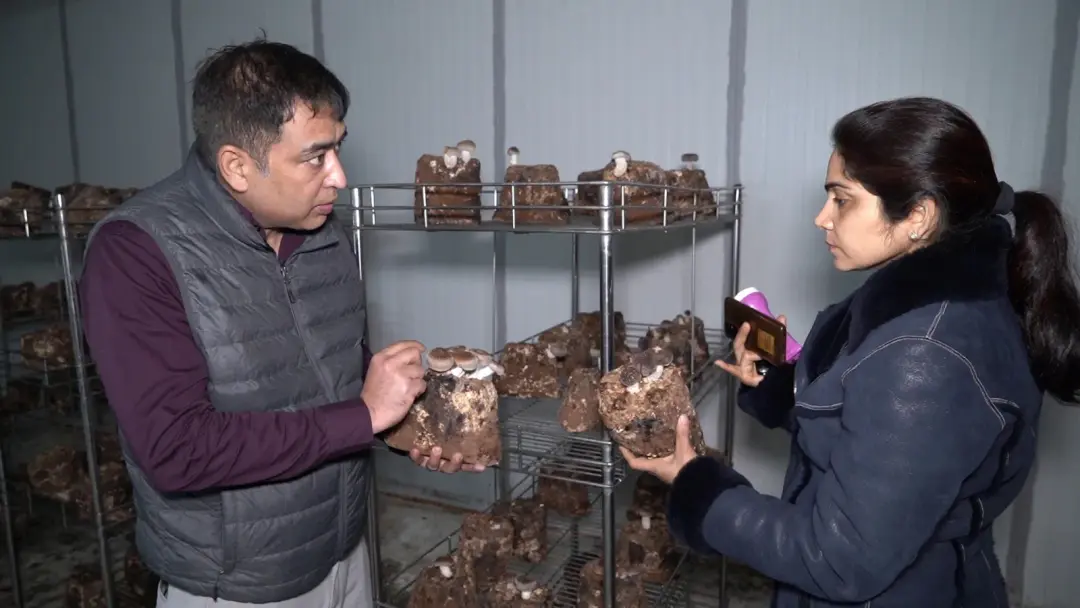
Four friends quit corporate careers for mushrooms, build Rs 15-crore business
Four childhood friends left corporate careers to grow mushrooms, building a business with a Rs 15-crore turnover. Engineers Naveen Patwal and Amit Kumar Sharma began in 2006, buying an acre in Roorkee and applying for a Rs 1.35 crore loan. IIT-Kharagpur graduate Poonam Sharma quit a manager's job at SIDBI and IIM Calcutta graduate Sunny Gupta joined in 2013. During Covid, 100 tonnes were discarded, a loss Naveen estimates at Rs 1.5 crore. They launched direct-to-consumer brand Planet Mushroom in 2022.
Source
Indian Express — India · read the original report ↗
Desk check · compared with the source
What the desk checked (5)
- The four friends' mushroom business now has a turnover of Rs 15 crore. — Figure appears in source; attributed to the report, not to independently audited data.
- Naveen Patwal and Amit Kumar Sharma co-founded the venture in 2006 and applied for a Rs 1.35 crore bank loan. — Attributed to Naveen Patwal in quoted remarks.
- During Covid, they discarded at least 100 tonnes of mushrooms, an estimated Rs 1.5 crore loss. — Explicitly described in source as Naveen's own estimate.
- Poonam Sharma, an IIT-Kharagpur graduate, quit a manager's job at SIDBI to join in 2013; IIM Calcutta graduate Sunny Gupta joined after four years at Bank of New York Mellon. — Biographical details stated in source; no documentary corroboration given.
- Production is still 90 per cent button mushrooms and mostly wholesale; direct-to-consumer brand Planet Mushroom launched in 2022. — Figure and dates appear in source, based on founders' account.
Analysts’ view opinion
Beyond the feel-good arc, this is a useful case study in how capital-intensive and risk-loaded protected-environment farming really is. A Rs 1.35 crore loan against one acre bought in 2006, and production stabilising only in 2011, points to a gestation period closer to a manufacturing unit than to conventional cropping. The decisive economic pivot came after the Covid shock: a Rs 1.5 crore loss from wholesale dependence pushed them in 2022 into a direct-to-consumer brand, essentially an attempt to capture more of the value chain's margin.
- A Rs 1.35 crore loan, AC panels and refrigerated transport show mushroom farming behaves less like farming and more like a high-fixed-cost production line.
- Cold chain is the recurring cost centre — car ACs, then reefer trucks, now ice packs and coolers — and in a perishable business logistics eats directly into margin.
- Dumping at least 100 tonnes for an estimated Rs 1.5 crore loss, partly because mushrooms were not classified under vegetables or farm commodities and trucks were blocked, shows how a classification gap turns into a balance-sheet hit.
- The 2022 launch of Planet Mushroom plus vendor codes with major five-star properties in metros is a pricing-power play: less dependence on adhatis and wholesale price swings.
- Yet 90 per cent of output is still button mushrooms and the bulk of business remains wholesale, so the shift to higher-value specialty varieties is still early-stage.
What to watch — Watch how fast the specialty-mushroom share and direct-to-consumer sales grow — that is what will decide whether this becomes margin-led growth rather than just volume.
The story gives turnover of Rs 15 crore but does not establish profitability, current debt levels, employment generated or return on the original investment.
Deep dive
Research brief · 8 facts · 8 dates · exam-readyThe brief
Context
Four childhood friends with elite engineering, IIT and IIM credentials — Naveen Patwal, Amit Kumar Sharma, Poonam Sharma and Sunny Gupta — gave up conventional corporate careers to build a mushroom-growing business, partly to keep their friendship intact despite separate career paths. Started in 2006 with an acre of land in Roorkee and a Rs 1.35 crore bank loan application, the venture stabilised production only in 2011 after repeated failed batches. Covid wiped out demand and forced them to discard at least 100 tonnes of mushrooms, pushing them to sell directly to consumers. In 2022 they launched Planet Mushroom, a Welkins brand, and the business now has a Rs 15-crore turnover.
Key facts
- The business today has a turnover of Rs 15 crore.
- Naveen Patwal and Amit Kumar Sharma co-founded the venture in 2006; Naveen was then 27, with a BTech in Computer Science from CITM Faridabad, Amit a mechanical engineering graduate from Jamia Millia Islamia.
- They used all their savings to buy an acre of land in Roorkee and applied for a bank loan of Rs 1.35 crore.
- A man in Dehradun's Selaqui warned them mushroom growing had a '90 per cent chance of failure'.
- Production stabilised in 2011 after many failed batches, including one where a bad batch of fermented compost yielded zero mushrooms.
- Poonam Sharma, an IIT-Kharagpur graduate, quit as a manager at the Small Industries Development Bank of India (SIDBI) and joined in 2013; she married Naveen in 2012.
- Sunny Gupta graduated from IIM Calcutta in 2009 and worked as a product management consultant with The Bank of New York Mellon in Chennai and Jersey City for four years before joining.
- During Covid, production had peaked at 4-5 tonnes a day; at least 100 tonnes had to be discarded, which Naveen estimates as a Rs 1.5 crore loss.
Timeline
- 2000Sunny Gupta meets Naveen and Amit through a mutual friend.
- 2006Naveen and Amit visit Selaqui, Dehradun looking for business options, choose mushroom farming, buy an acre in Roorkee and apply for a Rs 1.35 crore loan.
- 2009Sunny Gupta graduates from IIM Calcutta and joins The Bank of New York Mellon as a product management consultant.
- 2011The farm finally stabilises mushroom production after repeated failed batches.
- 2012Naveen marries Poonam Sharma, a childhood acquaintance and IIT-Kharagpur graduate.
- 2013Poonam quits SIDBI and Sunny returns from the US; all four partners begin living with their families on the Roorkee farm.
- During CovidDemand collapses; mushrooms not recognised under vegetables or farming commodities, so trucks are barred during restrictions; 100 tonnes discarded.
- 2022Planet Mushroom, a Welkins brand selling directly to customers, is launched.
Who has a stake
- Naveen Patwal — Co-founder from a Pauri Garhwal pahadi family; drives technical learning, installed AC panels and machines himself, staked home and land on the loan.
- Amit Kumar Sharma — Co-founder and childhood friend; co-authored with Naveen a paper in the journal Mushroom Research on replacing cotton with polyfill in spawn.
- Poonam Sharma — IIT-Kharagpur graduate who left a manager's post at SIDBI for the business despite parental warnings against 'putting all eggs in one basket'.
- Sunny Gupta — IIM Calcutta graduate who left an international banking consultancy career after Naveen showed him profit projections.
- Wholesale markets and adhatis — Still carry the bulk of the business, but offered abysmally low prices during Covid, exposing dependence risk.
- Restaurants and chefs — Seen as key to creating consumer demand for specialty mushrooms; Chef Satish Shridhar of Cantine Indienne, Goa, converted Naveen to shiitake.
- Five-star hotels in metro cities — The firm now holds vendor codes with almost all major five-star properties in metros.
Why it matters
The story shows how high-skill professionals entering agri-business can bring technology, R&D and branding to a niche crop, but also how fragile such ventures are to classification gaps and market shocks — mushrooms were not recognised under vegetables or farming commodities, so trucks were stopped during Covid restrictions. It illustrates the shift from commodity wholesale dependence, especially through adhatis, towards direct-to-consumer selling. It also highlights the demand-side challenge: 90 per cent of output is still button mushrooms because consumers must be taught new tastes.
UPSC angle
Prelims pointers
- Planet Mushroom is a Welkins brand launched in 2022 for direct-to-consumer mushroom sales; the name was suggested by the founders' 13-year-old daughter Shanaya.
- SIDBI (Small Industries Development Bank of India) was Poonam Sharma's employer before she joined the venture.
- Naveen and Amit published a paper in the journal Mushroom Research on replacing cotton with polyfill for mushroom spawn.
- Tyvek is used as a filter material on spawn bags: blocks contaminants while allowing gas exchange.
- Gucchi (morel) mushrooms are foraged in the wild in Uttarakhand's Pauri Garhwal.
- Specialty varieties targeted: shiitake, king oyster, cordyceps, morels, portobello, cremini, oyster, milky mushroom and lion's mane; shiitake is best grown on oak wood.
Mains framing
The venture illustrates both the promise and the precarity of high-value, protected-environment horticulture in India. On the causes side, the founders' entry was driven by personal choice rather than policy incentive, and their early failures — spoiled batches from bad fermented compost, inability to hold fixed temperature, transport losses from reefer trucks and ice cubes — underline that mushroom farming is a capital- and knowledge-intensive controlled-environment activity requiring a Rs 1.35 crore scale of investment and five years (2006-2011) to stabilise. Implications are visible in the Covid shock: with production at 4-5 tonnes a day and mushrooms not recognised under vegetables or farming commodities, movement permissions failed, at least 100 tonnes were dumped and roughly Rs 1.5 crore was lost, while wholesale prices collapsed. The way forward the founders themselves adopted is instructive: in-house technical innovation (polyfill spawn, Tyvek filters, ice packs with coolers), documentation of methods in peer-reviewed literature, diversification from 90 per cent button mushrooms into specialty varieties, and building direct-to-consumer and institutional channels such as five-star hotel vendor codes to reduce dependence on adhatis. Crucially, they identify demand creation — chefs introducing new varieties so consumers first taste and then cook them — as the binding constraint, not production.
Key terms
- Mushroom spawn
- The 'seed' material used with fermented compost to grow mushrooms; the founders switched from cotton to polyfill in making it.
- Tyvek
- A filter material used on spawn bags that blocks contaminants while allowing vital gas exchange.
- Adhatis
- Wholesale commission agents/intermediaries through whom the bulk of the firm's mushroom business still moves.
- Reefer trucks
- Refrigerated transport vehicles; used for mushrooms but ice cubes sometimes damaged produce, so ice packs with coolers are now used.
- SIDBI
- Small Industries Development Bank of India, where Poonam Sharma worked as a manager before joining the business.
- Gucchi mushroom
- A wild mushroom (morel) traditionally foraged by families in Pauri Garhwal, Uttarakhand.
Practice questions
- Mushroom cultivation is capital- and knowledge-intensive yet poorly classified in commodity frameworks. Examine, with reference to the Covid-era disruption described, how classification gaps can undermine high-value horticulture enterprises.
- Discuss how direct-to-consumer models and institutional buyers can reduce farmer dependence on wholesale intermediaries. Illustrate with the Planet Mushroom experience.
- 'The challenge isn't the mushroom, but teaching consumers a new taste.' Critically analyse the role of demand creation, including restaurants and chefs, in diversifying India's specialty food production.
Grounded only in the source report — figures and dates are the source's, not inferred.