
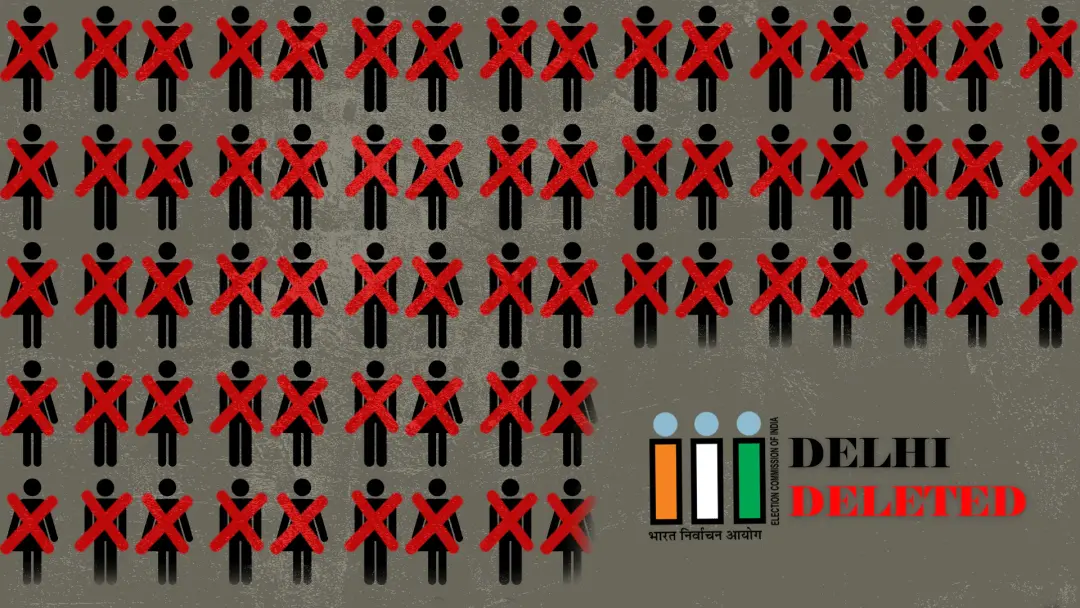
47.6 lakh Delhi voters deleted, 31.6 lakh served ECI notices
A Reporters' Collective investigation says Delhi began its Special Intensive Revision with 1.45 crore voters, of whom 47.6 lakh names were deleted from the draft electoral roll. Another 31.6 lakh voters on the draft list were served ECI notices to prove eligibility. Of Delhi's 14,947 booths, only 51 stayed within the Commission's two percent deletion limit, while deletions exceeded half the voters at 639 booths. Nine of the 29 booths with over 70 percent deletions were in demolished neighbourhoods.
Source
Election Commission · read the original report ↗
Desk check · some claims need care
What the desk checked (4)
- Delhi began the SIR with 1.45 crore voters and 47.6 lakh names were deleted from the draft roll. — Figures appear in the source; attributed to the publication's analysis of the SIR, not to an ECI release.
- Another 31.6 lakh voters on the draft list received ECI notices to prove eligibility. — Figure appears in source and is attributed to ECI action, but no official document or spokesperson is cited.
- Of Delhi's 14,947 booths, only 51 stayed within the ECI's 2% deletion threshold, and deletions exceeded 50% at 639 booths. — Booth-level numbers presented as the outlet's own mapping; internally consistent but externally unverified here.
- Nine of the 29 booths with over 70% deletions were in neighbourhoods demolished by government agencies. — Attributed to the publication's mapping; specific agencies are not named in the source.
Analysts’ view opinion
With 47.6 lakh names deleted from a base of 1.45 crore and notices issued to another 31.6 lakh, close to half of Delhi's electorate has been touched in some form by the SIR. That is not merely an administrative matter: when the composition of the roll changes, so does the political balance of constituencies, which makes this a direct contest over power. The Reporters' Collective finding that only 51 of 14,947 booths stayed within the ECI's own two percent deletion threshold goes to the heart of institutional credibility.
- Only 51 of 14,947 booths remaining within the two percent limit invites the question of whether verification kept pace with scale, and opposition parties are likely to press it as an accountability issue.
- Deletions exceeding fifty percent at 639 booths can reshape the local vote base in those pockets, with consequences at ward and assembly level arithmetic.
- The report that nine of the 29 booths crossing 70 percent deletions lie in demolished neighbourhoods allows rehabilitation and voting rights to be fused into a single political narrative.
- If the burden has indeed fallen hardest on the poor, migrants and women, parties that rely on these constituencies stand to lose ground, and their mobilisation machinery faces a test.
- Expect two competing frames: cleaning up duplicate and ineligible entries versus disenfranchisement of the vulnerable, with courts and the ECI's explanations deciding which frame holds.
What to watch — Watch how many of the 31.6 lakh noticed voters survive into the final roll, what the ECI says about booth-level cross verification, and whether parties take this to court or to the streets.
The story rests on one media investigation's numbers and does not establish intent behind the deletions, the net party-wise gain or loss, or the ECI's official response.
Deep dive
Research brief · 8 facts · 5 dates · exam-readyThe brief
Context
The Election Commission of India (ECI) has been conducting a Special Intensive Revision (SIR) of electoral rolls, and Delhi's exercise has produced one of India's largest voter deletion drives, according to an investigation by The Reporters' Collective. Delhi entered the process with 1.45 crore voters; 47.6 lakh names were struck off the draft roll and another 31.6 lakh voters who did make the draft list were served ECI notices to prove eligibility. The investigation finds the burden falling disproportionately on the poor, migrants and women, including families whose homes were demolished by government agencies before their names were deleted. It also flags breaches of the Commission's own safeguard requiring cross-verification at booths where deletions exceed two percent.
Key facts
- Delhi began its Special Intensive Revision (SIR) with 1.45 crore voters, per The Reporters' Collective investigation.
- 47.6 lakh names were deleted from Delhi's draft electoral roll under the SIR.
- A further 31.6 lakh voters whose names appeared on the draft list were served ECI notices asking them to prove eligibility.
- ECI guidelines treat booths with deletions above two percent as suspicious, requiring personal cross-verification.
- Of Delhi's 14,947 booths, only 51 stayed within the two percent deletion limit.
- At 639 booths, more than fifty percent of voters were deleted.
- Of the 29 booths where deletions crossed 70 percent, nine were in neighbourhoods demolished by government agencies; nearly nine in ten voters across these booths were erased.
- Some deleted families were living at addresses the government itself had allotted them after relocation.
Timeline
- Start of Delhi SIRDelhi's electoral roll revision begins with 1.45 crore voters on the rolls.
- Draft roll stage47.6 lakh names deleted from the draft electoral roll under the SIR.
- After draft publication31.6 lakh voters retained on the draft list served ECI notices to prove their eligibility.
- Before deletions (sequence noted in source)Government agencies demolished homes; some families were relocated, others scattered across the city, and their names were later struck off.
- OngoingThe Reporters' Collective tracks SIR fallout beyond voter lists, into welfare schemes, ration cards and citizenship.
Who has a stake
- Election Commission of India (ECI) — Conducting the SIR; its own safeguard against mass deletions (two percent booth threshold) appears breached at all but 51 of 14,947 Delhi booths.
- Delhi's 1.45 crore registered voters — More than half are either deleted from the draft roll or on the ECI's list of those asked to prove eligibility.
- Poor residents of slums and jhuggi-jhopri clusters — Loss of electoral history used to prove length of residence at demolished addresses, affecting rehabilitation and state benefits.
- Migrants and women voters — Hit hardest as they struggle to prove residence or reconcile mismatched documents during verification.
- Government agencies carrying out demolitions — Their demolitions displaced families whose names were then deleted, including at addresses the state itself allotted.
- VIPs / better-off voters — The investigation's headline notes VIPs 'get a pass' while the poorest bear the cost of the exercise.
- The Reporters' Collective — Reader-funded newsroom that produced the investigation and is tracking SIR's impact on welfare schemes, ration cards and citizenship.
Why it matters
The right to vote and the documentary trail behind it are the base of both democratic participation and access to welfare entitlements; in Delhi both were lost together for the poorest. The scale of deletions, with only 51 of 14,947 booths inside the ECI's own two percent safeguard, raises questions about whether the Commission's verification protections worked at all. Re-registration may restore names but not the electoral history that decides rehabilitation claims.
UPSC angle
Prelims pointers
- Special Intensive Revision (SIR) is the Election Commission of India's electoral roll revision exercise; Delhi began it with 1.45 crore voters.
- Delhi SIR: 47.6 lakh names deleted from the draft roll; 31.6 lakh draft-list voters served ECI notices to prove eligibility.
- ECI guideline: booths with deletions exceeding two percent are 'suspicious' and require personal cross-verification.
- Delhi has 14,947 polling booths; only 51 stayed within the two percent deletion limit.
- Deletions crossed fifty percent at 639 booths and 70 percent at 29 booths, nine of which were in demolished neighbourhoods.
- Electoral rolls serve as residence proof for jhuggi-jhopri households claiming rehabilitation or state benefits.
Mains framing
Delhi's Special Intensive Revision illustrates how an administrative cleanup of electoral rolls can turn into a de facto disenfranchisement of the urban poor. Starting from 1.45 crore voters, 47.6 lakh names were deleted and 31.6 lakh more were asked to prove eligibility, meaning more than half the capital's electorate was either purged or placed under doubt. The causes identified by the investigation are structural rather than merely clerical: demolitions displaced families, relocation scattered them across the city, and verification relied on documents that the poor, migrants and women are least likely to possess or match. The Commission's own safeguard - mandatory personal cross-verification at booths with more than two percent deletions - was effectively inoperative, with only 51 of 14,947 booths within the limit, and nine of the 29 booths with above-70 percent deletions falling in demolished neighbourhoods, some at addresses the state itself had allotted. The implications extend beyond voting: electoral history functions as proof of residence for rehabilitation and welfare claims, so the same demolition removes a home, a vote and the paper trail to claim either. A way forward, grounded in the source's own findings, lies in enforcing the two percent cross-verification rule in letter and spirit, treating state-allotted relocation addresses as verified residence, and ensuring re-registration does not erase prior electoral history.
Key terms
- Special Intensive Revision (SIR)
- The Election Commission's intensive electoral roll revision exercise under which Delhi's draft roll saw 47.6 lakh deletions.
- Draft electoral roll
- The provisional voter list published during revision; 47.6 lakh names were dropped from it and 31.6 lakh on it got ECI notices.
- Two percent deletion limit
- ECI guideline flagging booths with over two percent deletions as suspicious, mandating personal cross-verification.
- Jhuggi-jhopri cluster
- Informal slum settlement whose residents often use electoral records to prove length of residence for rehabilitation.
- ECI notice to prove eligibility
- Communication requiring a listed voter to submit documents establishing entitlement to remain on the roll.
- The Reporters' Collective
- Reader-funded investigative newsroom that reported the Delhi SIR findings and is tracking its welfare and citizenship fallout.
Practice questions
- Critically examine how electoral roll revision exercises such as the SIR can affect the voting rights of the urban poor and migrants, using the Delhi case.
- The Election Commission's own safeguard of cross-verifying booths with over two percent deletions held at only 51 of Delhi's 14,947 booths. What does this reveal about procedural accountability in electoral administration?
- Discuss how documentary requirements in state processes intersect with access to welfare, with reference to the use of electoral history as proof of residence in demolished settlements.
Grounded only in the source report — figures and dates are the source's, not inferred.