
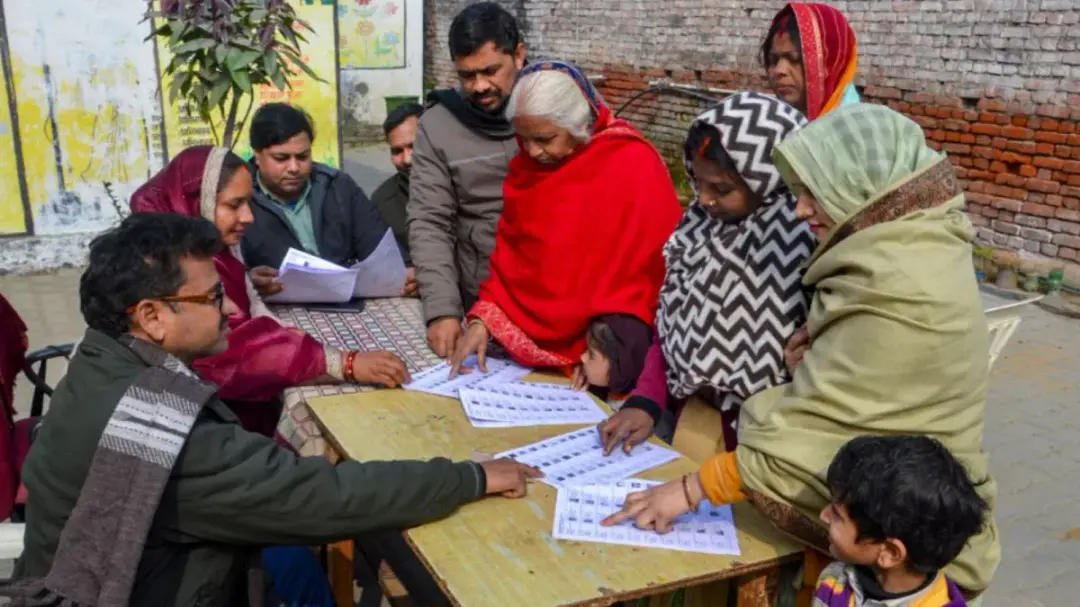
Over 33 lakh Delhi voters issued SIR notices; final roll on November 4
The Election Commission's Special Intensive Revision has flagged 33.13 lakh of the 97.5 lakh electors in Delhi's draft roll published on August 31. About 42% of notices cite records unmapped with the 2002 revision, 41% name mismatches and 16% age-related discrepancies. LK Advani, S Jaishankar, Rekha Gupta and Arvind Kejriwal are among recipients. The CEO's office said no name can be deleted without a hearing and an appealable order. The final roll comes on November 4.
Source
News18 — India · read the original report ↗
Desk check · compared with the source
What the desk checked (5)
- Over 33.13 lakh of the 97.5 lakh electors in Delhi's August 31 draft roll were issued notices under the SIR. — Figures appear in source, attributed to Delhi CEO notice data.
- About 42% of notices are for records 'unmapped with last SIR', 41% for name mismatches and 16% for age-related discrepancies. — Attributed in source to a Hindustan Times analysis of published notice data.
- LK Advani, S Jaishankar, Rekha Gupta and Arvind Kejriwal are among those issued notices. — Stated in source; Rekha Gupta's details later verified and validated per officials.
- Claims and objections end September 30, disposal by October 29, final roll on November 4. — Dates attributed to the election authorities' schedule in the source.
- Draft roll of 97.5 lakh is about 32.8% lower than 1.45 crore electors as of June 30. — Figure appears in source; no independent verification possible.
Analysts’ view opinion
The appearance of names like LK Advani, S Jaishankar, Rekha Gupta and Arvind Kejriwal on the SIR notice lists has, in one stroke, levelled the political field around this exercise — it gives the Election Commission a strong argument that no single party is being targeted, while simultaneously raising questions about how bluntly the system is operating. The real political fault line is not the notices but the draft roll itself: around 97.5 lakh electors against roughly 1.45 crore as of June 30, a fall of about 32.8 per cent. Even with the CEO's office insisting no name can go without a hearing and a speaking, appealable order, expect the argument over these numbers to run right up to the November 4 final roll.
- Notices reaching both the sitting Chief Minister and a former Chief Minister weakens the "selective targeting" charge and works as a shield for the Election Commission.
- Conversely, if even prominent citizens' records could not be mapped to the 2002 revision, the documentation burden on ordinary, migrant and poorer voters becomes a ready-made opposition talking point.
- The stated reasons — 42 per cent unmapped records, 41 per cent name mismatches, 16 per cent age anomalies — read as technical and data-driven, which cuts against any conspiracy framing.
- The wide constituency-level spread, from about 22.7 per cent notices in Matia Mahal to 44.2 per cent in Badarpur, creates fertile ground for localised claim and counter-claim.
- The tight calendar — claims closing September 30, disposal by October 29, final roll November 4 — is a test of party machinery, and whichever outfit best helps voters file documents gains organisational credit.
What to watch — Watch the November 4 final roll for how many of the flagged entries actually survive and which constituencies see the sharpest reduction — and how parties respond to those figures.
The story does not establish how many of the 33.13 lakh flagged voters will finally remain on the roll, nor what explains the 32.8 per cent drop from June, so any claim about which party gains or loses remains speculative.
Deep dive
Research brief · 8 facts · 6 dates · exam-readyThe brief
Context
The Election Commission is conducting a Special Intensive Revision (SIR) of electoral rolls in Delhi, matching current electors against the roll prepared during the last intensive revision in 2002. A draft roll with about 97.5 lakh electors was published on August 31, down from about 1.45 crore electors as of June 30. Of the draft electors, 33.13 lakh have been issued system-generated notices for discrepancies or because their records could not be linked to the 2002 roll, including prominent public figures. The Delhi Chief Electoral Officer has stressed that a notice is a verification step, not a deletion order, and the final roll is due on November 4.
Key facts
- Draft electoral roll published August 31 has around 97.5 lakh electors; 33.13 lakh of them have been issued SIR notices.
- Electors on Delhi rolls stood at about 1.45 crore as of June 30 — the draft roll marks a decline of roughly 32.8 per cent.
- About 13.8 lakh electors (roughly 42 per cent of notices) are in the 'unmapped with last SIR' (2002) category.
- Name mismatches account for about 41 per cent of notices — 24 per cent parent-name mismatches and 17 per cent the voter's own name.
- Age-related discrepancies account for about 16 per cent of notices, including parent-child age gaps under nine months.
- Around 1.4 lakh electors were flagged for having six or more children; 182 entries flagged as parents deemed ineligible in the previous SIR.
- About 94 per cent of notices list one reason; 1.28 lakh list two, about 9,000 list three, over 400 list four, and nearly 59,800 list no specific reason.
- Notice rates ranged from about 22.7 per cent in Matia Mahal to 44.2 per cent in Badarpur, as per a Hindustan Times analysis.
Timeline
- 2002Previous intensive revision of Delhi's electoral rolls — the baseline against which current entries are being mapped.
- June 30Delhi rolls carried about 1.45 crore electors.
- August 31Draft electoral roll published with around 97.5 lakh electors; 33.13 lakh flagged for notices.
- September 30Claims and objections process scheduled to conclude.
- October 29Disposal of cases expected to be completed.
- November 4Final electoral roll for Delhi scheduled to be published.
Who has a stake
- 33.13 lakh flagged Delhi electors — Must submit responses and documents to EROs or BLOs; continued presence on the final roll depends on verification and due process.
- Delhi Chief Electoral Officer's office — Must clarify the process, run hearings and ensure no deletion happens without a speaking, appealable order.
- Election Commission of India — Credibility of the SIR exercise, which it says aims to retain eligible citizens while identifying ineligible or duplicate entries.
- EROs and Booth Level Officers — Receive documents and reports and take case-by-case decisions on each flagged entry.
- Prominent notice recipients — LK Advani, S Jaishankar, Rekha Gupta, Arvind Kejriwal, Manish Sisodia, Jagdeep Dhankhar, SS Sandhu, Upendra Dwivedi, Praveen Sood, Vikram Misri, Kapil Sibal.
- Supreme Court — Has observed that voter deletion does not end citizenship status and that the EC cannot decide who is a citizen.
Why it matters
Roughly a third of Delhi's draft electors have been flagged, and the draft roll itself is about 32.8 per cent smaller than the June 30 roll, so the SIR directly shapes who can vote in the capital. The appearance of former deputy prime minister LK Advani, the External Affairs Minister, the sitting Chief Minister and a former Chief Minister among notice recipients shows the flags are algorithmic rather than targeted, but also raises questions about data quality and the burden of proof on ordinary voters. Whether due process — hearings, indicative document lists and appealable orders — works in practice will determine public confidence in the final roll.
UPSC angle
Prelims pointers
- Special Intensive Revision (SIR) in Delhi maps current electors against the last intensive revision of 2002.
- Delhi draft roll published August 31: about 97.5 lakh electors; final roll due November 4.
- Claims and objections end September 30; disposal of cases by October 29.
- Notices are generated through the Election Commission's ECINET system; responses go to the ERO or BLO.
- No name can be deleted without a hearing and a proper, speaking and appealable order, per the Delhi CEO.
- Supreme Court has said deletion from the voter roll does not end a person's citizenship status.
Mains framing
Delhi's Special Intensive Revision illustrates the tension between purifying electoral rolls and protecting the franchise. The exercise mapped 97.5 lakh draft electors against the 2002 intensive revision and flagged 33.13 lakh — about 42 per cent for unmapped records, 41 per cent for name mismatches and 16 per cent for age anomalies — indicating that most flags arise from legacy data gaps, transcription variance and rule-based 'logical discrepancy' checks rather than proven ineligibility. That prominent figures from Advani to Kejriwal received notices, and that nearly 59,800 notices cite no specific reason, underlines the limits of automated matching; the 32.8 per cent fall from the 1.45 crore electors of June 30 raises the risk of exclusion of the mobile poor, migrants and women whose parents' names or ages differ across documents. The safeguards the CEO's office cites — an indicative rather than exhaustive document list, BLO verification, hearing before deletion, and a speaking, appealable order, as in the physical validation of the Chief Minister's Shalimar Bagh entry — are the core of due process. The way forward lies in transparent constituency-wise disclosure (notice rates varied from 22.7 per cent in Matia Mahal to 44.2 per cent in Badarpur), proactive BLO outreach before the September 30 claims deadline, and reasoned orders before the November 4 final roll, consistent with the Supreme Court's caution that the EC cannot determine citizenship.
Key terms
- Special Intensive Revision (SIR)
- An intensive electoral-roll revision that re-verifies entries, here by linking current electors to the last intensive revision of 2002.
- Unmapped with last SIR
- An entry that could not be linked to a corresponding or qualifying progeny entry in the previous (2002) revision; about 42 per cent of Delhi notices.
- ECINET
- The Election Commission's system through which the notices were generated to facilitate correction and verification of elector data.
- Electoral Registration Officer (ERO)
- Officer who receives voters' responses and documents and decides individual cases along with the BLO's report.
- Booth Level Officer (BLO)
- Field-level official who verifies elector details and reports to the ERO.
- Speaking and appealable order
- A reasoned written order, open to appeal, without which the CEO says no name can be deleted from the roll.
Practice questions
- Critically examine the safeguards available to voters flagged during an intensive revision of electoral rolls. Are they adequate to prevent wrongful exclusion?
- Delhi's draft roll fell about 32.8 per cent from the June 30 electorate. Discuss the implications of large-scale roll revision for electoral inclusiveness and public trust.
- The Supreme Court has held that deletion from the electoral roll does not end citizenship status. Analyse the distinction between electoral eligibility and citizenship determination.
Grounded only in the source report — figures and dates are the source's, not inferred.