
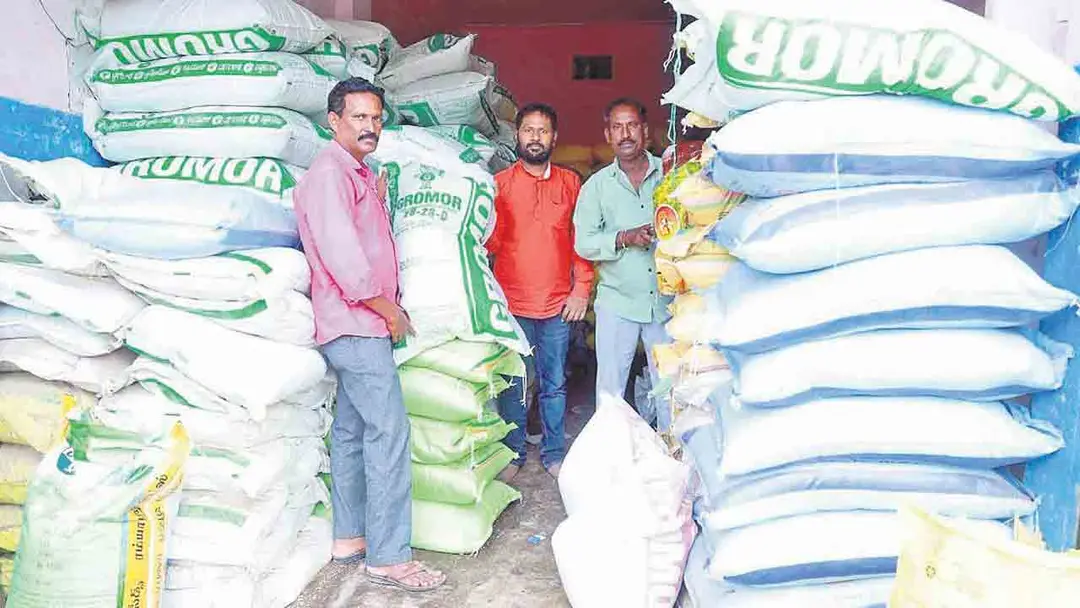
Fertiliser stocks exceed July requirement in Karimnagar region
Officials say 1,50,841 metric tonnes of fertiliser are available across the undivided Karimnagar district for the monsoon season, against a July requirement of 79,455 tonnes. Urea stocks stand at 65,595 tonnes against a need of 36,874, DAP at 18,344 against 11,552, and NPK at 63,884 against 24,565. MOP and SSP stocks are lower but are expected under the indent. An indent of 3,05,686 tonnes was placed based on cultivation estimates in four districts.
Source
Karimnagar — వ్యవసాయం · read the original report ↗
Desk check · some claims need care
What the desk checked (5)
- Undivided Karimnagar district currently holds 1,50,841 metric tonnes of fertiliser of all types. — Figure appears in the source and matches its stock table total; attributed to agriculture officials.
- July requirement for the undivided district is 79,455 metric tonnes. — Figure appears in the source text, though the accompanying table lists the total as 79,445 — an internal inconsistency an editor should flag.
- Urea requirement for July is 36,874 MT against 65,595 MT in stock; DAP 11,552 MT against 18,344 MT; NPK 24,565 MT against 63,884 MT. — Figures appear consistently in both the body text and the table.
- MOP and SSP stocks are lower than requirement (4,814 MT needed vs 1,845 MT; 1,650 MT vs 1,173 MT). — Figures appear in the source table; officials are quoted saying further supplies are expected under the indent.
- Cultivation is estimated at 3,39,059 acres in Karimnagar, 2,40,061 in Sircilla, 2,83,321 in Peddapalli and 3,40,000 in Jagtial, with an indent of 3,05,686 MT of fertiliser. — Attributed to district agriculture officers in the source.
Analysts’ view opinion
Against a July requirement of 79,455 tonnes, the combined Karimnagar districts are holding 1,50,841 tonnes of fertiliser — close to double. Front-loading supply delivers a real economic gain to farmers: fewer workdays lost in queues, less interest on loans taken to buy early, and less scope for scarcity premiums. But abundance is not free — carrying costs, warehousing, quality degradation and tied-up working capital shift from the farmer onto agencies and dealers. And the cushion is uneven: MOP (1,845 against 4,814 needed) and SSP (1,173 against 1,650) are short.
- Stocks at roughly twice the monthly requirement are price-friendly, reducing local scarcity premiums and the room for artificial shortages.
- The farmer's real saving sits in the 'cost of access': days spent waiting, repeat transport trips, interest on early-purchase borrowing, and spoilage of fertiliser stored too long.
- Holding a buffer carries warehousing, handling and locked-capital costs — the burden moves from farmer to the supply chain, and the story does not say who absorbs it.
- Nutrient balance is the weak spot: urea and NPK are in surplus (63,884 against 24,565 needed) while MOP and SSP lag, and officials say indented volumes will arrive — any delay at a critical crop stage could hit yields.
- With a patchy monsoon delaying sowing, demand may bunch into July and August; the 3,05,686-tonne indent for the four districts means the buffer has some capacity to absorb that spike.
What to watch — Watch whether MOP and SSP arrive on indent once July rains bunch demand together — that, not the headline surplus, is the real test of the supply plan.
The story rests on official stock figures and does not establish the cost of maintaining this buffer, who bears it, or how much per-acre cost or yield actually changed for farmers.
Deep dive
Research brief · 8 facts · 4 dates · exam-readyThe brief
Context
Ahead of the July peak of the 2023 monsoon (vanakalam) season, agriculture officials in the undivided Karimnagar district of Telangana say fertiliser stocks are well above the month's assessed requirement. Fertiliser is indented month-wise from April onwards on the basis of district-level cultivation estimates, and stocked with cooperative societies, DCMS, agro centres, Markfed godowns and private dealers. The undivided district covers four districts — Karimnagar, Sircilla, Peddapalli and Jagtial — where paddy dominates, driving urea, DAP and complex fertiliser demand. The report contrasts the present availability with earlier years of queues, scuffles and police lathi charges at fertiliser outlets, as recounted by farmers.
Key facts
- Total fertiliser available in undivided Karimnagar district: 1,50,841 metric tonnes, against a July requirement of 79,445 MT (reported as 79,455 in the summary).
- Urea: July requirement 36,874 MT; stock 65,595 MT. DAP: requirement 11,552 MT; stock 18,344 MT. NPK complex: requirement 24,565 MT; stock 63,884 MT.
- MOP stock is below need — 1,845 MT against 4,814 MT required; SSP 1,173 MT against 1,650 MT required.
- Indent of 3,05,686 MT of fertiliser was placed for the season based on cultivation estimates by district agriculture officers.
- Estimated 2023 cultivation area: Karimnagar 3,39,059 acres, Sircilla 2,40,061, Peddapalli 2,83,321, Jagtial 3,40,000 acres.
- July urea requirement vs stock by district: Karimnagar 13,091 vs 23,230 MT; Sircilla 5,621 vs 9,568; Peddapalli 4,998 vs 19,663; Jagtial 13,164 MT required with matching availability.
- Season requirement for 2023 vanakalam: urea 1,41,040 MT, NPK 98,616 MT, DAP 32,463 MT, MOP 28,047 MT, SSP 5,520 MT.
- Based on soil type, the undivided district typically uses 100 kg nitrogen, 60 kg phosphorus and 40 kg potassium per hectare.
Timeline
- From April onwards each yearOfficials assess month-wise fertiliser needs and keep stocks available in the market before the season begins.
- 2023 monsoon season onsetRains were delayed; farmers began sowing late, so fertiliser offtake was slow in June.
- June 27, 2023Karimnagar officials report 1,50,841 MT of all fertilisers in stock in the undivided district.
- July 2023 (projected)Assessed requirement of 79,445 MT; officials say stocks will suffice even if good rains raise consumption.
Who has a stake
- Farmers of undivided Karimnagar district — Timely access to urea, DAP and complex fertilisers at notified prices determines yields; they recall past shortages, queues and black marketing.
- District agriculture departments (Karimnagar, Sircilla, Peddapalli, Jagtial) — Estimate acreage, place the indent (3,05,686 MT) and ensure month-wise availability.
- Telangana state government — Credited in the report for supply, buffer stocks in Markfed godowns and farm schemes such as Rythu Bandhu and Rythu Bima.
- Distribution network — cooperative societies, DCMS, agro centres, private dealers, Markfed godowns — Act as the last-mile outlets where stocks are held and sold.
- Paddy and vegetable growers — Paddy dominance drives urea/DAP/complex demand; vegetable growers additionally need MOP, which is currently in short stock.
Why it matters
Fertiliser availability at the exact sowing and transplanting window decides yields for paddy-dominant districts, and shortfalls historically pushed farmers into queues and black-market purchases. Pre-positioned, month-wise stocks show how advance indenting and buffer stocking can smooth a seasonal demand spike, especially when delayed rains compress sowing into a short window. The lower MOP and SSP stocks are a reminder that adequacy must be judged nutrient by nutrient, not in aggregate tonnage.
UPSC angle
Prelims pointers
- Undivided Karimnagar district comprises Karimnagar, Sircilla (Rajanna Sircilla), Peddapalli and Jagtial districts.
- Vanakalam is the Telugu term for the kharif/monsoon season; yasangi is the rabi season.
- Fertiliser types named: urea, DAP, NPK complex, MOP (Muriate of Potash), SSP (Single Super Phosphate).
- Reported nutrient use norm in the district: 100 kg nitrogen, 60 kg phosphorus, 40 kg potassium per hectare.
- Markfed godowns hold buffer stocks; PACS, DCMS and agro centres are distribution points.
- Rythu Bandhu gives Rs 5,000 per acre investment support before sowing, as stated by a farmer in the report.
Mains framing
Fertiliser availability in undivided Karimnagar illustrates how seasonal input planning works in a paddy-dominant region: district agriculture officers estimate acreage (about 12 lakh acres across four districts), convert it into a season indent (3,05,686 MT), break it into month-wise requirements from April, and pre-position stocks with cooperatives, DCMS, agro centres and private dealers, with buffer stocks in Markfed godowns. The result reported is a comfortable July position — 1,50,841 MT in stock against 79,445 MT needed, with urea, DAP and NPK all in surplus. Two caveats temper the picture. First, aggregate sufficiency conceals nutrient-wise gaps: MOP (1,845 MT against 4,814 MT) and SSP (1,173 MT against 1,650 MT), both used at critical crop stages, are short and depend on the pending indent arriving. Second, this season's low offtake is partly a function of deficient rainfall delaying sowing; if July rains are good, consumption could rise sharply, testing the buffer. The way forward suggested by the report's own details is continued month-wise assessment, last-mile village-level distribution at notified prices to prevent black marketing, and soil testing with extension advice so that heavy nitrogen use (100 kg N per hectare) is balanced with phosphorus and potash.
Key terms
- Indent
- The formal requisition placed by district officials for a quantum of fertiliser, here 3,05,686 MT for the season, based on cultivation estimates.
- Vanakalam / Yasangi
- Telugu names for the monsoon (kharif) and winter (rabi) cropping seasons respectively.
- DAP and NPK complex
- Di-ammonium phosphate and mixed nitrogen-phosphorus-potassium fertilisers used mainly at sowing and basal application.
- MOP and SSP
- Muriate of Potash and Single Super Phosphate, applied at later, critical crop stages; currently in lower stock in the district.
- DCMS / PACS
- District Cooperative Marketing Society and Primary Agricultural Cooperative Societies — cooperative outlets that sell fertiliser to farmers.
- Rythu Bandhu / Rythu Bima
- Telangana schemes for pre-sowing investment support (Rs 5,000 per acre, per a farmer quoted) and farmer life insurance.
Practice questions
- Aggregate fertiliser stocks in undivided Karimnagar exceed July's requirement, yet MOP and SSP fall short. Discuss why nutrient-wise availability, and not total tonnage, should be the benchmark for input planning.
- How does month-wise indenting and buffer stocking with cooperatives and Markfed godowns address the problem of seasonal fertiliser shortages? Illustrate with the Karimnagar 2023 kharif figures.
- Delayed monsoon rains have slowed sowing in Karimnagar this season. Examine how rainfall variability complicates fertiliser demand forecasting and district-level supply management.
Grounded only in the source report — figures and dates are the source's, not inferred.