
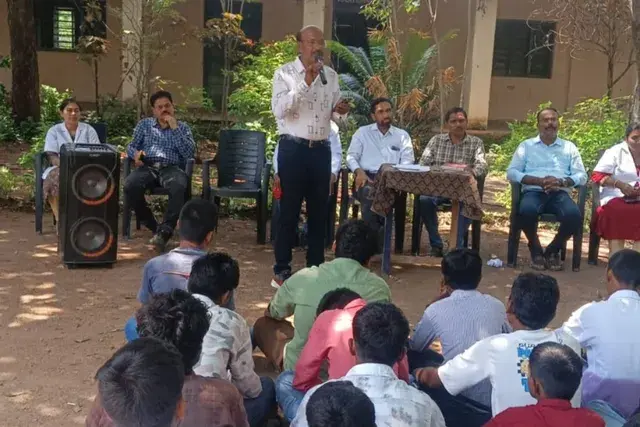
Nasha Mukt Bharat programme held at Armoor government junior college
A Nasha Mukt Bharat programme was held at the Government Junior College (Boys) in Armoor. A rally was taken out with students under the supervision of Principal Subhash, followed by an anti-drugs pledge. Deputy DM&HO Ravinder urged youth to stay away from intoxicants and to take Abdul Kalam as a role model. Health Officer Sai, Chandrashekhar, ASHA workers Sumalatha and Kamala, ANM Vasantha, lecturers Ravi, Naresh, Gangadhar, Srinivas, Prakash, Shekhar and students participated.
Source
Armoor — స్థానికం · read the original report ↗
Desk check · compared with the source
What the desk checked (4)
- A 'Nasha Mukt Bharat' programme was held at Government Junior College (Boys), Armoor. — Stated as fact in the source; no external documentation cited.
- A rally and an anti-drugs pledge were organised under Principal Subhash. — Attributed in the source to the college principal's supervision; figure/detail appears in source.
- Deputy DM&HO Ravinder urged youth to stay away from intoxicants and to take Abdul Kalam as a role model. — Directly attributed to the named official in the source.
- Health Officer Sai, Chandrashekhar, ASHA workers Sumalatha and Kamala, ANM Vasantha and lecturers Ravi, Naresh, Gangadhar, Srinivas, Prakash, Shekhar took part. — Names listed in the source; roles and spellings unverified beyond the text.
Analysts’ view opinion
The Armoor event is a small, local reflection of a much broader national policy template: tackle substance abuse through awareness, using the familiar three-part format of a rally, a pledge and an address by senior officials. The strength of this demand-reduction approach is that it is cheap and rides on institutions that already exist — the college, the health department, ASHA workers; the weakness is that single-day events rarely come with any mechanism to measure whether student behaviour actually changed. What stands out here is the inter-departmental coordination between education and health machinery.
- The target group is clearly college-age youth, which reflects a prevention-first policy logic of intervening before dependence sets in.
- The presence of the principal, the Deputy DM&HO, health officers, ASHA workers and an ANM suggests the programme leaned on existing public health staff rather than creating new machinery — a cost-efficient design choice.
- Symbolic instruments like rallies and pledges can raise awareness, but the story mentions no follow-on steps such as counselling, referral or treatment linkage.
- Holding up Abdul Kalam as a role model is an aspiration-based messaging strategy rather than fear-based prohibitionist messaging, which policy debate generally treats as more effective with young audiences.
- The real test of such programmes is not the event itself but year-round follow-up and measurable outcomes.
What to watch — Watch whether the college gets sustained counselling, referral linkages or periodic follow-up, or whether this remains a one-day observance.
The story establishes only that the event took place — it offers nothing on the actual scale of substance use in Armoor, student attendance, budget, or results from earlier editions of such drives.
Deep dive
Research brief · 8 facts · 4 dates · exam-readyThe brief
Context
A "Nasha Mukt Bharat" (Drug-Free India) awareness programme was organised at the Government Junior College (Boys) in Armoor. Students took out a rally under the supervision of Principal Subhash and were administered an anti-drugs pledge. Health department officials, ASHA workers and college lecturers joined the campus event, which was aimed at steering students away from intoxicants. The source gives no further detail on the wider campaign or district-level plans.
Key facts
- The Nasha Mukt Bharat programme was held at the Government Junior College (Boys), Armoor.
- The report carries the date Sep 28, 2026, 08:09 IST, filed by Bumeshwar.
- A student rally was taken out under the supervision of Principal Subhash.
- An anti-drugs pledge was administered to students after the rally.
- Deputy DM&HO Ravinder urged youth to stay away from intoxicants and to take Abdul Kalam as a role model.
- Health Officer Sai and Chandrashekhar took part in the programme.
- ASHA workers Sumalatha and Kamala and ANM Vasantha participated.
- Lecturers Ravi, Naresh, Gangadhar, Srinivas, Prakash and Shekhar joined along with students.
Timeline
- Sep 28, 2026 (report datelined 08:09 IST)Nasha Mukt Bharat programme reported at Government Junior College (Boys), Armoor.
- During the programmeRally taken out with students under Principal Subhash's supervision.
- After the rallyAnti-drugs pledge administered to students.
- On the occasionDeputy DM&HO Ravinder addressed students, urging them to shun intoxicants.
Who has a stake
- Students of Government Junior College (Boys), Armoor — Primary target group of the anti-drug awareness message and the pledge.
- Principal Subhash and lecturers (Ravi, Naresh, Gangadhar, Srinivas, Prakash, Shekhar) — Organised and supervised the rally and pledge on campus.
- Deputy DM&HO Ravinder and Health Officer Sai — District health machinery driving the awareness message among youth.
- ASHA workers Sumalatha and Kamala, ANM Vasantha — Frontline health workers extending the campaign to the community level.
Why it matters
Substance abuse among school- and college-going youth is a public health and social concern, and campus-level pledges and rallies are the most direct way to reach adolescents. The event shows the district health administration and the education institution working together, with frontline workers such as ASHA and ANM staff involved. Such outreach is the visible, ground-level face of the national drug-free India campaign.
UPSC angle
Prelims pointers
- Nasha Mukt Bharat translates as 'Drug-Free India' — an anti-drug awareness campaign theme.
- Venue: Government Junior College (Boys), Armoor; Principal: Subhash.
- DM&HO stands for District Medical and Health Officer; Deputy DM&HO Ravinder addressed the students.
- ANM = Auxiliary Nurse Midwife; ASHA = Accredited Social Health Activist — frontline health functionaries present at the event.
- Programme components: student rally plus an anti-drugs pledge.
- Deputy DM&HO cited Abdul Kalam as a role model for youth.
Mains framing
Campus-based anti-drug programmes such as the Nasha Mukt Bharat event at Armoor's Government Junior College (Boys) reflect a prevention-first approach to substance abuse among adolescents, where awareness, peer visibility through rallies and symbolic commitments like the anti-drugs pledge are used to shape behaviour at an impressionable age. The event's design is notable for convergence: the education institution provided the platform and supervision (Principal Subhash and lecturers), while the district health machinery supplied the message and credibility (Deputy DM&HO Ravinder, Health Officer Sai) and frontline workers — ASHA workers and an ANM — linked the campus to the community. The invocation of Abdul Kalam as a role model signals the use of aspirational messaging rather than only deterrence. The limitation, based on what the source records, is that one-day rallies and pledges cannot by themselves address supply-side availability, counselling needs or de-addiction follow-up; the source does not state any such follow-up mechanism. A way forward consistent with the reported approach would be sustained school-health engagement through the same convergence of teachers and health staff, though specific measures are not stated in the source.
Key terms
- Nasha Mukt Bharat
- Anti-drug awareness programme, literally 'Drug-Free India', held here at the Armoor government junior college.
- DM&HO / Deputy DM&HO
- District Medical and Health Officer and his deputy — the district-level health administration; Ravinder is the Deputy DM&HO here.
- ASHA worker
- Accredited Social Health Activist, a community-level health volunteer; Sumalatha and Kamala attended.
- ANM
- Auxiliary Nurse Midwife, a frontline health worker at the sub-centre level; Vasantha took part.
- Anti-drugs pledge
- A formal oath administered to students committing them to stay away from narcotics and intoxicants.
Practice questions
- Discuss how convergence between the education and health departments can strengthen anti-substance-abuse campaigns among adolescents, with reference to campus-level programmes.
- Awareness rallies and pledges are widely used in public health communication. Critically examine their effectiveness in preventing drug abuse among youth.
- What role do frontline health functionaries such as ASHA workers and ANMs play in extending district health campaigns from institutions to communities?
Grounded only in the source report — figures and dates are the source's, not inferred.