
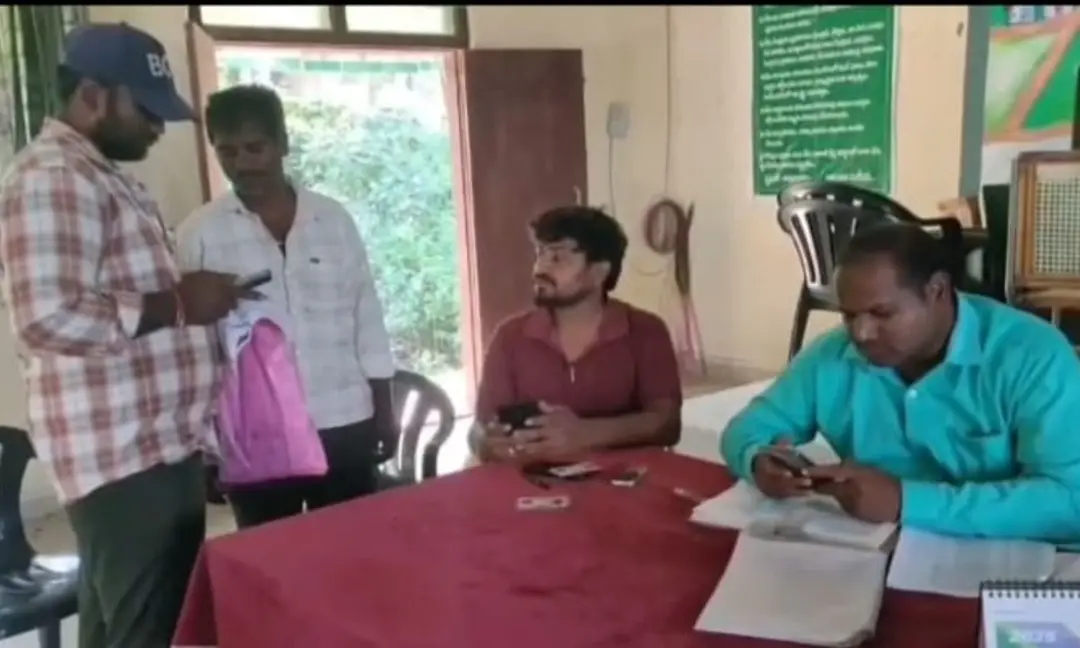
Husnabad officer urges all farmers to obtain Farmer ID card
Husnabad Agriculture Officer Pooja said every farmer must obtain a Farmer ID card as advised by the central government, speaking at an awareness session at the Husnabad Rythu Vedika in Siddipet district. She said the card is mandatory like an Aadhaar card and is useful for selling crops, crop registration, urea booking and availing central and state welfare schemes. Registration of 80% of mandal farmers is complete; the rest can register through the agriculture extension officer, MeeSeva or cooperative societies by September 30.
Source
Husnabad — స్థానికం · read the original report ↗
Desk check · compared with the source
What the desk checked (4)
- Every farmer must obtain a Farmer ID card as advised by the central government — Attributed to Husnabad Agriculture Officer Pooja in the source.
- 80% of farmers in the mandal have completed registration; the remaining 20% can register via the agriculture extension officer, MeeSeva or cooperative societies — Figures appear in the source, attributed to the agriculture officer; no supporting data given.
- The card is useful for selling crops, crop registration and urea booking, and for availing central and state welfare schemes — Attributed to the officer; no scheme names or documentation cited.
- September 30 is the last date for registration — Stated in the source as communicated by the agriculture department; no official order number cited.
Analysts’ view opinion
The Farmer ID is best read as economic plumbing: linking farmer, land and crop to a single digital identity is meant to cut leakage in subsidies, procurement and fertiliser distribution. The officer's claim of 80 per cent registration in Husnabad suggests rollout is moving, but the remaining 20 per cent are the ones exposed — once crop sale, crop registration and urea booking run through the card, being unregistered turns into a cash loss. With September 30 as the stated deadline, the short-term burden sits with the farmer.
- A single verified identity can lower the cost of beneficiary checks and reduce waste from duplicate claims — a fiscal gain for the state.
- Because urea booking, crop registration and crop sale are being tied to the card, not having one can amount in practice to losing market access.
- The compliance cost falls hardest on small and tenant farmers, for whom travel, paperwork and time mean lost working days.
- Allowing registration through the extension officer, Mee Seva or cooperative societies spreads the load, but a last-minute rush can still strain those service points.
- With the deadline falling close to the kharif procurement window, delayed registration risks hitting farm cash flow directly.
What to watch — Watch whether the deadline is extended for the remaining 20 per cent, or whether procurement and fertiliser services are actually withheld from those without the card.
The story does not establish what benefits stop, from when, whether the deadline will be extended, or whether registration carries any cost — and it reflects one mandal, not a wider picture.
Deep dive
Research brief · 8 facts · 4 dates · exam-readyThe brief
Context
Farmer ID cards are being rolled out on the advice of the central government so that every cultivator has a unique identity record, much like Aadhaar for individuals. In Husnabad mandal of Telangana's Siddipet district, the agriculture department held an awareness session at the Husnabad Rythu Vedika (farmers' platform) to push pending registrations. Agriculture Officer Pooja told farmers the card will be needed for routine farm transactions such as selling produce, crop registration and urea booking, and to draw benefits under central and state welfare schemes. With 80 per cent of mandal farmers already registered, the department set September 30 as the last date for the remaining farmers.
Key facts
- Husnabad Agriculture Officer Pooja said every farmer must compulsorily obtain a Farmer ID card, as advised by the central government.
- The awareness session for farmers on the Farmer ID card was held at the Husnabad Rythu Vedika, Siddipet district, Telangana.
- The government has introduced the system so that every farmer has a Farmer ID card just as every individual has an Aadhaar card.
- The card is useful for selling crops, crop registration (panta nomodu) and urea booking.
- 80 per cent of farmers in Husnabad mandal have completed registration so far.
- The remaining 20 per cent can register with the nearest agriculture extension officer, through MeeSeva, or through cooperative societies.
- The Farmer ID card is needed to avail welfare schemes provided by both central and state governments.
- The agriculture department announced September 30 as the last date for farmer registration.
Timeline
- Before the session (date not stated in the source)Central government advises that every farmer obtain a Farmer ID card; registration drive begins in Husnabad mandal.
- As of the sessionRegistration of 80 per cent of Husnabad mandal farmers completed.
- 29 September 2026Awareness session at Husnabad Rythu Vedika; Agriculture Officer Pooja urges all remaining farmers to register.
- 30 SeptemberLast date announced by the agriculture department for farmer registration.
Who has a stake
- Farmers of Husnabad mandal, Siddipet district — Without the Farmer ID card they may not be able to sell crops, register crops, book urea or receive central and state scheme benefits.
- Husnabad Agriculture Officer Pooja — Leading the awareness drive and responsible for completing the remaining registrations by the deadline.
- Agriculture extension officers (AEOs) — Field-level registration point for the pending 20 per cent of farmers.
- MeeSeva centres and cooperative societies — Serve as alternative channels for farmers to complete Farmer ID registration.
- Central and state governments — Rely on the Farmer ID database to route welfare scheme benefits and inputs such as urea to verified farmers.
Why it matters
A unique Farmer ID turns scattered land and crop records into a single verifiable identity, which is what decides whether a farmer can sell produce at procurement centres, book fertiliser or receive scheme money. With a September 30 cut-off and one in five farmers in Husnabad mandal still unregistered, those left out risk losing access to routine entitlements. The drive also shows how last-mile delivery depends on local institutions like Rythu Vedikas, extension officers, MeeSeva and cooperative societies.
UPSC angle
Prelims pointers
- Farmer ID card: introduced on central government advice; described as mandatory for farmers like Aadhaar for individuals.
- Uses stated: crop sale, crop registration, urea booking, and central and state welfare schemes.
- Registration channels: agriculture extension officer, MeeSeva, cooperative societies.
- Husnabad mandal is in Siddipet district, Telangana; awareness session held at the Husnabad Rythu Vedika.
- Registration status in the mandal: 80 per cent complete; deadline September 30.
- Rythu Vedika: village/cluster-level farmers' platform used for agricultural awareness meetings in Telangana.
Mains framing
The Farmer ID drive in Husnabad illustrates the shift from scheme-wise, paper-based farmer identification to a single digital identity that links a cultivator to crop registration, input supply and benefit transfer. The stated rationale is convenience and leak-proof delivery: one card to sell crops, register the crop sown, book urea and claim central and state welfare benefits. The implementation challenge is the last mile — the source records that 20 per cent of the mandal's farmers were still unregistered close to the September 30 deadline, which is why the department has opened multiple channels (agriculture extension officers, MeeSeva, cooperative societies) and used the Rythu Vedika for face-to-face awareness. The risk in any mandatory-ID model is exclusion: farmers who miss the cut-off, or whose records do not match, could be shut out of procurement and fertiliser access even though they cultivate. The way forward suggested by the story's own approach is sustained local awareness, decentralised enrolment points close to the farmer, and department-led follow-up on the residual group rather than reliance on a single deadline. Beyond the mandal, the episode is a reminder that digital agricultural governance succeeds only when enrolment and grievance redress are as accessible as the entitlement itself.
Key terms
- Farmer ID card (Rythu Gurthimpu Card)
- A unique identity card for farmers introduced on central government advice, required for crop sale, crop registration, urea booking and scheme benefits.
- Rythu Vedika
- Farmers' platform or meeting hall used in Telangana for agricultural awareness programmes; the Husnabad session was held here.
- Agriculture Extension Officer (AEO)
- Mandal-level agriculture department official who, per the source, can register farmers for the Farmer ID card.
- MeeSeva
- Telangana's citizen service delivery centres, listed as one channel for Farmer ID registration.
- Crop registration (panta nomodu)
- Official recording of the crop sown by a farmer; the Farmer ID card is stated to be useful for this.
- Urea booking
- Advance booking of urea fertiliser by farmers, for which the source says the Farmer ID card is used.
Practice questions
- Discuss how a unique Farmer ID can improve targeting of agricultural welfare schemes, and what safeguards are needed to prevent exclusion of unregistered cultivators.
- Institutions such as Rythu Vedikas, agriculture extension officers, MeeSeva centres and cooperative societies shape last-mile delivery in agriculture. Examine their role with reference to the Farmer ID registration drive.
- Deadline-driven mandatory registration can create both compliance and exclusion. Critically evaluate with examples from digital identity initiatives in the farm sector.
Grounded only in the source report — figures and dates are the source's, not inferred.