
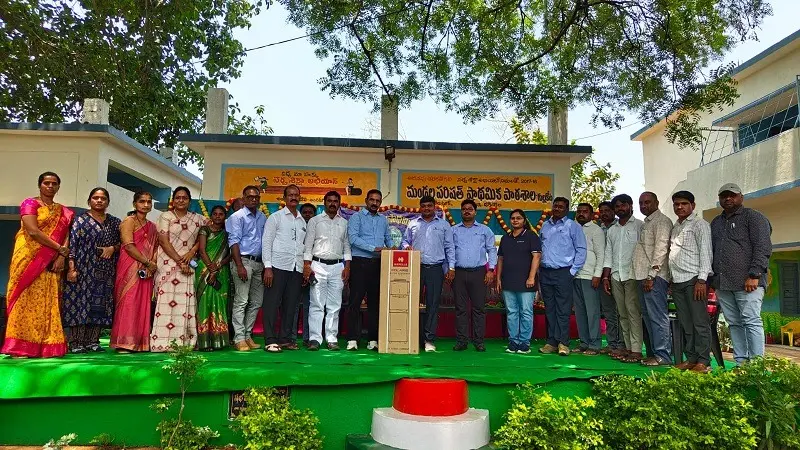
SEED Works donates Rs 1.8 lakh to Endapally school in Jagtial
Support for Educational and Economic Development (SEED) Works International donated Rs 1.8 lakh on Monday to the Mandal Parishad Primary School in Endapally village of Jagtial district. Headmaster Ch Raji Reddy said the funds would be used for painting the school building, providing a motor pump for the borewell and supplying safe drinking water through water dispensers. The school management felicitated SEED representatives Manager Sunil Harinath, Savitha Sadananda, Anand Reddy and Delishwar Reddy. MEO S Harikrishna, sarpanch G Mallesham and teachers attended.
Source
Jagtial — politics · read the original report ↗
Desk check · compared with the source
What the desk checked (4)
- SEED Works International donated Rs 1.8 lakh to MPPS Endapally in Jagtial district on Monday. — Figure and date appear in the source; donor named, no independent documentation cited.
- Funds will be used for painting the school building, a motor pump for the borewell and water dispensers for safe drinking water. — Attributed to MPPS headmaster Ch Raji Reddy.
- School management felicitated SEED representatives Sunil Harinath, Savitha Sadananda, Anand Reddy and Delishwar Reddy. — Names listed in source without further attribution; spellings unverified.
- MEO S Harikrishna, sarpanch G Mallesham, committee leader Lavanya, ward members and teachers attended. — Attendance list given in source with no separate sourcing.
Analysts’ view opinion
A Rs 1.8 lakh donation to a single mandal parishad primary school is a small, welcome intervention — but the spending list is the real story. Paint, a borewell motor pump and drinking water dispensers are basic infrastructure items that public school norms are meant to cover as a matter of course, so philanthropy here is filling a gap in routine maintenance funding rather than adding something extra. That points to a familiar design weakness in school infrastructure policy: capital creation is easier to fund and announce than the recurring upkeep that keeps a facility usable.
- The items funded — painting, a motor pump, water dispensers — sit squarely within basic school infrastructure and drinking water obligations, suggesting the donation substitutes for routine public maintenance spending rather than supplementing it.
- Government school maintenance typically depends on small annual grants and local body support, and a one-time external contribution of this size can dwarf what a single primary school otherwise has discretion to spend.
- The presence of the MEO, the sarpanch and ward members reflects the intended convergence model of school committee, panchayat and education department — useful for accountability, though the story does not describe who will actually oversee procurement or quality of work.
- One-off donor-funded fixes raise a sustainability question: a motor pump and dispensers need electricity, servicing and consumables, and no recurring provision for that is mentioned.
- A school-by-school philanthropy route is inherently uneven — schools with connected donors improve faster than comparable schools without them, which is the equity problem that pooled public funding is designed to solve.
What to watch — Watch whether the works are completed and audited within the school's own committee process, and whether the water and pump facilities remain functional beyond the first year — that, more than the announcement, is the test.
The story does not establish what maintenance or drinking water funds this school already receives from the state, whether any such funds were delayed or unspent, or what conditions, if any, are attached to the donation.
Deep dive
Research brief · 7 facts · 2 dates · exam-readyThe brief
Context
A diaspora-linked non-profit, Support for Educational and Economic Development (SEED) Works International, has donated Rs 1.8 lakh to a government primary school in Endapally village of Jagtial district, Telangana. The Mandal Parishad Primary School (MPPS) is a village-level government school run under the Mandal Parishad, the intermediate rural local body tier. The money is earmarked for basic infrastructure — building painting, a motor pump for the borewell and drinking water dispensers — a reminder that many rural schools still depend on external philanthropy for elementary facilities.
Key facts
- SEED Works International donated Rs 1.8 lakh to the Mandal Parishad Primary School (MPPS), Endapally village, Jagtial district, announced in a report dated April 6, 2026.
- The donation was made on Monday, as stated in the source.
- Funds will be used for painting the school building, providing a motor pump for the borewell, and supplying safe drinking water through water dispensers, said headmaster Ch Raji Reddy.
- SEED representatives felicitated by the school management were Manager Sunil Harinath, Savitha Sadananda, Anand Reddy and Delishwar Reddy.
- Mandal Education Officer (MEO) S Harikrishna and sarpanch G Mallesham attended the event.
- Amma Adarsha school committee leader Lavanya and ward members Tirupati and Prashanth were present.
- Teachers present included S Ramadevi, R Malathi, V Prashanth, N Naresh Kumar, K Krishna Reddy, N Srilatha Sri and Sirisha.
Timeline
- Monday (date not stated in the source)SEED Works International hands over Rs 1.8 lakh to MPPS Endapally; school management felicitates its representatives.
- April 6, 2026The donation is reported from Jagtial, with the headmaster detailing the planned use of funds.
Who has a stake
- Students of MPPS Endapally — Direct beneficiaries — safe drinking water through dispensers, functional borewell supply and a painted school building.
- SEED Works International — Donor organisation working on educational and economic development; its Rs 1.8 lakh grant funds the school's basic facilities.
- Headmaster Ch Raji Reddy and school teachers — Responsible for utilising the funds for the stated works and maintaining the new facilities.
- Mandal Education Officer S Harikrishna — Represents the education administration at mandal level overseeing government schools such as MPPS.
- Sarpanch G Mallesham, ward members and school committee leader Lavanya — Local self-government and community representatives who mediate village-level school needs and oversight.
Why it matters
The donation shows that a government primary school still needs outside money for elementary requirements — drinking water, a borewell motor and painting — rather than for enrichment or technology. Such philanthropy fills immediate gaps but also highlights how dependent rural school infrastructure can be on non-state support. It also illustrates the role village bodies, mandal education officials and school committees play in channelling such assistance.
UPSC angle
Prelims pointers
- SEED = Support for Educational and Economic Development (SEED Works International), the donor in this case.
- MPPS = Mandal Parishad Primary School, a government primary school under the Mandal Parishad.
- MEO = Mandal Education Officer, the mandal-level education administration functionary.
- Donation amount: Rs 1.8 lakh; location: Endapally village, Jagtial district, Telangana.
- Sarpanch heads the gram panchayat, the village tier of Panchayati Raj; ward members are its elected members.
- Stated uses of the fund: school building painting, borewell motor pump, water dispensers for safe drinking water.
Mains framing
The Endapally donation is a small but telling case of how basic school infrastructure in rural India is financed. A Rs 1.8 lakh private grant covering painting, a borewell motor pump and drinking water dispensers points to gaps in routine maintenance and water provisioning at the level of a Mandal Parishad Primary School, even as such items are foundational to attendance, health and retention. Causes typically lie in thin school-level maintenance funds, delayed releases and weak local monitoring; implications include unequal provisioning across schools depending on who has a willing donor. The way forward, on the evidence of this story, lies in institutionalising what already worked here — coordination between the headmaster, the Mandal Education Officer, the sarpanch, ward members and the school committee — so that donor money is transparently utilised for the declared purposes and facilities are maintained after the grant is spent, with community oversight rather than one-time philanthropy carrying the burden.
Key terms
- SEED Works International
- Support for Educational and Economic Development, the organisation that donated Rs 1.8 lakh to the Endapally school.
- Mandal Parishad Primary School (MPPS)
- Government primary school administered under the Mandal Parishad, the intermediate rural local body in Telangana.
- Mandal Education Officer (MEO)
- Official supervising schools and education administration within a mandal; here S Harikrishna.
- Sarpanch
- Elected head of the gram panchayat; G Mallesham attended the school function at Endapally.
- Water dispenser
- Equipment to be provided at the school to supply safe drinking water, as per the headmaster.
Practice questions
- Private and diaspora philanthropy is increasingly funding basic facilities in government schools. Discuss the benefits and risks of such dependence, with reference to rural primary schooling.
- How do Panchayati Raj institutions and mandal-level education officials contribute to the functioning and accountability of government primary schools? Illustrate with examples.
- Why does provision of safe drinking water remain a critical determinant of enrolment and retention in rural schools? Suggest measures for sustainable maintenance.
Grounded only in the source report — figures and dates are the source's, not inferred.