
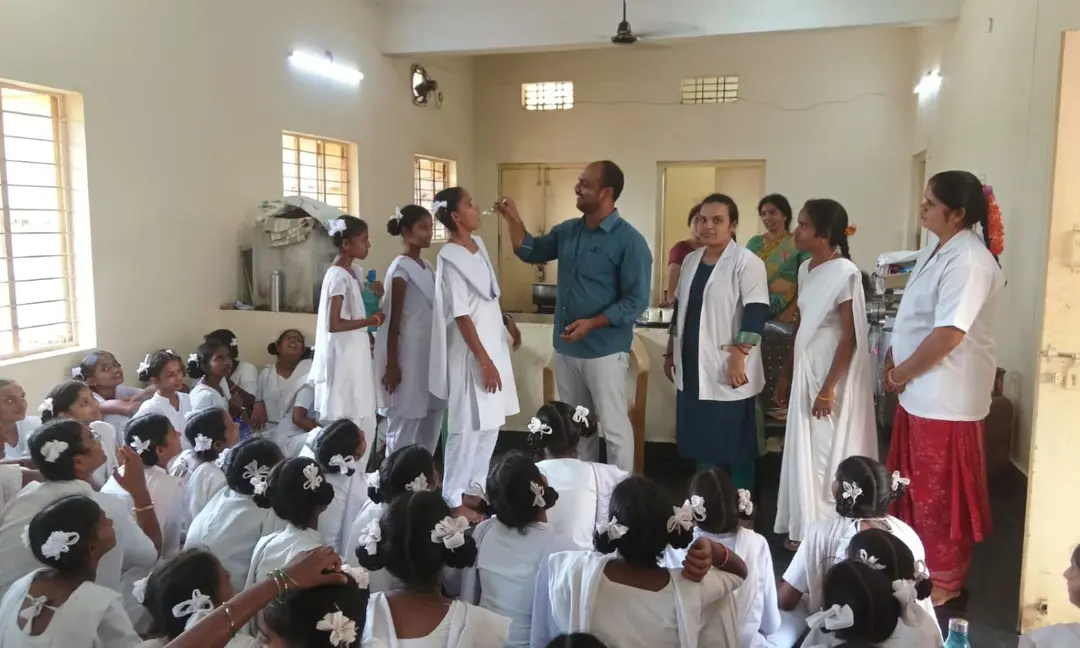
Albendazole tablets given to students in Obuladevaracheruvu
Albendazole tablets were distributed to students aged 1 to 19 in schools across Obuladevaracheruvu mandal on National Deworming Day, Medical Officer Dr Bhanu Prakash said. Speaking at a programme held at the local Kasturba school, he advised that the tablets be taken once every six months. Students were briefed on the importance of the iron tablets supplied every Thursday, the seven steps of handwashing, personal hygiene and nutritious food. Medical staff and teachers participated.
Source
Sri Sathya Sai — వార్తలు · read the original report ↗
Desk check · compared with the source
What the desk checked (5)
- Albendazole tablets were distributed to students aged 1 to 19 in mandal schools on National Deworming Day — Attributed in source to Medical Officer Dr Bhanu Prakash.
- The programme was held at the local Kasturba school — Stated in source; venue named without further documentation.
- Albendazole tablets should be taken once every six months for deworming — Advice attributed to the medical officer in the source.
- Iron tablets are given to students every Thursday — Appears in source as part of the officer's remarks; no separate data cited.
- Medical staff, teachers and other staff took part in the programme — Stated in source without names or numbers.
Analysts’ view opinion
This looks like a small local event, but it is actually one of India's largest school-based public health delivery models — using the school as the platform for reaching children. The design choice of giving a single tablet to everyone aged 1 to 19, rather than testing individuals first, deliberately trades precision for reach and lower cost. Bundling it with the weekly iron tablets, handwashing steps and nutrition messaging is the strongest part of the design: several schemes converging on one platform.
- Using schools as the delivery platform requires teachers and health staff to work together, so inter-departmental coordination is the real determinant of whether this model performs.
- A six-monthly cycle plus a fixed weekly iron tablet day are both routine-dependent designs, which means continuity — not the launch day — is the actual test.
- Pairing tablets with hygiene and handwashing education matters, because reinfection is driven by water and sanitation conditions; medication alone is not a durable fix.
- The core implementation challenge is coverage: out-of-school children, dropouts and the youngest age group can slip through, and the story says nothing about mop-up arrangements.
- Starting at a Kasturba residential school is notable, since such schools typically serve girls from disadvantaged backgrounds, suggesting a targeted equity benefit.
What to watch — Watch what share of eligible children in the mandal were actually covered, whether a mop-up day is held for those absent or out of school, and whether the second round lands on schedule in six months.
The story gives no numbers on how many students received tablets, how many schools were covered, or any change in worm infection rates, so it cannot support any judgement on impact.
Deep dive
Research brief · 7 facts · 1 dates · exam-readyThe brief
Context
On National Deworming Day, health staff in Obuladevaracheruvu mandal distributed Albendazole tablets to schoolchildren aged 1 to 19 years, according to Medical Officer Dr Bhanu Prakash. The main event was held at the local Kasturba school, where students also received health education. Deworming drives target intestinal worm infestation, which affects children's nutrition, and are paired with the weekly iron tablet supplementation and hygiene messaging in schools.
Key facts
- Albendazole tablets were distributed to students aged 1 to 19 years in schools across Obuladevaracheruvu mandal on National Deworming Day.
- The announcement was made by Medical Officer Dr Bhanu Prakash.
- The programme was held at the local Kasturba school.
- Dr Bhanu Prakash advised that Albendazole tablets be taken once every six months to prevent worm infestation.
- Students were told about the importance of the iron tablets provided every Thursday, alongside deworming tablets.
- Health education covered the seven steps of handwashing, personal hygiene and the nutritious food served in school.
- Medical staff, teachers and other staff participated in the programme.
Timeline
- National Deworming Day (exact date not stated in the source)Albendazole tablets distributed to students aged 1-19 in schools of Obuladevaracheruvu mandal; awareness programme held at the local Kasturba school.
Who has a stake
- Students aged 1-19 in Obuladevaracheruvu mandal — Receive deworming tablets, weekly iron tablets and hygiene education, affecting their nutrition and health.
- Dr Bhanu Prakash, Medical Officer — Led the announcement and advised six-monthly Albendazole dosage; responsible for local implementation.
- Medical staff — Administered tablets and delivered health education during the drive.
- Teachers and school staff of Kasturba school and other mandal schools — Participated in the programme; schools are the delivery platform for tablets and awareness.
Why it matters
Intestinal worm infestation drains nutrition from children and worsens anaemia, so school-based deworming combined with weekly iron tablets is a low-cost way to protect learning and growth. Reaching every child aged 1 to 19 in a mandal shows how national health days translate into ground-level delivery through schools and medical staff.
UPSC angle
Prelims pointers
- National Deworming Day: occasion on which Albendazole tablets are given to children and adolescents in schools.
- Target age group for deworming in this drive: 1 to 19 years.
- Albendazole is the drug used for prevention of intestinal worm (nulipurugulu) infestation.
- Recommended dosage frequency stated: once every six months.
- Iron tablets are supplied to students every Thursday in schools.
- Health education included the seven steps of handwashing and personal hygiene.
Mains framing
Worm infestation among children is a nutrition problem as much as an infection problem: worms compete for nutrients, aggravate anaemia and undermine school performance, which is why deworming is delivered through schools where children are already assembled. The Obuladevaracheruvu drive illustrates the model in practice — Albendazole for all students aged 1 to 19, a six-monthly dosage advisory, the weekly Thursday iron tablet supplementation, and simultaneous education on the seven steps of handwashing, personal hygiene and the nutritious meals served at school. The limitation of such campaign-day approaches is that tablets alone cannot break the reinfection cycle unless sanitation, safe water and hygiene behaviour improve, so convergence between health, education and sanitation departments is essential. The way forward, as the local programme suggests, lies in pairing periodic mass drug administration with sustained hygiene education, reliable iron supplementation and the active involvement of teachers and medical staff so that no child in the mandal is missed.
Key terms
- Albendazole
- Deworming tablet distributed to children and adolescents to prevent intestinal worm infestation.
- National Deworming Day
- Occasion on which deworming tablets are given to children in schools, as marked in Obuladevaracheruvu mandal.
- Iron tablets
- Supplement given to students every Thursday in schools, explained alongside deworming tablets.
- Kasturba school
- The local school in Obuladevaracheruvu where the deworming and health education programme was held.
- Seven steps of handwashing
- Standard handwashing technique taught to students as part of personal hygiene education.
Practice questions
- Why are schools used as the main platform for mass deworming and iron supplementation programmes in India? Discuss with reference to a local drive.
- Deworming tablets alone cannot end worm infestation among children. Examine the role of sanitation, safe water and hygiene education in sustaining gains.
- How does convergence between health, education and nutrition interventions improve child health outcomes at the mandal level?
Grounded only in the source report — figures and dates are the source's, not inferred.