
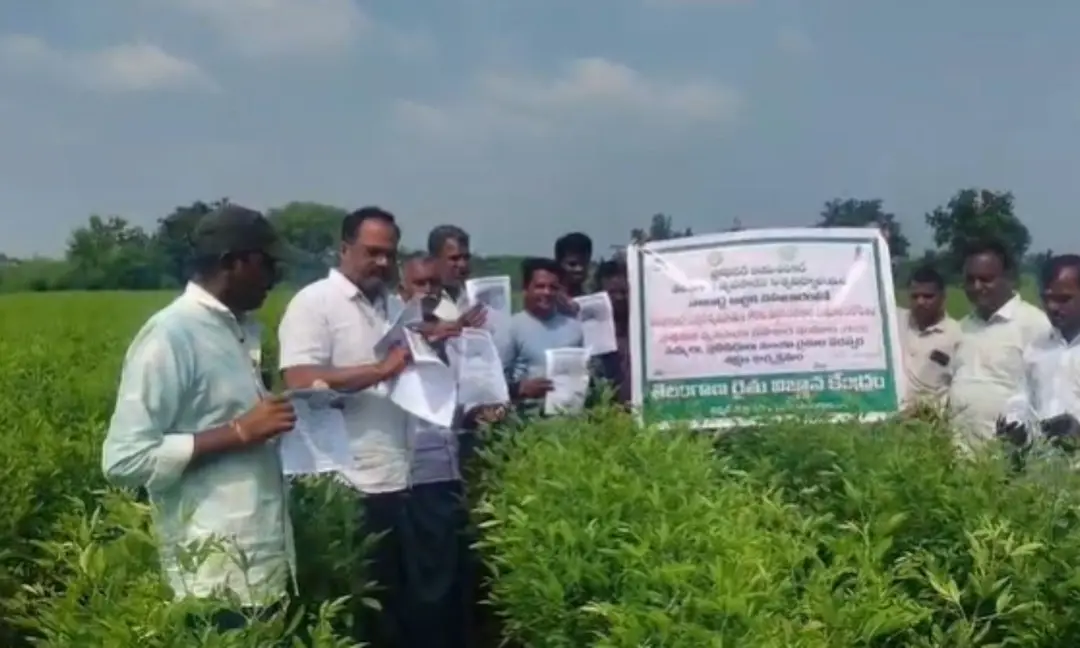
Farmers trained on redgram seed production at Eggam
Scientists Rahul and Dinesh of Professor Jayashankar Rao University inspected a redgram crop grown on six acres at Eggam village in Bhainsa mandal of Nirmal district under PACS Mirzapur. They said their aim is to supply better quality seeds to farmers. Kandi One and WRGE 97 varieties are being raised for seed production under the Agricultural Research Institute, Warangal. The produce will be bought by the society and sent to the seed research institute. Society secretary Rajender, staff member Suresh and farmer Kalyan Prasad took part.
Source
Nirmal — స్థానికం · read the original report ↗
Desk check · compared with the source
What the desk checked (5)
- Professor Jayashankar university scientists Rahul and Dinesh said the aim is to provide better quality seeds to farmers — Directly attributed to the two named scientists in the source
- Redgram is grown on six acres in Eggam village of Bhainsa mandal under PACS Mirzapur — Figure and arrangement appear in source; no independent documentation cited
- Kandi One and WRGE 97 varieties are being raised for seed production under the Agricultural Research Institute, Warangal — Attributed to the scientists' explanation in the source
- The harvest will be purchased through the society and sent to the seed research institute — Stated as a plan by the scientists; no timeline given in source
- Society secretary Rajender, staff member Suresh, farmer Kalyan Prasad and village farmers attended — Names listed in source without further identification
Analysts’ view opinion
This is a small item with a clear economic logic: pushing one stage of the seed supply chain down to the village level. Growing Kandi-1 and WRGE-97 pigeonpea on six acres for seed, with the cooperative society buying the harvest and routing it to the research institute, gives the farmer an assured buyer up front and strips out price uncertainty. The bigger long-run gain is not the sale itself but locally available quality seed, since poor seed in pigeonpea means lower yields and higher cost per acre.
- Contract-style seed production with a guaranteed buyer reduces the farmer's exposure to market price swings — that is the core economic attraction of this model.
- Producing seed locally can trim transport and intermediary margins, easing pressure on what farmers pay for seed.
- Pigeonpea is a structurally short pulse domestically, so seed quality that lifts yields carries macro relevance — though a six-acre pilot is nowhere near the scale that moves prices.
- Having the PACS act as buyer while university scientists provide the agronomy could open a modest new revenue line for the cooperative sector.
- The story gives no procurement price, premium, input cost or expected yield, so the net gain to the participating farmers cannot be calculated yet.
What to watch — Watch whether the society's procurement price carries a genuine premium over the open market and whether payments arrive on time — that will decide if the model scales beyond these six acres.
The story establishes no figures on prices, farmer incomes, yields or any expansion plan; it documents a field visit, not a proven outcome.
Deep dive
Research brief · 8 facts · 3 dates · exam-readyThe brief
Context
Scientists from Professor Jayashankar Telangana State Agricultural University visited Eggam village in Bhainsa mandal of Nirmal district, Telangana, to inspect a redgram (pigeonpea) crop being raised specifically for seed production. The six-acre plot is being cultivated under the Primary Agricultural Cooperative Society (PACS) Mirzapur, with technical backing from the Agricultural Research Institute, Warangal. Seed production programmes of this kind use selected farmers' fields to multiply notified varieties, whose produce is then procured and processed into certified quality seed for wider distribution.
Key facts
- Scientists Rahul and Dinesh of Professor Jayashankar Rao University inspected the redgram crop at Eggam village, Bhainsa mandal, Nirmal district.
- The redgram crop is being grown on six acres under PACS Mirzapur.
- Two varieties are being raised for seed production: Kandi One and WRGE 97.
- The seed production programme is under the Agricultural Research Institute, Warangal.
- The scientists said their aim is to supply better quality seeds to farmers.
- The harvested produce will be purchased through the society and sent to the seed research institute before quality seed is given to farmers.
- Farmers cultivating redgram were given several suggestions and advice during the visit.
- Society secretary Rajender, staff member Suresh, farmer Kalyan Prasad and other village farmers took part; report published 26 September 2026.
Timeline
- Kharif season (crop standing at time of visit; exact sowing date not stated in the source)Redgram raised on six acres at Eggam under PACS Mirzapur for seed production of Kandi One and WRGE 97.
- 26 September 2026University scientists Rahul and Dinesh inspect the crop, train farmers on seed production and outline the procurement plan; report published.
- After harvest (date not stated in the source)Society to buy the produce and send it to the seed research institute for supply of quality seed to farmers.
Who has a stake
- Farmers of Eggam village, Bhainsa mandal — Get training, advisory support and an assured buyer for their redgram seed crop on six acres.
- PACS Mirzapur (Primary Agricultural Cooperative Society) — Organises the six-acre seed plot and will procure the produce for onward supply to the seed research institute.
- Professor Jayashankar Rao University scientists (Rahul, Dinesh) — Responsible for field inspection, technical advice and the goal of supplying better quality seed to farmers.
- Agricultural Research Institute, Warangal — Oversees production of Kandi One and WRGE 97 seed varieties in the village.
- Society secretary Rajender, staff member Suresh, farmer Kalyan Prasad — Participated in the programme; local coordination and demonstration of the seed production model.
Why it matters
Quality seed is the cheapest and most decisive input in pulse farming, and redgram (tur/pigeonpea) is central to India's pulse supply and to dryland incomes in Telangana. By using cooperative societies and farmers' fields to multiply university-bred varieties like Kandi One and WRGE 97, the system shortens the chain between research institutes and the farm, while giving growers an assured buyer.
UPSC angle
Prelims pointers
- Redgram (kandi/tur/pigeonpea) seed production at Eggam village, Bhainsa mandal, Nirmal district, Telangana — six acres.
- Varieties under seed production: Kandi One and WRGE 97.
- Technical agency: Agricultural Research Institute, Warangal; scientists from Professor Jayashankar Rao University.
- PACS (Primary Agricultural Cooperative Society) Mirzapur is the implementing body that will procure the produce.
- Produce route: farmer field to society purchase to seed research institute to quality seed for farmers.
Mains framing
The Eggam initiative illustrates a decentralised model of seed multiplication: a state agricultural university and the Agricultural Research Institute, Warangal, identify notified redgram varieties (Kandi One, WRGE 97), a primary agricultural cooperative society organises six acres of farmer land for seed production, scientists provide in-field training and advisory, and the society buys back the produce for processing into quality seed. The underlying problem it addresses is the low seed replacement rate and uneven seed quality in pulses, which caps yields in rainfed districts; the strength of the approach is that it combines an assured market for participating farmers with a local supply of tested seed, reducing dependence on distant or informal sources. Implications include better varietal purity, scope for scaling to more villages through the cooperative network, and closer research-extension linkage. The way forward, on the evidence of this story, lies in wider farmer training on seed production practices such as isolation and roguing, timely procurement so that farmers are not left holding stocks, and transparent quality testing at the seed research institute — details on price, procurement volume and quality parameters are not stated in the source.
Key terms
- Redgram (kandi)
- Pigeonpea or tur, a major pulse crop; the crop grown on six acres at Eggam for seed production.
- Seed production (vitthanotpatti)
- Growing a crop specifically to produce seed of a given variety rather than for grain consumption.
- PACS
- Primary Agricultural Cooperative Society — village-level cooperative; PACS Mirzapur here organises and procures the seed crop.
- Kandi One and WRGE 97
- The two redgram varieties being multiplied for seed under the Warangal research institute's programme.
- Agricultural Research Institute, Warangal
- The research body under whose aegis the redgram seed varieties are being raised at Eggam.
Practice questions
- Discuss how farmer-participatory seed production through cooperative societies can raise the seed replacement rate in pulses. Illustrate with the redgram programme in Nirmal district.
- Examine the role of state agricultural universities and regional research institutes in strengthening research-extension linkages at the village level.
- Assured procurement is central to the success of seed multiplication programmes. Critically evaluate this statement with reference to pulse cultivation in Telangana.
Grounded only in the source report — figures and dates are the source's, not inferred.