
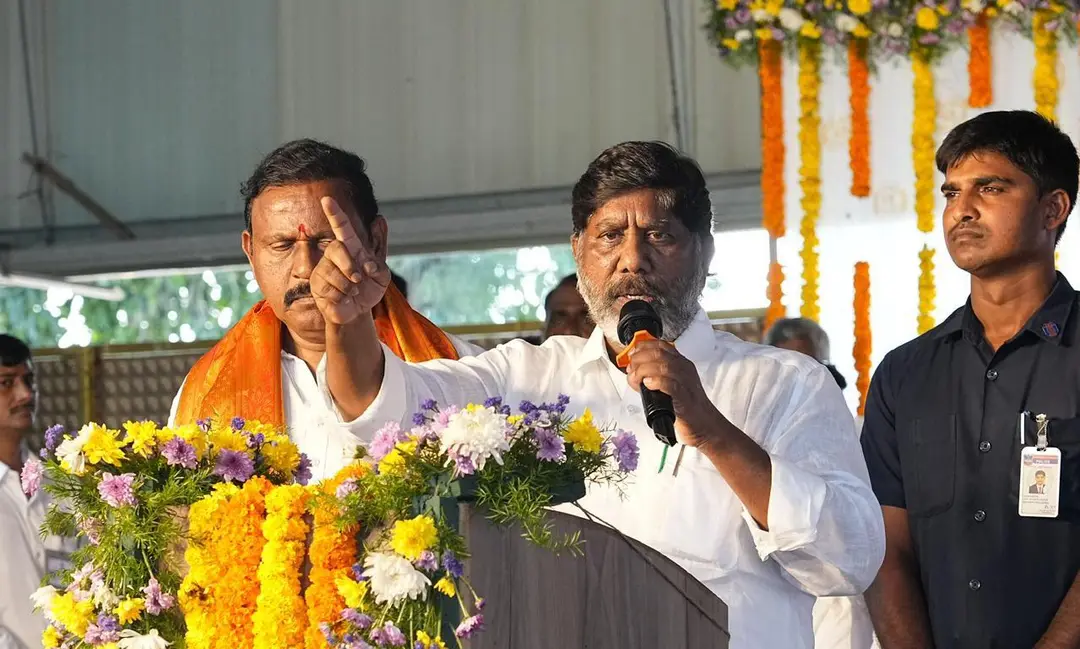
53 lakh families getting free power in Telangana: Bhatti
Deputy Chief Minister Mallu Bhatti Vikramarka said 53 lakh families in Telangana are receiving free electricity up to 200 units under the Gruha Jyothi scheme. He said 2.47 lakh families in Vikarabad district and 44,500 homes in the Parigi constituency are benefiting, and the state pays Rs 2,830 crore monthly for the supply. Addressing a meeting on Wednesday after inaugurating development works, he announced Rs 1,000 crore of power infrastructure works for Parigi.
Source
Vikarabad — jobs · read the original report ↗
Desk check · compared with the source
What the desk checked (5)
- 53 lakh families in Telangana get free power up to 200 units under Gruha Jyothi. — Attributed to Deputy CM Mallu Bhatti Vikramarka; figure appears in source.
- 2.47 lakh families benefit in Vikarabad district, including 1.43 lakh poor households; 44,500 homes in Parigi. — Attributed to the Deputy CM in his public meeting speech; no independent data cited.
- Government pays Rs 2,830 crore monthly statewide and Rs 42 crore for Vikarabad district for free power. — Stated by the Deputy CM; no departmental document referenced in source.
- Rs 1,000 crore electricity infrastructure works sanctioned for Parigi, including a 400 kV substation. — Announcement attributed to the Deputy CM; sanction order not cited.
- Allegations of massive corruption in the Rs 1 lakh crore Kaleshwaram project by BRS. — Political allegation by the Deputy CM; no BRS response included in source.
Analysts’ view opinion
This was less a ribbon-cutting than a scorecard exercise: the Gruha Jyothi numbers, double-bedroom houses and recruitment figures were stacked on one stage to reinforce Congress's "we delivered on our guarantees" narrative. Because the Deputy Chief Minister also holds the finance portfolio, presenting Rs.2,830 crore a month as benefit delivered rather than fiscal strain is a deliberate framing choice. At the same time, raising BRS's older promises — three acres of land, a job per household — is an attempt to shift the argument from the government's performance to the Opposition's credibility.
- Quoting state, district and constituency-level beneficiary counts is a strategy to translate welfare into booth-level, beneficiary-facing language.
- The Rs.1,000 crore power infrastructure package for Parigi plus public praise for the sitting MLA follows the familiar pattern of shoring up an incumbent legislator's local standing.
- Corruption allegations over Kaleshwaram and the NREGA reference revive the older political dividing line of Congress as pro-poor versus BRS as elite-oriented.
- Claiming credit for unblocking stalled projects — the Navy radar station, the Manneguda–Bijapur road — feeds the "decade of neglect" storyline against the previous regime.
- The reference to legal steps on Group-1 recruitment and thrice-weekly "Prajabata" outreach signals pre-emptive management of two political pressure points: jobless youth and power-sector grievances.
What to watch — Watch how hard the Opposition presses on the sustainability of a Rs.2,830 crore monthly free-power bill, and whether "Prajabata" functions as a genuine grievance-redressal channel or mainly as a publicity platform.
Everything here is a claim made by the Deputy Chief Minister at a public meeting — the beneficiary numbers, spending figures and project progress are not independently verified in this story, and no BRS or other Opposition response is recorded.
Deep dive
Research brief · 8 facts · 5 dates · exam-readyThe brief
Context
Telangana's Congress government, in office since December 2023, counts free household electricity among its flagship guarantees, delivered through the Gruha Jyothi scheme that gives up to 200 units free to eligible families. Deputy Chief Minister Mallu Bhatti Vikramarka, who also handles finance and energy portfolios in the state government, used a public meeting in the Parigi constituency of Vikarabad district to present coverage numbers and the subsidy bill. The speech doubled as a political attack on the previous BRS government over unfulfilled promises and alleged corruption in the Kaleshwaram project.
Key facts
- 53 lakh families across Telangana get free electricity up to 200 units under the Gruha Jyothi scheme, according to Deputy CM Mallu Bhatti Vikramarka.
- In Vikarabad district 2.47 lakh families benefit, including 1.43 lakh poor households; in Parigi constituency 44,500 homes get free power.
- The state pays Rs 2,830 crore every month statewide, and Rs 42 crore for Vikarabad district, to the electricity department for the free power supply.
- Rs 1,000 crore of electricity infrastructure works sanctioned for Parigi: one 400 kV substation, one 220 kV, one 33/11 kV and nine others.
- Rs 3,000 crore secured for the Navy radar station project in Vikarabad district, credited to Parigi MLA T. Rammohan Reddy.
- Double-bedroom houses: 3,500 per constituency sanctioned, totalling 4.5 lakh units at Rs 5 lakh each.
- 93 lakh families receive fine rice and medical benefits up to Rs 10 lakh under the Rajiv Aarogyasri scheme.
- Rs 1.6 lakh crore spent on welfare programmes; 60,000 jobs filled; 100 integrated schools with world-class standards being set up.
Timeline
- Undivided Andhra Pradesh periodThe Manneguda to Bijapur road was approved, but was later ignored by the previous regime, per Bhatti Vikramarka.
- UPA eraBRS leaders mocked NREGA workers, as recalled by the Deputy Chief Minister.
- Preceding decade (BRS rule)The Navy radar station project in Vikarabad district was neglected, he alleged.
- Recent (date not stated in the source)Chevella road accident; government extending all possible assistance to affected families.
- Wednesday (date not stated in the source)Bhatti Vikramarka inaugurates development works in Parigi and addresses a public meeting announcing Rs 1,000 crore power works.
Who has a stake
- 53 lakh beneficiary families in Telangana — Free electricity up to 200 units a month under Gruha Jyothi, reducing household energy costs.
- Telangana government / state exchequer — Bears Rs 2,830 crore monthly subsidy payment to the electricity department, plus Rs 1.6 lakh crore claimed welfare spend.
- Electricity department / discoms — Receives subsidy reimbursement; to run "Prajabata" grievance programmes thrice a week and promote solar generation.
- Parigi constituency and MLA T. Rammohan Reddy — Rs 1,000 crore power infrastructure and credit for Rs 3,000 crore Navy radar station project.
- BRS (Opposition) — Accused of unfulfilled promises (three-acre land, jobs per household, Bangaru Telangana) and corruption in Rs 1 lakh crore Kaleshwaram project.
- Chevella road accident-affected families — Promised all possible government assistance.
- Group-1 job aspirants — Government pursuing legal measures to ensure Group-1 recruitment; 60,000 jobs stated as filled.
Why it matters
Free power to 53 lakh households at Rs 2,830 crore a month is one of the largest recurring commitments on Telangana's budget, making the scheme both a welfare lifeline and a fiscal question for the state and its power utilities. The same speech shows how welfare delivery numbers are becoming the main currency of political contestation between the Congress government and the BRS.
UPSC angle
Prelims pointers
- Gruha Jyothi: Telangana scheme giving free electricity up to 200 units per month; 53 lakh families covered as stated.
- Rajiv Aarogyasri: health scheme cited as giving medical benefits up to Rs 10 lakh; 93 lakh families also get fine rice.
- Mallu Bhatti Vikramarka is Deputy Chief Minister of Telangana.
- Kaleshwaram project valued at Rs 1 lakh crore in the source; BRS accused of corruption in it.
- Parigi power works include a 400 kV substation, a 220 kV and a 33/11 kV substation among 12 works worth Rs 1,000 crore.
- "Prajabata" programmes to be held thrice a week under the electricity department for grievance redressal and solar promotion.
Mains framing
Telangana's Gruha Jyothi scheme illustrates the political economy of electricity subsidies in Indian states: universalised free supply up to 200 units for 53 lakh families, financed by a Rs 2,830 crore monthly transfer from the state to the electricity department, alongside claimed welfare spending of Rs 1.6 lakh crore and 4.5 lakh double-bedroom houses. Such transfers improve energy access and household consumption for poor families, but they also lock in large recurring liabilities that compete with capital spending on the grid itself — which is why the same announcement pairs consumption subsidy with Rs 1,000 crore of substation and network works in Parigi to support industrial growth. The government's stated remedies point in useful directions: strengthening transmission capacity, promoting rooftop and other solar generation to cut the subsidised load, and institutionalising grievance redressal through thrice-weekly "Prajabata" camps. The contest with the BRS over unmet promises and alleged Kaleshwaram corruption shows that the deeper governance test is not the announcement but verifiable delivery, timely subsidy reimbursement to discoms so their finances are not strained, and transparent targeting so benefits reach the poorest households.
Key terms
- Gruha Jyothi
- Telangana government scheme providing free electricity up to 200 units per month to eligible households.
- Rajiv Aarogyasri
- State health scheme cited as offering medical benefits up to Rs 10 lakh to beneficiary families.
- Kaleshwaram project
- Rs 1 lakh crore irrigation project in Telangana over which the Deputy CM alleged massive BRS-era corruption.
- Prajabata
- Proposed outreach programme under the electricity department, thrice a week, to resolve grievances and promote solar power.
- NGT-2 hurdles
- Clearance obstacles cited as cleared by the Congress government to expedite the four-lane Manneguda-Bijapur road; details not stated in the source.
- Double-bedroom houses
- State housing scheme units, 3,500 per constituency and 4.5 lakh in total, each costing Rs 5 lakh.
Practice questions
- Free electricity schemes like Telangana's Gruha Jyothi expand energy access but strain state finances. Examine this trade-off with reference to the figures announced by the state government.
- Discuss how electricity subsidies interact with the financial health of state distribution companies, and suggest measures to reconcile welfare goals with utility viability.
- Welfare delivery numbers have become the primary language of state-level political competition. Critically analyse, using the Telangana case.
Grounded only in the source report — figures and dates are the source's, not inferred.