
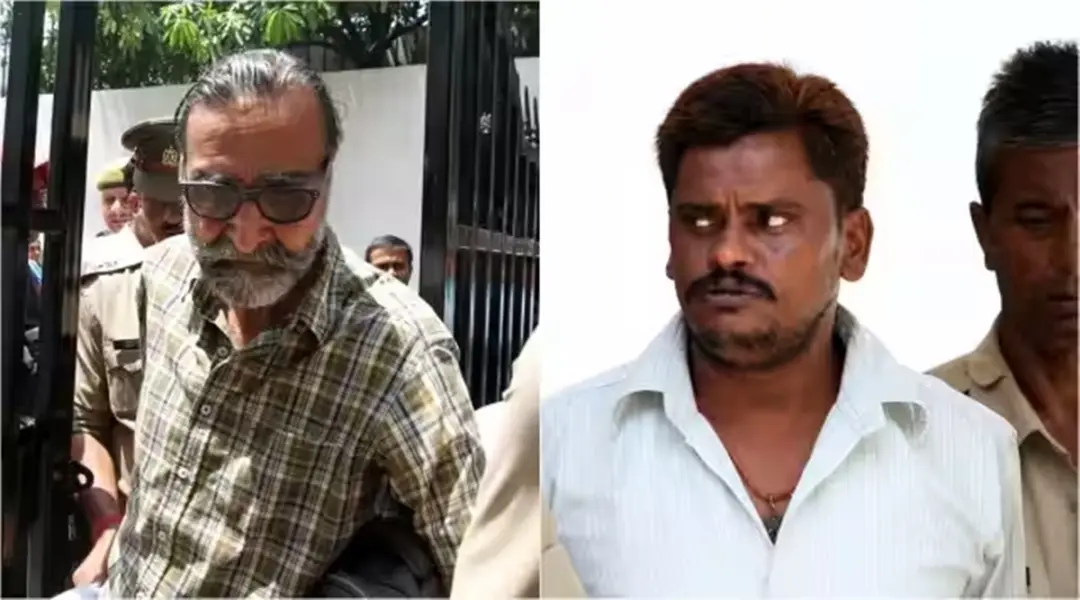
Surendra Koli, acquitted in Nithari case, found dead in Haridwar
Surendra Koli, acquitted in the 2006 Nithari serial murders case in 2025, was found dead at his tea stall in Haridwar on Friday, police said. He had moved to the Uttarakhand city a few months ago. Tried in over a dozen cases of rape and murder of women and children, Koli spent 19 years in jail and walked out of Kasna jail in Greater Noida last November after the Supreme Court set aside his conviction in the rape and murder of a teenage girl. His former employer Moninder Singh Pandher was acquitted in 2023.
Source
Indian Express — India · read the original report ↗
Desk check · some claims need care
What the desk checked (5)
- Surendra Koli was found dead at his tea stall in Haridwar on Friday — Attributed to police in the source; no officer named and cause of death not detailed in the body text.
- Koli walked out of Kasna jail in Greater Noida in November 2025 after the Supreme Court set aside his conviction — Appears in source as reported fact, consistent with the timeline given.
- He spent 19 years in jail in the Nithari serial killings case — Figure appears in source; source elsewhere says 'nearly two decades' and 'over 20 years', a minor internal inconsistency.
- 19 FIRs were filed against Koli and Pandher; CBI filed chargesheets in 16 — Figures appear in the source timeline attributed to the CBI investigation; no document cited.
- Moninder Singh Pandher, Koli's former employer, was acquitted in 2023 — Consistent with the timeline in the source, which cites Allahabad High Court acquittal for lack of evidence.
Analysts’ view opinion
Surendra Koli's death brings a tragic and unresolved close to the Nithari litigation — a sequence of 19 years in custody, a death sentence, commutation to life, and finally acquittal by the Supreme Court that points to two structural weaknesses in Indian criminal justice: investigative failure and delay. An acquittal does not mean no crime occurred; it means the prosecution did not meet the standard of proof, which leaves the question of justice for the victims' families unanswered. His death legally ends any remaining proceedings against him, but it does not end the question of systemic accountability.
- Acquittals of this kind usually rest on evidentiary weakness and investigative lapses, and as a matter of settled principle do not amount to a positive finding of innocence.
- The 2015 commutation of the death sentence on grounds of "inordinate delay" in deciding the mercy petition reflects the established principle that prolonged delay is itself a distinct ground under Article 21.
- That 19 FIRs and 16 chargesheets against one man ended in acquittal across the board shows how sharply evidence was assessed differently at the special court, High Court and Supreme Court levels.
- As a general rule, criminal proceedings abate on the death of an accused; here, with acquittals already recorded, the practical effect of that rule is limited.
- Where any death raises the possibility of unnatural cause, police are expected to follow routine steps such as inquest and post-mortem — this story establishes nothing about the cause.
What to watch — Watch whether the police inquiry and post-mortem clarify the cause of death, and whether questions of accountability or compensation for prolonged incarceration and investigative failure are taken up in any forum.
The story establishes nothing about how or why Koli died, and it does not answer who was actually responsible for the Nithari murders or who bears responsibility for the flawed investigation.
Deep dive
Research brief · 8 facts · 10 dates · exam-readyThe brief
Context
The Nithari case refers to the discovery in December 2006 of human skeletal remains in a drain and open land behind a house in Noida's Sector 31 (Nithari village) owned by businessman Moninder Singh Pandher, where Surendra Koli worked as domestic help. The two were accused of abducting, raping and killing women and children from nearby areas, and 19 FIRs were registered against them. After nearly two decades of trials, convictions, death sentences and appeals, both were eventually acquitted — Pandher in 2023 and Koli by the Supreme Court in November 2025. Koli, who had moved to Haridwar a few months ago, was found dead at his tea stall there on Friday, police said.
Key facts
- Surendra Koli was found dead at his tea stall in Haridwar, Uttarakhand, on Friday; he had moved to the city a few months ago.
- Koli spent 19 years behind bars in the Nithari serial killings case and walked out of Kasna jail in Greater Noida in November 2025.
- The murders came to light in December 2006 when human remains were found in a drain near Pandher's house in Nithari, Noida's Sector 31.
- Pandher and Koli were arrested on December 29, 2006 after police recovered skeletons and belongings of missing girls from the drain.
- A total of 19 FIRs were filed against the duo for crimes against 19 different girls; the CBI filed chargesheets in 16 of them.
- On February 13, 2009, a special CBI court convicted and sentenced both to death for the rape and murder of a 14-year-old.
- In 2023, the special court acquitted Pandher in two cases and Koli in 12 cases; the Allahabad High Court then acquitted both for lack of evidence and Pandher walked free.
- Koli was tried in over a dozen cases of rape and murder of women and children.
Timeline
- 2005-2006Several women and children reported missing from Nithari village in Noida's Sector 31.
- December 2006Human skeletal remains found in a drain and open land behind Moninder Singh Pandher's house, bringing the murders to light.
- December 29, 2006Pandher and his domestic help Koli arrested after skeletons and belongings of missing girls were recovered.
- 2006-2009CBI teams visit the Nithari house and interrogate the accused; 19 FIRs filed, chargesheets in 16.
- February 13, 2009Special CBI court convicts and sentences Koli and Pandher to death in the rape and murder of a 14-year-old.
- 2011Supreme Court dismisses Koli's appeal.
- 2011-2014Allahabad High Court affirms Koli's death sentence and acquits Pandher; Koli's review petition dismissed in 2014.
- January 2015Allahabad High Court commutes Koli's death sentence to life imprisonment citing inordinate delay in disposal of the mercy petition.
- 2017Special CBI court in Ghaziabad awards death sentence to the duo in the rape and murder of a 25-year-old help who went missing in 2006.
- 2023Special court acquits Pandher in two cases and Koli in 12; Allahabad High Court acquits both for lack of evidence and Pandher walks out free.
Who has a stake
- Surendra Koli — Domestic help accused in over a dozen rape-murder cases; spent 19 years in jail, was acquitted in 2025 and has now been found dead in Haridwar.
- Moninder Singh Pandher — Koli's former employer, at whose Nithari house the skeletons were found; acquitted in 2023 and walked out of jail.
- Families of the 19 victims — Missing women and children from Nithari; with all acquittals complete, the cases end without anyone convicted.
- Central Bureau of Investigation (CBI) — Investigating agency that filed chargesheets in 16 of 19 FIRs; its evidence was found wanting by the High Court.
- Judiciary (special CBI courts, Allahabad High Court, Supreme Court) — Passed death sentences, commutation and eventual acquittals across nearly two decades of litigation.
- Haridwar police / Uttarakhand police — Confirmed Koli's death at his tea stall; investigation of the death is with them.
Why it matters
The Nithari case was among India's most notorious serial-crime investigations, yet after 19 years in custody, death sentences and multiple trials, both accused ended up acquitted, with the last acquittal coming from the Supreme Court in November 2025. Koli's death months after his release closes the human story of a case in which 19 FIRs produced no surviving conviction, raising hard questions about investigation quality, custodial time and justice for victims' families.
UPSC angle
Prelims pointers
- Nithari case: skeletal remains found December 2006 behind a house in Nithari village, Noida Sector 31.
- Accused: Moninder Singh Pandher (house owner) and Surendra Koli (his domestic help); arrested December 29, 2006.
- Investigating agency: CBI; 19 FIRs registered, chargesheets filed in 16 cases.
- February 13, 2009: special CBI court awarded death sentence to both in the rape-murder of a 14-year-old.
- January 2015: Allahabad High Court commuted Koli's death sentence to life imprisonment for inordinate delay in deciding his mercy petition.
- November 2025: Supreme Court acquitted Koli, the final acquittal in the Nithari cases; Pandher was acquitted in 2023.
Mains framing
The Nithari saga illustrates how a sensational crime investigation can collapse under the weight of weak evidence and prolonged litigation. Between 2005 and 2006 several women and children went missing from Nithari; the discovery of remains in December 2006 led to 19 FIRs, CBI chargesheets in 16, death sentences from special CBI courts in 2009 and 2017, and eventually acquittals — Pandher in 2023 and Koli by the Supreme Court in November 2025 — with the Allahabad High Court citing lack of evidence. Along the way Koli spent 19 years in jail and had his death sentence commuted to life in January 2015 because of inordinate delay in disposing of his mercy petition, a reminder that procedural delay itself becomes a constitutional issue. The implications are twofold: victims' families are left without any convicted perpetrator, while an accused lost two decades of liberty on evidence courts finally found insufficient. The way forward, as the source's sequence suggests, lies in evidence-led investigation, timely trial and appellate disposal, and prompt decision on mercy petitions, so that neither the victim's right to justice nor the accused's right to a fair and speedy trial is defeated.
Key terms
- Nithari case
- The 2006 serial rape-murder case arising from skeletal remains found in a drain and land behind a house in Nithari village, Noida Sector 31.
- CBI (Central Bureau of Investigation)
- Central agency that investigated the Nithari killings, interrogated the accused and filed chargesheets in 16 of the 19 FIRs.
- Special CBI court
- Designated court trying CBI cases; convicted Koli and Pandher on February 13, 2009 and awarded another death sentence in 2017 at Ghaziabad.
- Mercy petition
- Clemency plea by a death-row convict; its inordinate delay led the Allahabad High Court to commute Koli's death sentence in January 2015.
- Kasna jail
- Jail in Greater Noida from which Koli walked out in November 2025 after the Supreme Court set aside his conviction.
- Acquittal for lack of evidence
- Ground on which the Allahabad High Court in 2023 freed the duo, holding the prosecution evidence insufficient to sustain conviction.
Practice questions
- The Nithari case ended in acquittals after 19 years of incarceration. Critically examine what such outcomes reveal about the quality of criminal investigation and the right to a speedy trial in India.
- Discuss the constitutional and jurisprudential significance of commuting a death sentence on the ground of inordinate delay in deciding a mercy petition, with reference to the Nithari case.
- Where the prosecution fails and the accused is acquitted, what remedies remain for victims' families? Suggest institutional reforms with reference to the Nithari killings.
Grounded only in the source report — figures and dates are the source's, not inferred.