
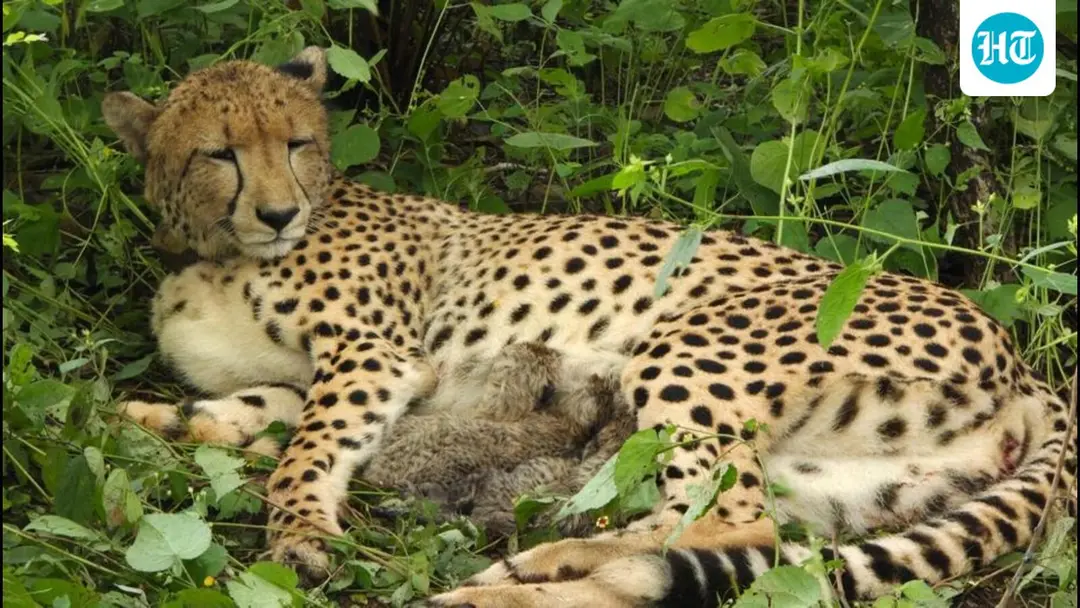
Kuno cheetah KGP12 gives birth to four cubs, India's count reaches 36
India-born female cheetah KGP12 gave birth to four cubs on September 18 at Kuno National Park in Madhya Pradesh's Sheopur. Field director Uttam Sharma said staff spotted the cubs on Friday and are monitoring them from a distance, adding she is the second India-born female to give birth at Kuno after Mukhi. The number of cheetahs born and surviving in India has risen to 36. Kuno hosts 53 cheetahs and three are at Gandhi Sagar. Union minister Bhupendra Yadav called it a historic moment for Project Cheetah.
Source
Hindustan Times — India · read the original report ↗
Desk check · compared with the source
What the desk checked (5)
- India-born female cheetah KGP12 gave birth to four cubs on September 18 at Kuno National Park, Sheopur. — Attributed to Union environment minister Bhupendra Yadav's statement and confirmed by field director Uttam Sharma in the source.
- Forest staff spotted the cubs on Friday and are monitoring them from a distance. — Attributed to Kuno National Park field director Uttam Sharma.
- Number of cheetahs born and surviving in India has risen to 36; Kuno hosts 53 cheetahs and three are at Gandhi Sagar Wildlife Sanctuary. — Figures appear in the source without an individually named source; consistent within the text.
- Project Cheetah began on September 17, 2022 with eight cheetahs from Namibia, followed by 12 from South Africa and nine from Botswana. — Figures appear in the source; no separate attribution given.
- KGP12 is the second India-born female to give birth at Kuno, after Mukhi. — Directly quoted from field director Uttam Sharma.
Analysts’ view opinion
KGP12's four cubs at Kuno are not just a conservation story — they hand the Union government a ready-made political narrative. Project Cheetah, launched on September 17, 2022 under the Prime Minister's leadership and criticised in its early phase over cheetah deaths, can now point to an India-born female breeding on Indian soil. The fact that Union minister Bhupendra Yadav framed it immediately as a "historic and joyous moment", around the project's anniversary window, signals how deliberately this milestone will be used.
- Reintroduction projects take years to show results, so the "four years, four new lives" framing gives the government a simple, countable success metric.
- Because Project Cheetah is explicitly tied to the Prime Minister's leadership, the credit flows to the Centre rather than staying a state-level achievement.
- The ruling party in Madhya Pradesh also gains locally, with three cheetah sites — Kuno, Gandhi Sagar and the planned Rani Durgavati Tiger Reserve — carrying tourism and employment appeal.
- Opposition voices and some conservation experts who questioned the project's costs, habitat capacity and local displacement during the early deaths phase may revive those arguments; none of those counter-claims appear in this story.
- The natural-breeding claim is politically useful because it answers the charge that the project depends indefinitely on imports from Africa.
What to watch — Watch the timing and scale of the translocation to Rani Durgavati Tiger Reserve, and whether it is turned into a high-visibility government showcase.
The story does not establish how many of the cubs will survive, what the project's long-term cost-benefit balance is, or how critics and the opposition will respond.
Deep dive
Research brief · 8 facts · 5 dates · exam-readyThe brief
Context
India's Project Cheetah, launched at Kuno National Park (KNP) in Madhya Pradesh's Sheopur district on September 17, 2022, brought the cheetah back to Indian habitats through translocations from Africa. The programme's success is now measured by natural breeding within India, especially births to India-born females. On September 18, KGP12, a female cheetah born in India, gave birth to four cubs at Kuno, taking the number of cheetahs born and surviving in India to 36.
Key facts
- KGP12, an India-born female cheetah, gave birth to four cubs on September 18 at Kuno National Park, Sheopur, Madhya Pradesh.
- Forest staff spotted the cubs on Friday and are monitoring them from a distance, said KNP field director Uttam Sharma.
- Sharma said KGP12 is the second India-born female to give birth at Kuno, after Mukhi.
- With these births, the number of cheetahs born and surviving in India has risen to 36.
- Kuno National Park now hosts 53 cheetahs; three cheetahs are at Gandhi Sagar Wildlife Sanctuary.
- Preparations are complete for a third home at Rani Durgavati Tiger Reserve, where translocation will begin soon.
- Project Cheetah was launched on September 17, 2022 with eight cheetahs from Namibia; since then 12 more came from South Africa and nine from Botswana.
- Union environment minister Bhupendra Yadav called it a historic and joyous moment, describing it as 'Four years, four new lives'.
Timeline
- September 17, 2022Project Cheetah launched at Kuno National Park under PM Narendra Modi's leadership with eight cheetahs from Namibia.
- After 2022 (dates not stated in the source)12 more cheetahs brought from South Africa and nine from Botswana.
- Earlier (date not stated in the source)Mukhi becomes the first India-born female cheetah to give birth at Kuno.
- September 18 (Thursday)India-born female KGP12 gives birth to four cubs at Kuno National Park.
- Friday (the next day)Forest staff spot the cubs and begin monitoring them from a distance.
Who has a stake
- Kuno National Park administration and field director Uttam Sharma — Responsible for monitoring cubs from a distance, habitat management, drone surveys and ensuring survival and breeding.
- Union Ministry of Environment / minister Bhupendra Yadav — Political and policy ownership of Project Cheetah; presents the births as proof of conservation success.
- Madhya Pradesh (Sheopur, Gandhi Sagar, Rani Durgavati Tiger Reserve) — Hosts all current cheetah populations; must ready a third home for translocation.
- Namibia, South Africa and Botswana — Source countries that supplied eight, 12 and nine cheetahs respectively for the reintroduction.
- KGP12 and her four cubs — Survival of the cubs is central to the project's long-term breeding success in Indian conditions.
Why it matters
Births to India-born females such as KGP12 and Mukhi shift Project Cheetah from repeated imports to self-sustaining natural breeding on Indian soil. With 36 cheetahs born and surviving in India, 53 at Kuno and three at Gandhi Sagar, the population is now large enough to require a third site at Rani Durgavati Tiger Reserve, making habitat expansion and monitoring the next test of the project.
UPSC angle
Prelims pointers
- Project Cheetah launched on September 17, 2022 at Kuno National Park, Sheopur district, Madhya Pradesh.
- Source countries: Namibia (8 cheetahs), South Africa (12) and Botswana (9).
- Cheetahs born and surviving in India: 36 after KGP12's four cubs.
- Current distribution: 53 cheetahs at Kuno, three at Gandhi Sagar Wildlife Sanctuary.
- Rani Durgavati Tiger Reserve is being readied as the third cheetah home; translocation to begin soon.
- Mukhi was the first India-born female to give birth at Kuno; KGP12 is the second.
Mains framing
The birth of four cubs to KGP12, an India-born female, marks a qualitative shift in Project Cheetah: from translocating cheetahs from Namibia, South Africa and Botswana to demonstrating natural breeding and adaptation within Indian conditions, with 36 cheetahs now born and surviving in India. The immediate management challenge is carrying capacity and dispersal: Kuno alone hosts 53 cheetahs, only three are at Gandhi Sagar, and a third site at Rani Durgavati Tiger Reserve is being prepared for translocation, indicating that a single park cannot sustain the growing population. As the field director notes, survival and breeding have depended on drone surveys, habitat management and close monitoring, including keeping cubs under observation from a distance to minimise disturbance. The way forward, on the evidence in the source, lies in completing the multi-site network, sustaining intensive monitoring and habitat preparation so that cub survival rates hold, and treating India-born litters rather than imports as the true metric of the project's long-term success.
Key terms
- Project Cheetah
- India's cheetah reintroduction programme launched at Kuno National Park on September 17, 2022 under PM Narendra Modi's leadership.
- Kuno National Park (KNP)
- Protected area in Sheopur, Madhya Pradesh, the first site of cheetah reintroduction; now hosts 53 cheetahs.
- KGP12
- India-born female cheetah that gave birth to four cubs on September 18 at Kuno; the second India-born female to give birth there.
- Mukhi
- The first India-born female cheetah to give birth at Kuno National Park.
- Gandhi Sagar Wildlife Sanctuary
- Second cheetah home in Madhya Pradesh, currently holding three cheetahs.
- Rani Durgavati Tiger Reserve
- Site being readied as a third home for cheetahs, where translocation will begin soon.
Practice questions
- Assess Project Cheetah's progress since September 17, 2022. To what extent do births to India-born females indicate a self-sustaining population?
- Why is expansion beyond Kuno National Park to sites such as Gandhi Sagar and Rani Durgavati Tiger Reserve necessary for the cheetah reintroduction programme?
- Discuss the role of monitoring technologies such as drone surveys and habitat management in the survival and breeding of translocated large carnivores in India.
Grounded only in the source report — figures and dates are the source's, not inferred.