
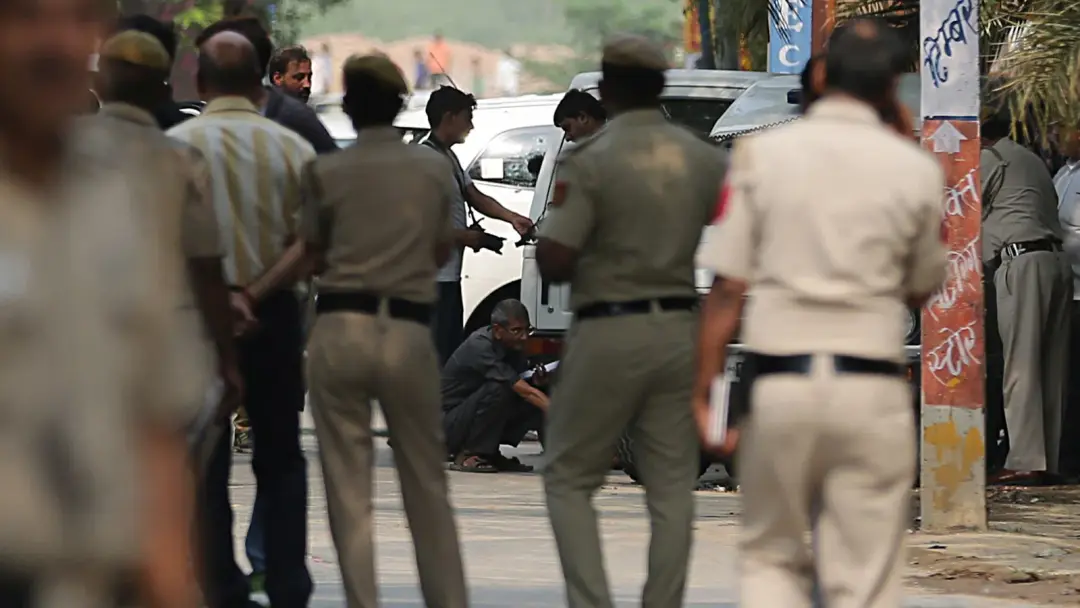
Girl harassed in Samastipur; four arrested, POCSO case filed
Police said a girl was allegedly harassed by a group of youths on a bypass road a few kilometres from Samastipur district headquarters in Bihar. SP Arvind Pratap Singh said the video was noticed during social media monitoring on September 23 and the incident appears to have occurred about a week earlier. An FIR was registered at Karpurigram police station under the Bharatiya Nyaya Sanhita, POCSO Act and IT Act. Vikas Kumar, Rahul Kumar, Ram Babu Sahni and Awadhesh Paswan were arrested within six hours.
Source
Indian Express — India · read the original report ↗
Desk check · some claims need care
What the desk checked (5)
- A girl was harassed by a group of youths on a bypass road near Samastipur district headquarters in daylight. — Described as alleged, based on a purported video and police sources cited in the source text.
- Four accused — Vikas Kumar, Rahul Kumar, Ram Babu Sahni and Awadhesh Paswan — were arrested within six hours of the alert. — Attributed to Samastipur SP Arvind Pratap Singh in the source.
- FIR registered at Karpurigram police station under the Bharatiya Nyaya Sanhita, POCSO Act and IT Act on a police officer's statement. — Attributed to the SP; source notes the girl's identity could not be immediately established.
- The video surfaced during social media monitoring on September 23 and the incident appears to have occurred about a week earlier. — Attributed to the SP; the timing is stated as an apparent estimate, not confirmed.
- Tejashwi Yadav said the incident proves law and order has collapsed in BJP-ruled Bihar. — Quoted from his post on X as reproduced in the source; political allegation, not verified fact.
Analysts’ view opinion
The legally significant move here is that police registered the FIR on the statement of an officer, without the victim having come forward or been identified. Because the girl appeared prima facie to be a minor, invoking POCSO changes the shape of the case entirely: a designated special court, statutory timelines and specific protections for the victim. Four arrests within six hours signals speed, but the real legal test will be forensic authentication of the video, formal age determination and the quality of evidence gathered a week after the alleged incident.
- An FIR based on a police officer's statement is legally workable, since sexual harassment and POCSO offences are cognisable and do not require a victim's complaint to start an investigation.
- Age determination is pivotal: if the girl is confirmed a minor, POCSO's stiffer penalties and special-court procedure apply; if not, the case rests on Bharatiya Nyaya Sanhita provisions alone.
- The IT Act provisions point at the recording and circulation of the video, meaning liability may extend beyond those present at the scene to those who spread identifying content.
- The roughly week-long gap between incident and FIR gives the defence room to question delay and the integrity of scene-based evidence, so the video's chain of custody becomes central.
- The arrested men retain full constitutional protections — presumption of innocence, legal representation and due process — and political criticism of law and order is not a substitute for judicial findings.
What to watch — Watch for official age verification of the girl, compliance with the statutory charge-sheet timeline, and whether the case is formally committed to a POCSO special court.
This account rests on police statements and untested allegations; it does not establish guilt, confirm the victim's age, or show that the video will withstand scrutiny in court.
Deep dive
Research brief · 8 facts · 6 dates · exam-readyThe brief
Context
A video purportedly showing a girl being harassed by a group of youths on a bypass road a few kilometres from Samastipur district headquarters in Bihar surfaced on social media. Police said the clip shows men pulling her by the hair and hand, asking her name and dragging her while she resists; she had stopped to take photographs while travelling with a boy. Samastipur police detected the video during social media monitoring on the evening of September 23, registered an FIR at Karpurigram police station and arrested four men. The case follows a similar incident on the outskirts of Jamui, where two teenagers were stopped, assaulted and allegedly molested, which became a political flashpoint.
Key facts
- The alleged harassment occurred on a bypass road a few kilometres from Samastipur district headquarters, in broad daylight.
- Police sources said the girl had stopped to take photographs while travelling with a boy when three men surrounded and harassed her.
- The video came to police notice during social media monitoring on the evening of September 23, when it was circulating widely across platforms.
- SP Arvind Pratap Singh said the incident appears to have taken place around a week before the video was detected.
- The girl appeared, prima facie, to be a minor; as her identity could not be established immediately, the FIR was registered on Thursday on a police officer's statement.
- The FIR at Karpurigram police station invokes the Bharatiya Nyaya Sanhita, the POCSO Act and the Information Technology Act.
- All four accused — Vikas Kumar, Rahul Kumar, Ram Babu Sahni and Awadhesh Paswan, all residents under the local police station limits — were arrested within six hours of the alert.
- In the earlier Jamui case, Nandan Yadav and Hareram Yadav were arrested, three minors detained, and Yadav was injured in a police encounter earlier this week with police claiming he resisted arrest.
Timeline
- About a week before September 23The alleged harassment of the girl on the Samastipur bypass road takes place, per police assessment.
- Days before the Samastipur caseVideo of two teenagers stopped, assaulted and allegedly molested on the outskirts of Jamui triggers outrage; FIR under BNS and POCSO.
- Evening of September 23Samastipur police notice the video during social media monitoring; technical verification done and location identified.
- ThursdayFIR registered at Karpurigram police station on a police officer's statement under BNS, POCSO and IT Act.
- Within six hours of the alertAll four accused identified and arrested; questioning under way, efforts on to identify others.
- Earlier this week (Jamui case)Accused Nandan Yadav injured in a police encounter; police say he was resisting arrest.
Who has a stake
- The girl (prima facie a minor) — Safety, privacy and protection from further mental or social harm through circulation of the video.
- Samastipur Police / SP Arvind Pratap Singh — Credibility of investigation; identifying remaining accused and preventing identity disclosure of the victim.
- The four arrested men — Face charges under BNS, POCSO and IT Act; further legal action under way.
- Social media users sharing the video — Police warned that revealing a minor victim's identity amounts to a cognisable offence and action will be taken.
- Tejashwi Yadav, Leader of the Opposition and RJD national working president — Alleges collapse of law and order in Bihar, making the case a political issue.
- Bihar government and Chief Minister — Accused by the Opposition of inaction and caste-based handling of criminals; law-and-order record under scrutiny.
Why it matters
The case shows how videos of crimes against women and minors now surface online days after the offence, making social media monitoring itself a trigger for FIRs. It also highlights the tension between public outrage driven by viral clips and the legal duty to shield a minor victim's identity, which police say is a cognisable offence to breach. Coming days after the Jamui incident, it has turned women's safety and law and order in Bihar into a political flashpoint.
UPSC angle
Prelims pointers
- POCSO Act, 2012 protects children from sexual offences; disclosure of a minor victim's identity is punishable.
- Bharatiya Nyaya Sanhita has replaced the IPC as India's general penal law and was invoked in both the Samastipur and Jamui FIRs.
- Information Technology Act provisions were invoked for circulation of the video on social media.
- FIR in the Samastipur case was registered at Karpurigram police station on the statement of a police officer, as the victim's identity was not established.
- Samastipur SP Arvind Pratap Singh said the video was detected during social media monitoring on the evening of September 23.
- Four accused — Vikas Kumar, Rahul Kumar, Ram Babu Sahni, Awadhesh Paswan — arrested within six hours of the alert.
Mains framing
The Samastipur case, coming days after Jamui, points to a pattern of public harassment of women and minors in which the offence becomes actionable only after a video circulates, indicating under-reporting, bystander silence and delayed complaint-making rather than absence of law. Police response here relied on suo motu action: technical verification of the clip, location identification and an FIR on a police officer's statement under the Bharatiya Nyaya Sanhita, the POCSO Act and the IT Act, with four arrests within six hours — showing that proactive social media monitoring can substitute for a victim complaint where the survivor is a minor whose identity is unknown. Yet the same virality that enables detection endangers the victim, which is why Samastipur police warned that sharing content revealing a minor's identity is a cognisable offence. The political contestation, with the Leader of the Opposition alleging a collapse of law and order and caste-based handling of criminals, illustrates how such crimes become electoral issues, risking both exaggeration and dismissal as "stray incidents". The way forward lies in victim-centric investigation, strict enforcement of identity-protection provisions, speedy POCSO trials, and sustained policing of vulnerable public stretches rather than reactive action after outrage.
Key terms
- POCSO Act
- Protection of Children from Sexual Offences Act, the special law used when the victim of a sexual offence is a minor.
- Bharatiya Nyaya Sanhita (BNS)
- India's general criminal code under which the Samastipur and Jamui FIRs were registered.
- Information Technology Act
- Law covering online offences, invoked here for the recording and circulation of the video.
- FIR on a police officer's statement
- A case registered by police on their own initiative when the victim's identity or complaint is unavailable, as done in Samastipur.
- Cognisable offence
- An offence in which police can act and arrest without prior court permission; police said revealing a minor victim's identity is one.
- Social media monitoring
- Police surveillance of online platforms, through which the Samastipur video was detected on September 23.
Practice questions
- Viral videos are increasingly the trigger for registering cases of crimes against women and children. Examine the opportunities and risks this poses for victim-centric policing in India.
- Discuss the safeguards under the POCSO Act relating to the identity of a minor victim, and the challenges of enforcing them in the era of social media.
- "Crimes against women become political flashpoints but rarely lead to systemic reform." Critically analyse with reference to recent incidents in Bihar.
Grounded only in the source report — figures and dates are the source's, not inferred.