
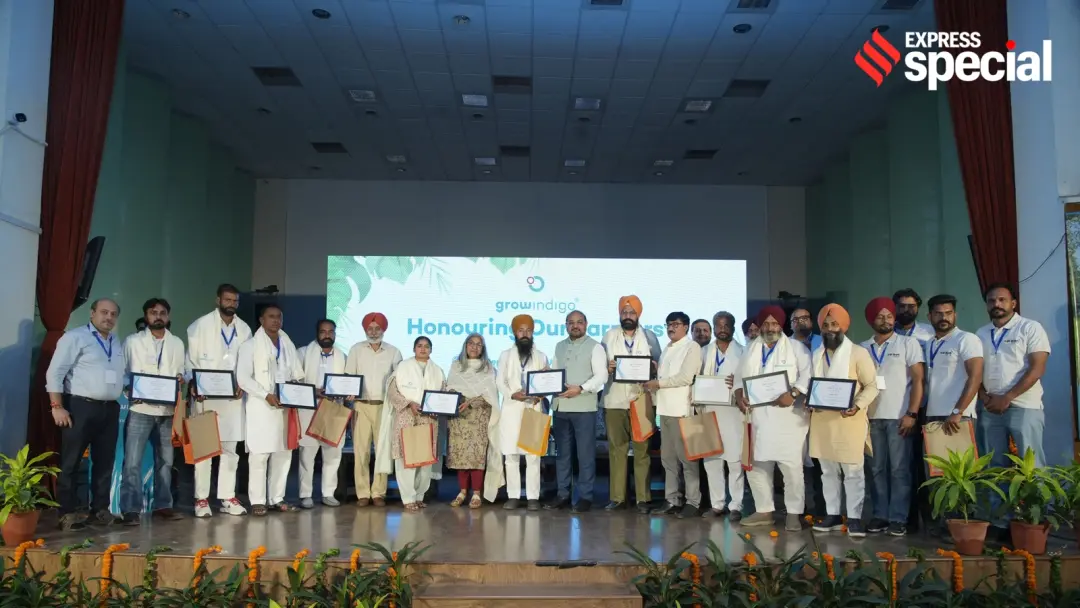
Farmers get Rs 2.5 crore in first carbon credit payouts
Around 2,500 farmers have become the first in India to receive carbon credit payments for improved agricultural practices, including about 1,400 from Punjab and the rest from Haryana. Over 50,000 carbon credits were generated, with farmers receiving Rs 3,000-Rs 15,000 each, totalling around Rs 2.50 crore. The programme was initiated by agro-tech firm Grow Indigo in 2019 with technical guidance from ICAR. The farmers were felicitated at an event in Ludhiana. ICAR said Punjab's farm-fire incidents fell from over 83,000 in 2020 to fewer than 5,000 in 2025.
Source
Indian Express — Cities · read the original report ↗
Desk check · compared with the source
What the desk checked (5)
- About 2,500 farmers — around 1,400 from Punjab, rest from Haryana — received carbon credit payments totalling about Rs 2.50 crore, with individual payments of Rs 3,000-Rs 15,000. — Figures appear in source; presented as a first-of-its-kind payout, no independent verification possible.
- Over 50,000 carbon credits were generated in the first set of payments, based on verified credits and not acreage. — Figure appears in source, attributed to the programme; verification method described but not documented.
- Programme was initiated by agro-tech firm Grow Indigo in 2019 with technical guidance from ICAR, with an MoU with ICAR-ATARI Ludhiana. — Attributed to source reporting; institutional details named.
- Punjab farm-fire incidents fell from over 83,000 in 2020 to fewer than 5,000 in 2025. — Attributed to ICAR in the source.
- Individual payouts include Sahib Singh Rs 5,700, Jagmail Singh Rs 19,000, Baldev Singh Rs 6,070, Gurpreet Singh Rs 9,075, Bhim Singh Rs 12,000. — Named farmers with amounts in source; note Jagmail Singh's Rs 19,000 exceeds the stated Rs 3,000-15,000 range.
Analysts’ view opinion
The headline number is small — about Rs 2.5 crore split across roughly 2,500 farmers, or a few thousand rupees each — but the economic significance is not the size of the cheque, it is the creation of a price for something that previously earned nothing. For the first time, a Punjab or Haryana farmer's decision to use direct seeded rice, skip tillage or bale residue instead of burning it has a cash return attached, paid by a private buyer rather than the exchequer. That shifts stubble management from a compliance cost imposed by regulation to a revenue line, however thin. The open economic question is whether payments of Rs 3,000-15,000 are large enough to cover the machinery, labour and yield-risk costs these practices involve.
- Who pays and who gains is the key structural change here: the money comes through a private agri-tech programme monetising verified credits, not from a state subsidy, so the taxpayer burden is limited while farmers capture a new income stream.
- Per-farmer amounts are modest and vary widely (Rs 3,000 to Rs 15,000 in the reported cases), and because payments track verified credits rather than acreage, returns depend on measured practice change — the story does not establish the cost side of adoption for comparison.
- The measurement and verification layer — satellite monitoring, geo-fencing, soil sampling, ICAR technical oversight — is the real asset being built, since credit prices ultimately depend on buyer confidence that the reductions are real.
- The sharp fall in Punjab farm fires from over 83,000 in 2020 to under 5,000 in 2025 points to large avoided public costs in health and air quality, but the story attributes it only to ICAR data and does not credit this programme with causing it.
- Scale-up economics are untested: 50,000-plus credits across a couple of thousand farmers is a pilot-sized market, and expanding it means recurring verification costs and dependence on volatile voluntary carbon prices.
What to watch — Watch whether payouts recur and rise in subsequent cycles, and whether more buyers and farmers enter — a one-off pilot payment and a durable annual income stream have very different effects on adoption of climate-smart practices.
The story does not establish the price per credit, who the ultimate buyers are, what adopting these practices costs farmers, or that the carbon payments caused the decline in farm fires.
Deep dive
Research brief · 8 facts · 6 dates · exam-readyThe brief
Context
For the first time in India, farmers have been paid for verified carbon credits earned by changing farming practices rather than by acreage. Around 2,500 farmers in Punjab and Haryana received a total of about Rs 2.50 crore, generated from over 50,000 carbon credits. The programme was started by agro-tech firm Grow Indigo in 2019 with technical guidance from ICAR, and includes an MoU with ICAR-ATARI, Ludhiana. Eligible practices include direct seeded rice, reduced or zero tillage, better crop residue management and more efficient fertiliser use — all relevant to Punjab's rice-wheat system.
Key facts
- Around 2,500 farmers received India's first carbon credit payments — roughly 1,400 from Punjab and the rest from Haryana.
- Over 50,000 carbon credits were generated; payouts ranged from about Rs 3,000 to Rs 15,000 per farmer, totalling around Rs 2.50 crore.
- Payment is based on verified carbon credits attributed to a farmer, not linked to acreage.
- The programme was initiated by agro-tech firm Grow Indigo in 2019, with technical guidance from ICAR; an MoU exists between ICAR-ATARI Ludhiana and Grow Indigo.
- Punjab's farm-fire incidents fell from over 83,000 in 2020 to fewer than 5,000 in 2025, as per ICAR.
- Sahib Singh (45) of Kothe Lal Singh Wale village, Bathinda, owning about 13 acres, got Rs 5,700 for stopping paddy residue burning for 7-8 years.
- Other payouts: Jagmail Singh Rs 19,000, Nishan Singh Rs 14,000, Baldev Singh Rs 6,070, Gurpreet Singh Rs 9,075, Bhim Singh Rs 12,000; Varinderpal Singh and Surendra Kumar Rs 3,000 each.
- Punjab's pre-existing carbon credit scheme, launched in August 2024, pays farmers for agroforestry, requiring trees to be maintained for at least five years.
Timeline
- 2019Grow Indigo initiates the carbon credit programme for improved farm practices, with technical guidance from ICAR.
- 2020Punjab records over 83,000 farm-fire incidents (ICAR figure).
- August 2024Punjab launches an agroforestry-based carbon credit scheme paying farmers for raising and maintaining trees on farmland.
- 2025Punjab's farm-fire incidents drop to fewer than 5,000, as per ICAR.
- Recent (date not stated in the source)BRICS Summit in New Delhi adopts declarations on a BRICS Network of Centres of Excellence on Agroecology and Regenerative Agriculture, and a BRICS Network on Digital Agriculture.
- Not stated in the sourceFarmers receiving the first payouts are felicitated at an event in Ludhiana attended by scientists.
Who has a stake
- Farmers of Punjab and Haryana (around 2,500 beneficiaries) — New income stream of Rs 3,000-Rs 15,000 for adopting emission-reducing, soil- and water-conserving practices.
- Grow Indigo (agro-tech firm) — Initiated and runs the programme since 2019; designs it as a continuing process rather than a one-time payment.
- ICAR and ICAR-ATARI, Ludhiana — Provide technical guidance, farmer education, documentation and verification through field evidence and technology; MoU partner.
- DARE (Department of Agriculture, Research and Education) — Its Secretary and ICAR DG Dr M L Jat highlights satellite, remote-sensing, geo-fencing and soil sampling for monitoring.
- Punjab government — Runs a separate August 2024 agroforestry carbon credit scheme; benefits from declining farm fires.
- Public/environment — Reduced stubble burning, lower greenhouse-gas emissions, better soil organic carbon and water conservation.
Why it matters
It monetises climate-smart farming for the first time in India, giving cultivators a direct financial reason to stop stubble burning, cut water use and build soil carbon — as one farmer put it, his way of farming "has finally acquired an economic value". Coupled with ICAR's report of farm fires falling from over 83,000 in 2020 to under 5,000 in 2025 in Punjab, it suggests incentives plus verification technology can shift practices in the rice-wheat belt. The model's credibility, however, rests on rigorous measurement, documentation and verification of carbon gains.
UPSC angle
Prelims pointers
- India's first farm carbon credit payouts: around 2,500 farmers, over 50,000 credits, about Rs 2.50 crore in total.
- Programme initiated by Grow Indigo in 2019; technical guidance from ICAR; MoU with ICAR-ATARI, Ludhiana.
- Payment is linked to verified carbon credits, not to acreage.
- Punjab farm fires: over 83,000 in 2020 to fewer than 5,000 in 2025 (ICAR).
- Punjab's earlier agroforestry carbon credit scheme launched August 2024; trees to be maintained at least five years.
- Recent BRICS Summit in New Delhi adopted declarations on a BRICS Network of Centres of Excellence on Agroecology and Regenerative Agriculture and a BRICS Network on Digital Agriculture.
Mains framing
India's rice-wheat cropping system in Punjab and Haryana is emission-intensive and water-stressed, with paddy residue burning a persistent air-quality problem; conventional bans and penalties address the symptom rather than the incentive structure. The first carbon credit payouts — around Rs 2.50 crore to about 2,500 farmers for over 50,000 verified credits — mark a shift from regulation to remuneration, rewarding direct seeded rice, reduced or zero tillage, residue management and efficient fertiliser use. Because payment is tied to verified credits rather than acreage, the model's integrity depends on measurement, reporting and verification: ICAR officials cite satellite and remote-sensing systems including geo-fencing to monitor fields and burning, and soil sampling to assess soil organic carbon. Institutional scaffolding matters too — ICAR's extension role, the ICAR-ATARI Ludhiana MoU with Grow Indigo, Punjab's separate agroforestry credit scheme of August 2024, and international frameworks such as the BRICS networks on agroecology, regenerative agriculture and digital agriculture. The way forward, as officials suggest, is to treat carbon payments as a continuing process rather than a one-time transfer, broaden the focus beyond stubble burning to whole-farm practices, and strengthen documentation so small payouts of Rs 3,000-Rs 15,000 can grow into a dependable supplementary income.
Key terms
- Carbon credit
- A tradable unit representing verified reduction in greenhouse-gas emissions or added/retained carbon, here earned by farmers for changed practices.
- Direct seeded rice (DSR)
- Sowing paddy directly in the field instead of transplanting, which cuts water use.
- ICAR-ATARI
- ICAR's Agricultural Technology Application Research Institute; the Ludhiana unit has an MoU with Grow Indigo for this programme.
- DARE
- Department of Agriculture, Research and Education, whose Secretary is also Director General of ICAR.
- Ex-situ residue management
- Removing crop residue from the field, for example as bales, instead of burning or incorporating it in situ.
- Geo-fencing
- Satellite/remote-sensing based virtual boundary used to monitor specific fields for practices and residue burning.
Practice questions
- Carbon markets in agriculture can align farmer incomes with climate goals. Examine this in light of India's first farm carbon credit payouts in Punjab and Haryana.
- Discuss how monitoring technologies such as satellite remote sensing, geo-fencing and soil sampling can strengthen the credibility of agricultural carbon credit programmes.
- Punjab's farm fires fell from over 83,000 in 2020 to fewer than 5,000 in 2025. Analyse the role of incentives versus regulation in achieving such change.
Grounded only in the source report — figures and dates are the source's, not inferred.