
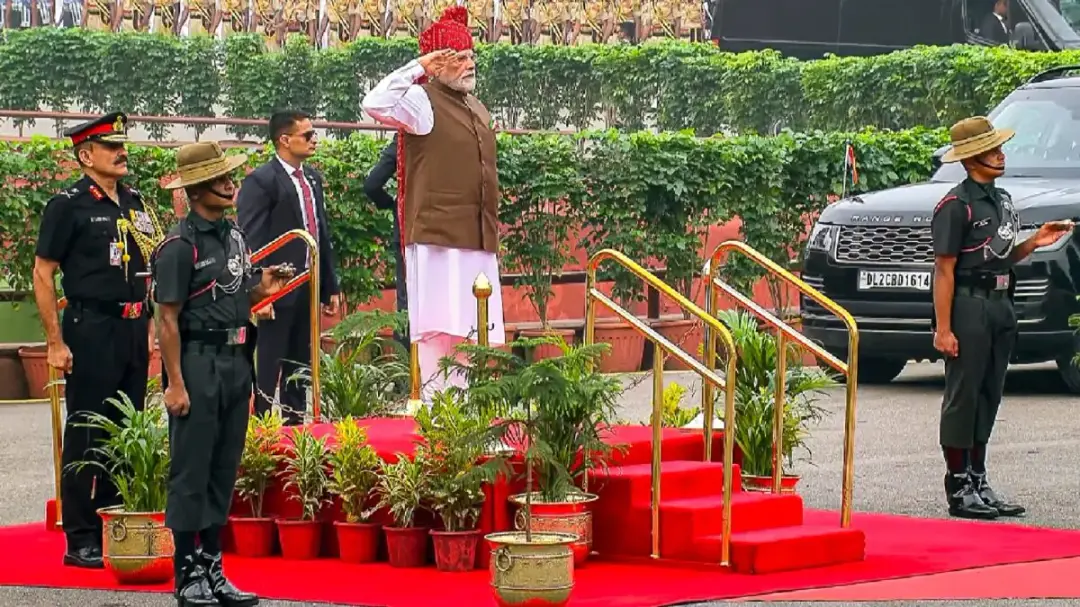
Modi turns 76, marks 25 years heading a government
Prime Minister Narendra Modi turned 76 on September 17, alongside 25 years since he first took charge of a government. He became Gujarat chief minister on October 7, 2001, served nearly 13 years and moved to national politics in 2014. The BJP won 282 seats in 2014, 303 in 2019 and 240 in 2024, when Modi took oath for a third consecutive term on June 9. The BJP is marking the milestone with a month-long Seva Sankalp Abhiyan from September 17 to October 17.
Source
News18 — India · read the original report ↗
Desk check · compared with the source
What the desk checked (5)
- Narendra Modi turns 76 on September 17 and marks 25 years heading a government. — Stated in source; source is dated September 17, 2026, and refers to a 2026 campaign.
- Modi became Gujarat chief minister on October 7, 2001, serving nearly 13 years. — Specific date and duration appear in the source text.
- BJP won 282 seats in 2014, 303 in 2019 and 240 in 2024; Modi took oath for a third term on June 9, 2024. — All figures appear in the source; no external verification performed.
- BJP is running a month-long Seva Sankalp Abhiyan from September 17 to October 17 linking Vadnagar and Varanasi. — Attributed to the BJP in the source.
- BJP president Nitin Nabin described the period since 2001 as a journey devoted to public service. — Attributed statement; designation as BJP president is as given in the source.
Analysts’ view opinion
The BJP is treating Modi's 76th birthday less as a personal date and more as a political framing device — a "quarter century in government" narrative that doubles as legacy-building and organisational mobilisation. The month-long Seva Sankalp Abhiyan, with programmes linking Vadnagar to Varanasi, is designed to fuse leadership with the vocabulary of service. That matters more after 2024, when the BJP won 240 seats on its own and needed coalition partners, making leader-centred campaigns a useful instrument to keep the cadre energised.
- The seat arc — 282 in 2014, 303 in 2019, 240 in 2024 — shows continued dominance at the centre alongside a changed parliamentary arithmetic.
- Without a single-party majority, allies carry more weight, which raises the political value of campaigns anchored in personal appeal.
- A month-long drive is as much a ground-level cadre mobilisation exercise as a celebration, effectively keeping the electoral machinery warm.
- The symbolic Vadnagar-to-Varanasi link reinforces the BJP's preferred storyline of a modest beginning leading to national leadership.
- Opposition criticism of personality-centred politics, and of contested chapters such as 2002, Article 370 and the pandemic response, is likely to continue as the counter-narrative.
What to watch — Watch how far the campaign, running to October 17, tilts from service-and-schemes messaging towards outright electoral mobilisation, and how opposition parties choose to respond.
The story establishes a timeline and a campaign, not anything about succession, future leadership plans, or whether such outreach shifts voter behaviour.
Deep dive
Research brief · 8 facts · 10 dates · exam-readyThe brief
Context
Prime Minister Narendra Modi turned 76 on September 17, a birthday that coincides with 25 years since he first headed a government. He was appointed Gujarat chief minister on October 7, 2001, as a BJP organisational leader with no prior stint in constitutional office, and served nearly 13 years before moving to national politics in 2014. He has since completed three terms as prime minister, taking oath for a third consecutive term on June 9, 2024. The BJP is marking the quarter-century milestone with a month-long Seva Sankalp Abhiyan running from September 17 to October 17.
Key facts
- Modi became Gujarat chief minister on October 7, 2001, and held the post for nearly 13 years before shifting to national politics in 2014.
- Gujarat had been hit by a devastating earthquake in January 2001; Modi said "the biggest responsibility at that time was the rehabilitation of Gujarat".
- In the 2002 Gujarat Assembly election, held after the Godhra train-burning incident of February 2002, the BJP won 127 of the state's 182 seats.
- The BJP won 117 Gujarat seats in 2007 and 115 in 2012, giving Modi second and third consecutive terms as chief minister.
- In September 2013 the BJP named Modi its prime ministerial candidate for the 2014 Lok Sabha election.
- The BJP won 282 of 543 Lok Sabha seats in 2014, 303 in 2019 (NDA crossing 350) and 240 in 2024, below the 272-seat majority mark.
- Modi became prime minister on May 26, 2014, and took oath for a third consecutive term on June 9, 2024 — only the second PM after Jawaharlal Nehru to do so after general elections.
- The BJP's Seva Sankalp Abhiyan runs September 17 to October 17 and includes programmes symbolically linking Vadnagar, Modi's birthplace, with Varanasi, his Lok Sabha constituency.
Timeline
- January 2001A devastating earthquake hits Gujarat; reconstruction becomes the incoming government's main task.
- October 7, 2001Modi, then a BJP organisational leader, is appointed Gujarat chief minister.
- February 2002Godhra train-burning incident, followed by communal violence in Gujarat.
- 2002BJP wins 127 of 182 seats in the Gujarat Assembly election; Modi begins his first full term as CM.
- 2007BJP wins 117 Gujarat seats; the "Gujarat model" becomes central to political debate around Modi.
- 2012BJP wins 115 seats; Modi secures a third consecutive term as Gujarat chief minister.
- September 2013BJP declares Modi its prime ministerial candidate for the 2014 general election.
- May 26, 2014Modi becomes prime minister after the BJP wins 282 seats on its own in the 543-member Lok Sabha.
- August 2019Parliament approves legislation ending Jammu and Kashmir's special status under Article 370 and reorganising it into two Union Territories.
- March 2020India enters a nationwide COVID-19 lockdown; large-scale vaccination and relief measures follow.
Who has a stake
- Narendra Modi — His 25-year record as head of government — Gujarat CM for nearly 13 years and three PM terms — forms the core of his political legitimacy.
- Bharatiya Janata Party — Uses the milestone, through Seva Sankalp Abhiyan, to frame Modi's career as continuous public service and national development.
- NDA coalition partners — After the BJP won only 240 seats in 2024, allies became essential to government formation, unlike in 2014 and 2019.
- Opposition parties and critics — Question the 2002 violence handling, the manner of the Article 370 decision, federalism concerns, and the 2020 lockdown's human cost.
- Voters of Varanasi and Vadnagar — Modi's Lok Sabha constituency and birthplace are symbolically linked in the BJP campaign's programmes.
- BJP president Nitin Nabin — Has framed the period since 2001 as a journey devoted to public service and national development.
Why it matters
Twenty-five continuous years at the head of a government — first in a state, then at the Centre — is unusual in contemporary Indian politics and reshapes how leadership continuity, welfare delivery and coalition management are debated. The changing seat tallies of 282, 303 and 240 show both the durability and the limits of a single-leader mandate. How the record is remembered, as continuous service or as contested policy choices, will shape political argument well beyond one birthday.
UPSC angle
Prelims pointers
- Modi became Gujarat chief minister on October 7, 2001; PM on May 26, 2014; third-term oath on June 9, 2024.
- BJP Lok Sabha tallies: 282 (2014), 303 (2019), 240 (2024); majority mark is 272 in the 543-member House.
- Modi is the second PM after Jawaharlal Nehru to return for a third consecutive term following general elections.
- Gujarat Assembly has 182 seats; BJP won 127 (2002), 117 (2007) and 115 (2012).
- August 2019: Parliament ended J&K's special status under Article 370 and created the UTs of Jammu and Kashmir, and Ladakh.
- Seva Sankalp Abhiyan: BJP campaign, September 17 to October 17, linking Vadnagar (birthplace) and Varanasi (constituency).
Mains framing
Modi's 25 years at the head of a government fall into three phases the source identifies: BJP organisational work, nearly 13 years as Gujarat chief minister from October 2001, and over a decade as prime minister. The Gujarat phase was built on post-earthquake reconstruction and three successive Assembly wins (127, 117 and 115 seats), which supporters converted into the \"Gujarat model\" of infrastructure, investment and administrative efficiency, while critics questioned whether social indicators and equitable distribution were adequately captured. At the Centre, the record includes flagship programmes such as Swachh Bharat Mission, Jan Dhan Yojana, Make in India and Digital India, the August 2019 abrogation of Article 370 with the reorganisation of Jammu and Kashmir, and pandemic governance from the March 2020 lockdown to mass vaccination — each contested, with critics citing federalism, civil liberties, the migrant-worker crisis and the 2021 second wave. The 2024 verdict of 240 seats, short of 272, marks a structural shift: coalition partners are now essential, implying greater negotiation in legislative and policy design. The way forward, on the source's own terms, is to assess the record through electoral outcomes and verifiable policy consequences rather than through campaign framing alone.
Key terms
- Seva Sankalp Abhiyan
- Month-long BJP campaign from September 17 to October 17 marking Modi's 76th birthday and 25 years heading a government.
- Gujarat model
- Term for Gujarat's investment, infrastructure and administrative record under Modi, used as the basis of his 2014 national pitch.
- Pradhan Sevak
- "Chief servant" — Modi's self-description in his first Independence Day speech from the Red Fort: "I am not the Prime Minister. I am the Pradhan Sevak."
- Article 370
- Constitutional provision giving Jammu and Kashmir special status; effectively ended by Parliament in August 2019 alongside reorganisation into two UTs.
- NDA
- National Democratic Alliance; crossed 350 seats in 2019 and in 2024 supplied the numbers the BJP alone lacked.
- Sabka Saath, Sabka Vikas
- BJP slogan later expanded with "Sabka Vishwas" and "Sabka Prayas", part of the government's political vocabulary.
Practice questions
- Trace the three phases of Narendra Modi's political career as set out in the source, and assess what the changing BJP seat tallies of 2014, 2019 and 2024 indicate about the nature of his mandates.
- The 2024 result made coalition partners essential to government formation. Discuss the implications of coalition dependence for policy-making, compared with single-party majorities in 2014 and 2019.
- Evaluate the competing assessments of the "Gujarat model" and of the government's COVID-19 response as presented in the source.
Grounded only in the source report — figures and dates are the source's, not inferred.