
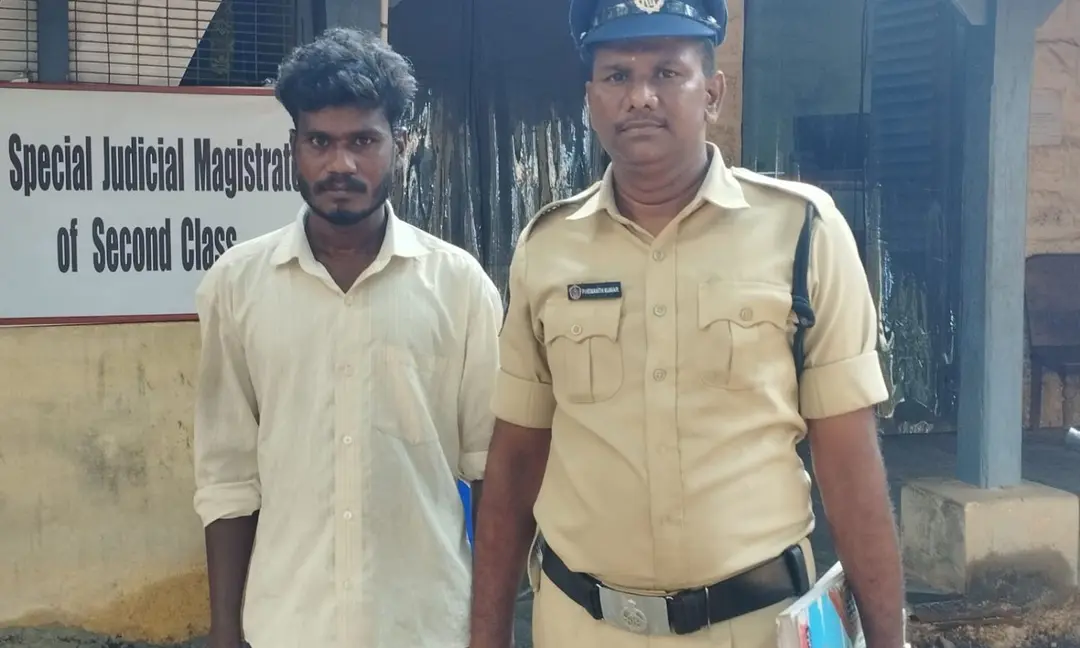
Renigunta drunk driving case: accused gets 10 days community service
A court in Tirupati has ordered community service for a man in a drunk driving case. The II Special Judicial Magistrate of II Class court issued the order on October 7 after A. Munikrishna (34) of Venkatagopalapuram in Renigunta mandal admitted the offence. He must clean and maintain areas around Renigunta urban police station and the government hospital from October 7 to 16, under the Renigunta SHO's supervision, and submit a photo compliance report by 10:30 am on October 17.
Source
Tirupati — వార్తలు · read the original report ↗
Desk check · compared with the source
What the desk checked (4)
- Tirupati's II Special Judicial Magistrate of II Class court issued the order on October 7. — Attributed to the court in the source; date and court designation appear in source text.
- A. Munikrishna (34) of Venkatagopalapuram in Renigunta mandal admitted to drunk driving. — Name, age and address appear in source; admission of guilt attributed to court proceedings.
- Court ordered 10 days of community service from October 7 to 16 around Renigunta urban police station and the government hospital. — Figure and dates appear in source as part of the court order.
- A compliance report with photographs must be submitted by 10:30 am on October 17, with the Renigunta SHO supervising. — Specific directive stated in source, attributed to the court.
Analysts’ view opinion
This is a small case that nonetheless signals a shift in sentencing practice. With the accused pleading guilty, the court chose 10 days of community service instead of custody or a fine — consistent with the growing recognition of community service as a sentencing option for minor offences under India's newer criminal law framework. The conditions attached — SHO supervision, a photo-backed compliance report and a fixed deadline — are designed to keep enforcement of the order under judicial oversight.
- The guilty plea let the case move straight to sentencing without a full trial, which is routine in summary proceedings before a magistrate.
- Opting for community service over jail or a fine reflects a reformative rather than purely punitive approach for low-severity offences.
- The chosen sites — the police station surroundings and the government hospital premises — are both publicly useful and easy to supervise.
- Requiring a photographic compliance report by a set date builds in a verification mechanism so the sentence does not remain only on paper.
- The court's warning of action under law for non-compliance makes clear that community service here is an enforceable sentence, not leniency.
What to watch — Watch how the court receives the October 17 compliance report, and whether such orders begin to form a pattern in drunk-driving cases in this jurisdiction.
The story does not specify which statutory provision the sentence was passed under, whether any fine or licence action accompanied it, or whether the accused had legal representation.
Deep dive
Research brief · 8 facts · 3 dates · exam-readyThe brief
Context
A magistrate's court in Tirupati has used community service, rather than a jail term or only a fine, as the punishment in a drunk driving case from Renigunta in Andhra Pradesh. The accused, A. Munikrishna (34), pleaded guilty to driving a car after consuming alcohol. The II Special Judicial Magistrate of II Class court ordered him to clean and maintain public spaces for 10 days under police supervision. The order reflects a growing judicial practice of using reformative, socially useful sentences in minor traffic offences where the accused admits guilt.
Key facts
- The II Special Judicial Magistrate of II Class court, Tirupati, issued the community service order on October 7 (source published 7 Oct 2026).
- The accused is A. Munikrishna, aged 34, from Venkatagopalapuram in Renigunta mandal.
- The case was one of driving a car after consuming alcohol (drunk driving); the accused admitted the offence.
- The court ordered 10 days of community service, from October 7 to October 16.
- He must clean and maintain sanitation in areas around Renigunta urban police station and the Renigunta government hospital.
- The Renigunta police station SHO is to supervise the service, and the accused must follow the SHO's instructions.
- A compliance report with photographs must be submitted to the court before 10:30 a.m. on October 17.
- The court warned that failure to comply with its orders will invite appropriate action as per law.
Timeline
- October 7 (order date; story published 7 Oct 2026)Tirupati's II Special Judicial Magistrate of II Class court orders community service after the accused admits the drunk driving offence.
- October 7 to October 16Accused to clean and maintain areas around Renigunta urban police station and Renigunta government hospital.
- By 10:30 a.m. on October 17Photo-backed compliance report to be submitted to the court.
Who has a stake
- A. Munikrishna (34), the accused — Admitted guilt and must complete 10 days of community service; non-compliance can attract further legal action.
- II Special Judicial Magistrate of II Class court, Tirupati — Passed the sentence and must verify compliance through the photo report due by October 17.
- SHO, Renigunta police station — Responsible for issuing instructions to the accused and supervising the community service.
- Renigunta urban police station and government hospital premises — The public spaces to be cleaned and maintained under the order.
- Local residents of Renigunta mandal — Benefit from cleaner public premises and from deterrence against drunk driving on local roads.
Why it matters
Community service as a sentence shifts the response to minor offences from pure punishment to visible public restitution, while sparing courts and jails a routine case. Because the order is time-bound, supervised by the local SHO and verified through photographs, it also tests whether such reformative sentences can be enforced in practice. For road safety, it signals that admitting a drunk driving offence still carries a concrete, publicly accountable consequence.
UPSC angle
Prelims pointers
- Community service was ordered by the II Special Judicial Magistrate of II Class court, Tirupati, on October 7.
- Accused: A. Munikrishna (34), Venkatagopalapuram, Renigunta mandal; offence: driving a car after consuming alcohol.
- Sentence: 10 days of community service, October 7 to 16, cleaning the Renigunta urban police station and government hospital surroundings.
- Supervising authority: SHO, Renigunta police station.
- Compliance proof: photo-backed report to the court before 10:30 a.m. on October 17.
- Court warned of action as per law if its orders are not followed.
Mains framing
The Renigunta order illustrates the turn towards reformative and restitutive sentencing in petty and traffic offences. Drunk driving is a public-risk offence, but where the accused pleads guilty and the harm is potential rather than realised, courts increasingly weigh whether a short custodial term or a fine alone serves either deterrence or rehabilitation; here the court chose supervised community service in the interests of justice. The design of the order is as significant as the sentence: it is specific (cleaning around the police station and government hospital), time-bound (October 7 to 16), supervised by a named authority (the Renigunta SHO), and verifiable (a photo compliance report by 10:30 a.m. on October 17), with an express warning of legal action for default. The implications are threefold: reduced burden on prisons and dockets, a visible public good from the offender's labour, and a shaming-cum-reform effect that may deter repeat behaviour. The risks are enforcement-related, since such sentences depend on diligent police supervision and honest documentation rather than institutional custody. The way forward, on the evidence of this case, lies in clearly specified tasks, a designated supervising officer, documentary verification and a stated consequence for non-compliance; further details of statutory basis or wider policy are not stated in the source.
Key terms
- Community service (samajika seva)
- A sentence requiring an offender to perform unpaid public work instead of, or alongside, conventional punishment.
- II Special Judicial Magistrate of II Class
- The magistrate-level court in Tirupati that heard the case and passed the community service order on October 7.
- SHO (Station House Officer)
- The officer in charge of a police station; here the Renigunta SHO instructs and supervises the accused during the service.
- Compliance report
- A report, in this case with photographs, filed before the court to prove the ordered work was actually completed.
- Drunk driving
- Operating a vehicle after consuming alcohol; the offence admitted by the accused in this case.
- Mandal
- A sub-district administrative unit in Andhra Pradesh and Telangana; Renigunta mandal is where the accused resides.
Practice questions
- Can community service be an effective substitute for short custodial sentences in minor offences such as drunk driving? Examine with reference to deterrence and reform.
- Discuss the enforcement challenges in supervising non-custodial sentences, using the safeguards built into the Renigunta order (named supervisor, fixed dates, photo compliance report).
- Evaluate the role of guilty pleas in expediting trials of petty offences and in shaping sentencing outcomes.
Grounded only in the source report — figures and dates are the source's, not inferred.