
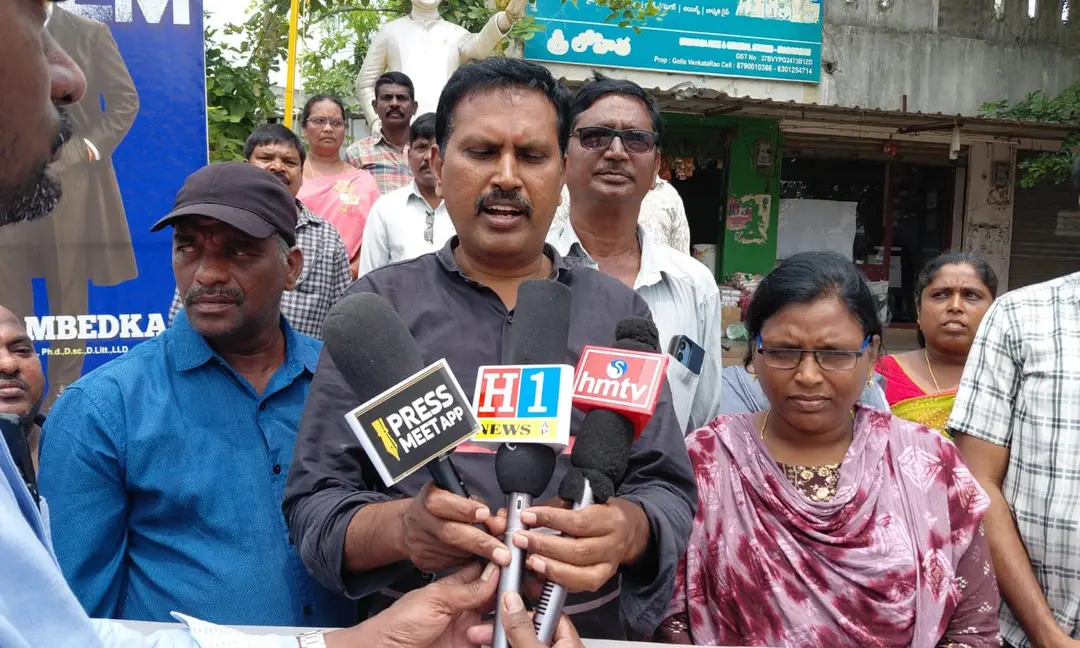
VRAs' non-cooperation strike enters tenth day at Iragavaram
The non-cooperation agitation launched at Iragavaram mandal headquarters on the call of the state VRA associations' Joint Action Committee entered its tenth day on Friday. VRAs submitted a petition at the NTR statue at the main Iragavaram junction. Association honorary president Eeda Ramarao demanded a pay scale matching rising prices of essential commodities. Vice-president Bojja Prasanna Kumari alleged the government was ignoring the ten-day strike, and sought promotions and regularisation of nominees.
Source
West Godavari — వార్తలు · read the original report ↗
Desk check · compared with the source
What the desk checked (5)
- The VRA non-cooperation agitation at Iragavaram mandal headquarters reached its tenth day on Friday. — Figure appears in source; presented as reporter's observation without official confirmation.
- The agitation was launched on the call of the state VRA associations' Joint Action Committee. — Stated in source; no document or JAC statement cited.
- VRAs demand a pay scale in line with rising prices of essential commodities. — Attributed to association honorary president Eeda Ramarao.
- The government is ignoring the ten-day-old strike. — Allegation attributed to vice-president Bojja Prasanna Kumari; no government response in source.
- VRAs submitted a petition to the NTR statue at the main Iragavaram junction. — Described in source as part of the protest; no independent corroboration.
Analysts’ view opinion
A non-cooperation agitation reaching its tenth day is no longer just a pay dispute — it is a test of how much political leverage the lowest rung of the revenue machinery actually has. Handing a petition to an NTR statue is a carefully chosen symbolic act: when the administration does not respond, protesters raise the political cost by taking their grievance to a memorial instead. The leaders' framing around promises made at election time signals an attempt to shift the argument from wages to accountability.
- Because the stir follows a state-level joint action committee call, localised mandal protests like Iragavaram can aggregate into statewide pressure.
- The charge that the government has ignored ten days of agitation is a classic movement tactic — making perceived indifference, not just pay, the central political accusation.
- Petitioning a statue rather than an official amplifies the message that normal administrative channels have failed to respond.
- The three demands — a pay scale, promotions and regularisation of nominees — mix fiscal cost with purely administrative decisions, giving the government room to defuse pressure with a partial concession.
- Since VRAs are central to village-level revenue work, a prolonged stir could convert administrative disruption into political cost for the ruling side and an opening for the opposition.
What to watch — Watch whether the government opens talks, or whether the agitation spreads to more mandals and forces local elected representatives to respond publicly.
The story establishes no government response, no fiscal context and no figures on how many VRAs are participating or how services are affected — only the union leaders' assertions.
Deep dive
Research brief · 8 facts · 2 dates · exam-readyThe brief
Context
Village Revenue Assistants (VRAs) are the lowest rung of the village-level revenue establishment in Andhra Pradesh, assisting village revenue officers with land records, surveys and other field duties. At Iragavaram mandal headquarters in the Tanuku area, VRAs have launched a non-cooperation agitation on the call of the state VRA associations' Joint Action Committee, pressing demands on pay, promotions and regularisation. On Friday the protest completed ten days, with VRAs symbolically submitting their petition to the NTR statue at the main Iragavaram junction. Association leaders say the government has not responded to the strike so far.
Key facts
- The non-cooperation agitation at Iragavaram mandal headquarters entered its tenth day on Friday.
- The stir was launched on the call of the state VRA associations' Joint Action Committee (JAC).
- VRAs submitted their petition to the NTR statue at the main junction in Iragavaram.
- Association honorary president Eeda Ramarao demanded a pay scale in line with rising prices of essential commodities.
- Ramarao said VRAs face severe financial hardship on inadequate wages and cannot afford better schools for their children.
- He asked the government and elected representatives to honour promises made to VRAs at election time.
- Vice-president Bojja Prasanna Kumari alleged the government was ignoring the ten-day strike.
- Demands included promotions for eligible VRAs and regularisation of those working as nominees, plus immediate talks.
Timeline
- Ten days before FridayVRAs begin the non-cooperation agitation at Iragavaram mandal headquarters on the JAC's call.
- FridayAgitation enters its tenth day; VRAs hand over a petition at the NTR statue and leaders address the gathering.
Who has a stake
- Village Revenue Assistants (VRAs) — Seek a revised pay scale, promotions for eligible staff and regularisation of nominees; say current wages cause financial distress.
- State VRA associations' Joint Action Committee — Gave the call for the non-cooperation agitation and is driving the demand for talks with the government.
- Andhra Pradesh government — Accused of ignoring the ten-day strike; expected to open negotiations and settle the demands.
- Elected representatives (public representatives) — Asked to act on assurances given to VRAs during elections.
- Local association office-bearers (Kattunga Koteswara Rao, M. Papa Rao, Khandavalli Aseervadam, Sabbiti Venkateswara Rao and others) — Mobilising VRAs locally and participating in the agitation at Iragavaram.
Why it matters
VRAs perform ground-level revenue work such as assisting with land and village records, so a prolonged non-cooperation stir can slow routine administration at the mandal level. The agitation also highlights the wider question of wages, promotion channels and regularisation for the lowest tier of government field staff and for those serving as nominees.
UPSC angle
Prelims pointers
- VRA stands for Village Revenue Assistant, a village-level functionary in the revenue department.
- The agitation at Iragavaram mandal headquarters was called by the state VRA associations' Joint Action Committee.
- Iragavaram mandal falls in the Tanuku area of Andhra Pradesh, as per the datelined report.
- Core demands: pay scale linked to rising prices of essentials, promotions for eligible VRAs, regularisation of nominees.
- Association honorary president: Eeda Ramarao; vice-president: Bojja Prasanna Kumari; president: Kattunga Koteswara Rao.
- Protest form: non-cooperation agitation, with a petition submitted at the NTR statue on day ten (Friday).
Mains framing
The Iragavaram VRA stir illustrates how service-condition grievances at the lowest rung of the revenue hierarchy can translate into sustained collective action. The immediate causes cited in the source are wages that have not kept pace with the prices of essential commodities, the absence of promotions for eligible VRAs, and the unsettled status of those working as nominees; leaders add that election-time assurances by public representatives remain unfulfilled. The implications are twofold: financial distress for a low-paid cadre, to the point where leaders say they cannot afford better schooling for their children, and the risk of disruption to routine village-level revenue functions if non-cooperation continues past ten days without engagement. The way forward suggested by the protesters themselves is procedural rather than confrontational — that the government respond positively, hold immediate talks and arrive at a settlement covering pay scale, promotion and regularisation. Beyond this instance, the episode raises the generic governance question of institutionalised grievance-redress and periodic review of pay and career progression for grassroots field staff, so that service disputes are resolved through negotiation rather than prolonged agitation. The source does not state any government response or negotiation schedule.
Key terms
- Village Revenue Assistant (VRA)
- A village-level functionary of the revenue department, referred to in the source as gram revenue sahayaks, forming the lowest tier of revenue field staff.
- Non-cooperation agitation
- A protest form in which employees withhold cooperation with routine official work while continuing to press demands.
- Joint Action Committee (JAC)
- A combined platform of the state's VRA associations that issued the call for the agitation.
- Regularisation of nominees
- The demand that persons currently working in VRA posts as nominees be given regular service status.
- Pay scale
- A structured wage band with defined increments; VRAs want one fixed in line with rising prices of essential commodities.
Practice questions
- Discuss the challenges faced by grassroots revenue functionaries such as Village Revenue Assistants and suggest mechanisms for timely redressal of their service grievances.
- What are the administrative consequences when lower-level field staff resort to prolonged non-cooperation agitations, and how can governments pre-empt such situations?
- Examine the issues of regularisation and promotion avenues for employees working in nominee or irregular capacities in state government departments.
Grounded only in the source report — figures and dates are the source's, not inferred.