
Peng Liyuan takes central role in China's soft diplomacy
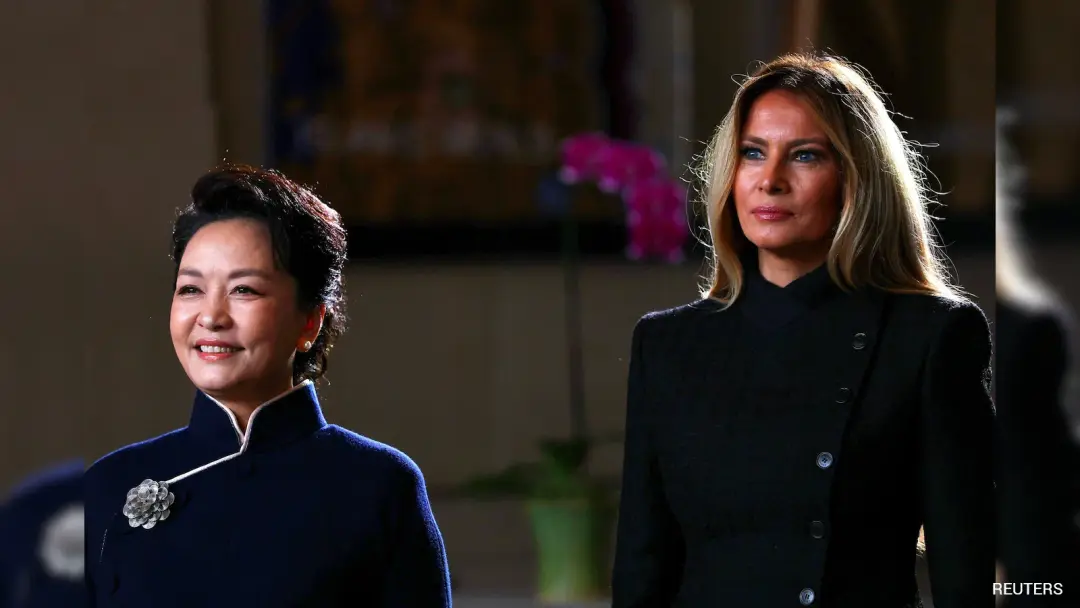
Chinese President Xi Jinping's wife Peng Liyuan emerged as the face of Beijing's soft diplomacy during his Washington trip. She spoke with US first lady Melania Trump in English without a translator. On Thursday, a children's choir sang the folk song 'Jasmine Flower' for her at the Smithsonian National Museum of Asian Art. Ambassador Xie Feng said on X she urged American teenagers to keep studying Chinese language and culture. Discussion of her on Chinese social media remains limited.
Source
NDTV — World · read the original report ↗
Desk check · compared with the source
What the desk checked (5)
- Peng Liyuan spoke with US first lady Melania Trump in English without a translator during Xi Jinping's Washington trip. — Stated in source as reporting; no named eyewitness or official source given.
- A youth choir performed 'Jasmine Flower' for Peng at the Smithsonian National Museum of Asian Art in Washington on Thursday. — Appears in source with venue and day specified; unattributed beyond the report.
- Ambassador Xie Feng posted a video on X and said Peng encouraged American teenagers to study Chinese language and culture. — Attributed to Xie Feng's own post on X.
- Peng helps put a human face on hard-nosed diplomacy and generate feel-good moments in US-China ties. — Attributed quote from Joe Mazur, analyst at Trivium China.
- Jiang Qing, Mao Zedong's widow and Gang of Four leader, received a suspended death sentence in 1981. — Historical claim as it appears in the source; no source cited and not independently verified.
Analysts’ view opinion
Peng Liyuan's Washington appearances are not mere protocol — they are a calibrated soft-power play at a moment when Beijing and Washington remain at odds on hard issues from trade to Taiwan. By speaking English without a translator and choosing a cultural venue, China put forward a human, approachable face aimed squarely at public opinion abroad. Yet the limited domestic discussion of her role is a reminder of an older political caution inside the Chinese system: this message is built for external audiences, not internal ones.
- Cultural diplomacy typically softens the atmosphere around negotiations rather than shifting the substance of policy disputes.
- Encouraging American teenagers to study Chinese language and culture is a long-horizon public-diplomacy investment, not a bid for immediate returns.
- The fact that China's ambassador amplified the moment on X suggests the messaging was designed primarily for Western audiences.
- Restrained discussion on Chinese platforms reflects systemic sensitivity about public scrutiny of leaders' personal lives.
- Feel-good moments of this kind do not reduce the structural competition between the two powers; they offer surface-level relief.
What to watch — Watch whether the goodwill converts into concrete outcomes on trade or educational and people-to-people exchanges, or remains purely optical.
The story does not establish what, if anything, was agreed on the trip, nor whether these cultural gestures influenced actual policy talks; China's foreign ministry did not comment.
Deep dive
Research brief · 8 facts · 5 dates · exam-readyThe brief
Context
During Chinese President Xi Jinping's trip to Washington, his wife Peng Liyuan took a visible public role, functioning as what analysts call Beijing's soft-power asset amid US-China frictions over trade and Taiwan. A former military soprano singer, she conversed with US first lady Melania Trump in English without a translator and attended a youth choir performance at the Smithsonian National Museum of Asian Art. Her prominence contrasts with the decades-long tradition of Chinese leaders' wives keeping a low profile, a legacy of Jiang Qing, Mao Zedong's widow and Gang of Four leader. Even now, Chinese social media discussion of Peng's activities and fashion remains heavily limited.
Key facts
- Peng Liyuan spoke with US first lady Melania Trump in English without a translator during Xi Jinping's Washington trip.
- On Thursday, a children's choir sang the Chinese folk song 'Jasmine Flower' for her at the Smithsonian National Museum of Asian Art in Washington; children said 'Thank you, mother Peng!'
- China's ambassador to Washington, Xie Feng, posted a video on X of Peng applauding the performance and highlighted her diplomatic role.
- Xie Feng wrote that Peng encouraged American teenagers to keep studying Chinese language and culture and to become 'envoys of friendship' between China and the US.
- Joe Mazur, geopolitics analyst at Beijing-based consultancy Trivium China, said she puts 'a more human face' on otherwise hard-nosed diplomacy.
- Searches for Peng's fashion sense and English abilities on the Chinese platform Red Note yielded no results.
- Jiang Qing, Mao Zedong's widow and leader of the 'Gang of Four', received a suspended death sentence in 1981 for deaths during the Cultural Revolution (1966-1976).
- Peng, previously best known in China as a military soprano, said in a 2007 state-run magazine interview: 'In my eyes, he's just my husband.'
Timeline
- 1966-1976Cultural Revolution in China, during which the 'Gang of Four' led by Jiang Qing wielded supreme power.
- 1981Jiang Qing receives a suspended death sentence for the deaths of tens of thousands during the Cultural Revolution.
- Early 2000sAs Xi Jinping rises to power, Chinese media get more leeway to cover Peng Liyuan's activities.
- 2007Peng gives an interview to a state-run magazine describing Xi as frugal, hardworking and down-to-earth.
- Thursday (during Xi's Washington trip)Youth choir performs 'Jasmine Flower' for Peng at the Smithsonian National Museum of Asian Art; Xie Feng posts video on X.
Who has a stake
- Peng Liyuan — Wife of Xi Jinping and former military soprano; projects a gentler, approachable image of China abroad while facing limits on domestic coverage.
- Xi Jinping — Chinese President whose Washington visit benefits from softer optics amid disputes with the US over trade and Taiwan.
- Melania Trump / US first lady's office — Counterpart in the informal, people-to-people side of the summit; conversed with Peng in English without a translator.
- Xie Feng, China's ambassador in Washington — Publicised Peng's role on X, framing her as promoting Chinese language study and China-US friendship.
- Chinese social media platforms (e.g., Red Note) and censors — Manage sensitivities about public discussion of top leaders' personal lives; searches on Peng returned no results.
- Smithsonian National Museum of Asian Art and the children's choir — Venue and performers for the cultural diplomacy moment in Washington.
- China's foreign ministry — Did not respond to a request for comment on Peng's Washington reception.
Why it matters
Cultural and personal optics can soften the edges of a hard-nosed bilateral relationship, and Peng Liyuan's visibility signals Beijing's willingness to use soft-power symbolism even as trade and Taiwan disputes persist. At the same time, the near-absence of domestic discussion of her shows how tightly the personal lives of Chinese leaders are still policed, a sensitivity rooted in the Jiang Qing era. For readers tracking US-China ties, such feel-good moments are a barometer of tone, not of substantive agreement.
UPSC angle
Prelims pointers
- Peng Liyuan: wife of Chinese President Xi Jinping; earlier known as a soprano singer for the Chinese military.
- 'Jasmine Flower' is the Chinese folk song performed by a children's choir at the Smithsonian National Museum of Asian Art in Washington.
- Xie Feng is China's ambassador in Washington, who publicised Peng's role on X.
- Jiang Qing, Mao Zedong's widow, led the 'Gang of Four' during the Cultural Revolution (1966-1976) and got a suspended death sentence in 1981.
- Red Note is a popular Chinese social media platform where searches about Peng yielded no results.
- Trivium China is a Beijing-based consultancy; its analyst Joe Mazur commented on Peng's soft-power role.
Mains framing
Peng Liyuan's high-visibility role on Xi Jinping's Washington trip illustrates how states deploy soft power and cultural diplomacy to humanise relationships strained by hard interests. With US-China disputes spanning trade and Taiwan, symbolic gestures such as a children's choir singing 'Jasmine Flower', an unmediated English conversation with the US first lady, and an appeal to American teenagers to study Chinese language and culture create, as analyst Joe Mazur put it, 'feel-good moments' that put a human face on hard-nosed diplomacy. Yet the domestic dimension reveals a contradiction: while the ambassador amplifies her role abroad on X, Chinese platforms like Red Note return no results on her fashion or English skills, reflecting entrenched sensitivities about the personal lives of top leaders that trace back to Jiang Qing and the Cultural Revolution. The lesson for analysts is to distinguish atmospherics from substance: cultural outreach and people-to-people ties can lower the temperature and build constituencies for engagement, but they do not resolve structural disagreements. A balanced reading would track whether such goodwill translates into working mechanisms on trade and security, while noting that asymmetric openness, projected outward but curated at home, limits how far first-lady diplomacy can shift public opinion in China itself.
Key terms
- Soft power
- Influence exercised through culture, values and appeal rather than coercion; here, Peng's cultural and personal outreach in Washington.
- Gang of Four
- Faction led by Mao's widow Jiang Qing that wielded supreme power during China's Cultural Revolution; Jiang was sentenced in 1981.
- Cultural Revolution
- Period of political chaos in China from 1966 to 1976 in which, per the source, tens of thousands died.
- Red Note
- Popular Chinese social media platform where searches on Peng's fashion and English abilities produced no results.
- Trivium China
- Beijing-based consultancy whose geopolitics analyst Joe Mazur assessed Peng's diplomatic role.
- Smithsonian National Museum of Asian Art
- Washington museum where a children's choir sang 'Jasmine Flower' for Peng Liyuan on Thursday.
Practice questions
- Discuss the role of cultural and 'first lady' diplomacy as instruments of soft power in contemporary great-power relations, using recent China-US interactions as an example.
- Why have wives of top Chinese leaders traditionally kept a low profile? Examine the historical legacy shaping this practice.
- Can soft-power gestures meaningfully alter the trajectory of relationships marked by structural disputes such as trade and Taiwan? Critically evaluate.
Grounded only in the source report — figures and dates are the source's, not inferred.