
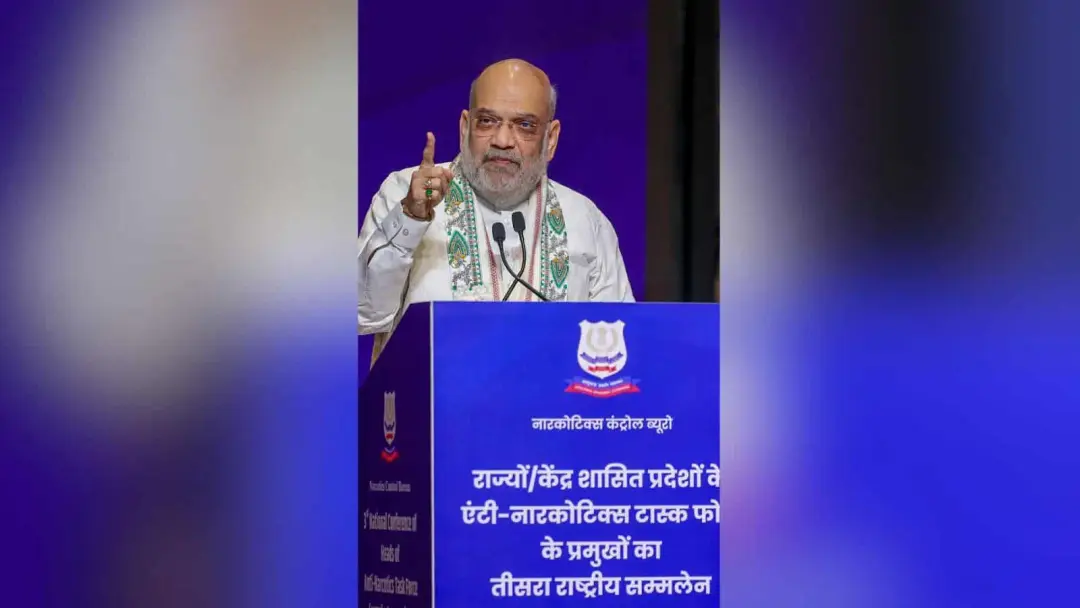
Shah sets 2029 target for drug-free India at ANTF meet
Union Home Minister Amit Shah on September 22 inaugurated the third national conference of anti-narcotics task force (ANTF) chiefs in New Delhi. He said the government would pursue complete victory over narcotics by 2029 by fixing target, timeline and accountability, and that the drug trade would be uprooted from India by December 31, 2029. Shah said 'Vision Document 2026-2029' was prepared after discussions with over 35 departments, and laid foundation stones for NCB zonal complexes in Lucknow and Dehradun.
Source
PTI wire · read the original report ↗
Desk check · compared with the source
What the desk checked (5)
- Government will wage a decisive battle for complete victory against narcotics by 2029, with target, timeline and accountability. — Attributed to Union Home Minister Amit Shah at the third ANTF conference in New Delhi.
- By December 31, 2029, the drug trade will be uprooted from India. — Attributed to Shah via a government statement cited in the source.
- 'Vision Document 2026-2029' was prepared after discussions with more than 35 departments. — Figure appears in the source, attributed to Shah; not independently verifiable here.
- ANTF heads from 36 states and Union Territories are attending the two-day NCB conference. — Figure appears in the source; attributed to the event organisers/NCB.
- Shah laid foundation stones for new NCB zonal complexes in Lucknow and Dehradun and launched anti-drug TV commercials and a redesigned NCB website. — Stated as event facts in the source with no separate attribution.
Analysts’ view opinion
The December 31, 2029 deadline is not an accidental date — it sits close to the next general election cycle, effectively tying the promise to the BJP's next term rather than this one. By placing narcotics alongside Kashmir terrorism, Northeast insurgency and Naxalism in a list of solved problems, Amit Shah is consolidating the Home Ministry's brand as the department that closes long-standing files. At the same time, the line that the MHA and NCB "cannot do this alone" builds a frame in which accountability for any shortfall is shared with the states.
- Pegging the target to 2029 means it will be judged as a political pledge as much as an administrative programme.
- Convening ANTF chiefs from 36 states and UTs strengthens the Centre's role as coordinator, though non-BJP states may read the architecture as further centralisation.
- The shift from "seizure to dismantling networks" and "case to conviction" implicitly concedes that past headline numbers have not translated into outcomes.
- New NCB zonal complexes in Lucknow and Dehradun give institutional expansion a locational dimension in two politically significant northern states.
- Framing the drive through Viksit Bharat 2047, youth and grieving families positions drugs as a rare consensus issue no party can easily oppose.
What to watch — Watch whether the specific targets and review mechanism in Vision Document 2026-2029 are made public, and how the Centre ranks state performance — that is where Centre-state friction is most likely to surface.
The story establishes an announced goal and roadmap, not the funding, legal changes, measurement methods, or any reaction from opposition parties or state governments.
Deep dive
Research brief · 8 facts · 6 dates · exam-readyThe brief
Context
Anti-Narcotics Task Forces (ANTFs) are state/UT-level specialised police units coordinated with the Narcotics Control Bureau (NCB) under the Union Ministry of Home Affairs to tackle drug trafficking. The MHA has been holding annual national conferences of ANTF chiefs, the first to create an institutional mechanism and the second to focus on capability and execution. On September 22, Union Home Minister Amit Shah inaugurated the third such conference in New Delhi, where he announced a target of a drug-free India by 2029 and released the framework of a 'Vision Document 2026-2029'. He linked the drive to the larger goal of a Viksit Bharat by 2047.
Key facts
- Amit Shah on Tuesday, September 22, inaugurated the third national conference of chiefs of anti-narcotics task force (ANTF) in New Delhi.
- Shah said the drug trade will be uprooted from India by December 31, 2029, through "target, timeline and accountability".
- 'Vision Document 2026-2029' was prepared after discussions with more than 35 departments and contains definite targets and timelines; it will be reviewed later.
- ANTF heads from 36 states and Union Territories, plus government departments and other stakeholders, are attending the two-day NCB-organised conference.
- Shah laid the foundation stone for new NCB zonal complexes in Lucknow and Dehradun.
- He launched television commercials on anti-narcotics awareness and the newly designed NCB website.
- Best-performing ANTFs of states and UTs were honoured at the event.
- Shah said the shift must be "from meeting to mission, from reporting to result, from seizure to dismantling of networks, and from case to conviction".
Timeline
- First ANTF conference (date not stated in the source)An institutional mechanism against narcotics was created and strengthened.
- Second ANTF conference (date not stated in the source)Discussions on capability, action and execution to convert the mechanism into action.
- September 22 (Tuesday)Shah inaugurates third ANTF chiefs' conference in New Delhi; lays foundation stones for NCB zonal complexes in Lucknow and Dehradun; launches NCB website and TV commercials.
- 2026-2029Period covered by the 'Vision Document' prepared after consultations with over 35 departments.
- December 31, 2029Deadline set by Shah for uprooting the drug trade from India.
- 2047Target year for Viksit Bharat, to which the drug-free India roadmap is linked.
Who has a stake
- Ministry of Home Affairs (MHA) — Nodal ministry driving the drug-free India goal; Shah said MHA or NCB cannot do it alone.
- Narcotics Control Bureau (NCB) — Organiser of the conference; getting new zonal complexes at Lucknow and Dehradun and a redesigned website.
- State and UT anti-narcotics task forces (36 represented) — Expected to deliver on state-level roadmaps aligning intelligence, investigation, financial action and prosecution; best performers honoured.
- State administration and police hierarchy — Shah named school principals, village patwaris, police sub-inspectors, DGPs, Chief Secretaries and the Union Home Secretary as needing to work in one direction.
- Youth and families affected by drug addiction — Shah framed the fight as saving future generations, citing parents and siblings of addicted young people.
- More than 35 central/state departments consulted — Their inputs shaped the 'Vision Document 2026-2029' and they must execute assigned targets.
Why it matters
The announcement converts a broad anti-drugs pledge into a dated, accountability-linked mission, with a 2029 deadline and a multi-department vision document rather than only enforcement drives. The declared shift from seizure-centric policing to dismantling networks and securing convictions signals a change in how success against narcotics will be measured. Since drug trafficking cuts across policing, finance, health, education and border management, delivery depends on coordination between the Centre, 36 states and UTs and dozens of departments.
UPSC angle
Prelims pointers
- Third national conference of ANTF chiefs was held in New Delhi and organised by the Narcotics Control Bureau (NCB).
- NCB functions under the Union Ministry of Home Affairs; new zonal complexes announced at Lucknow and Dehradun.
- 'Vision Document 2026-2029' drew on consultations with more than 35 departments.
- Deadline announced for uprooting drug trade in India: December 31, 2029.
- ANTF heads from 36 states and Union Territories participated in the two-day conference.
- Shah linked the drug-free India goal to the Viksit Bharat 2047 vision.
Mains framing
The Home Minister's 2029 drug-free India target reframes narcotics control from an enforcement exercise into a time-bound, accountability-driven national mission, with a 'Vision Document 2026-2029' built on inputs from over 35 departments and state-level roadmaps aligning intelligence, investigation, financial action and prosecution. The stated causes of past under-performance are institutional: a seizure-centric approach that measures success by quantity confiscated rather than by networks dismantled and convictions obtained, and fragmented action across departments and tiers of administration, which is why Shah invoked everyone from the school principal and village patwari to the DGP, Chief Secretary and Union Home Secretary working in one direction. Implications include greater demand on state ANTF capacity, on financial investigation to trace drug money, and on demand-reduction and awareness measures, reflected in the launch of television commercials and the recognition of best-performing state task forces. The way forward, as framed by the source, lies in the sequence "meeting to mission, reporting to result, seizure to dismantling of networks, case to conviction", with periodic review of the vision document's targets and timelines, cooperative federal execution across 36 states and UTs, and a sensitivity-driven approach centred on affected youth and their families, all tied to the broader Viksit Bharat 2047 goal.
Key terms
- ANTF (Anti-Narcotics Task Force)
- State/UT-level specialised task forces against narcotics whose chiefs meet in national conferences convened under the MHA.
- NCB (Narcotics Control Bureau)
- Central agency that organised the conference; getting new zonal complexes in Lucknow and Dehradun and a redesigned website.
- Vision Document 2026-2029
- Roadmap with fixed targets and timelines for a drug-free India, prepared after talks with more than 35 departments; Shah likened it to "the Gita" for the effort.
- Viksit Bharat 2047
- Prime Minister Narendra Modi's goal of a developed India by 2047, to which the drug-free India roadmap is linked.
- Seizure to dismantling of networks
- Shift from counting drug consignments seized to breaking up entire trafficking networks and converting cases into convictions.
Practice questions
- "Target, timeline and accountability" – examine how the 2029 drug-free India goal seeks to change India's anti-narcotics strategy from a seizure-centric approach to the dismantling of networks.
- Drug trafficking requires coordinated action across the Centre, states and multiple departments. Discuss with reference to the ANTF mechanism and the 'Vision Document 2026-2029'.
- Write a short note on the institutional role of the Narcotics Control Bureau and the ANTF national conferences in India's anti-drug framework.
Grounded only in the source report — figures and dates are the source's, not inferred.