
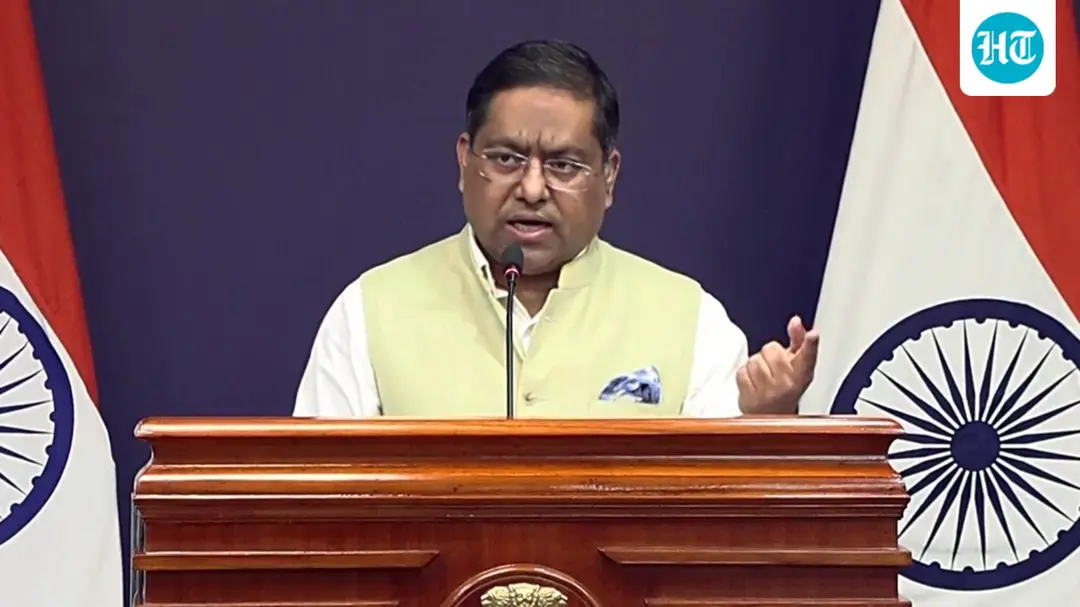
India asks Pakistan for credible action on cross-border terrorism
India on Tuesday asked Pakistan to demonstrate credible action against cross-border terrorism after Pakistan Army Chief Field Marshal Asim Munir said the armed forces remain resolute in defeating terrorism, during a visit to Corps Headquarters in Peshawar. MEA spokesperson Randhir Jaiswal said Pakistan must show action and firm commitment before the world believes it. India also condemned Pakistani airstrikes on Afghanistan's Kunar and Paktika provinces. Pakistan claimed 28 militants killed; Kabul reported three civilians dead and four injured.
Source
Hindustan Times — India · read the original report ↗
Desk check · compared with the source
What the desk checked (5)
- India asked Pakistan to take 'credible action' against cross-border terrorism. — Directly attributed to MEA spokesperson Randhir Jaiswal at a bi-weekly press briefing; quoted in source.
- Asim Munir said the armed forces remain resolute in their determination to defeat terrorism. — Attributed to Pakistan's ISPR statement via PTI, made during a visit to Corps Headquarters in Peshawar.
- Pakistani airstrikes hit Kunar and Paktika provinces in Afghanistan. — Attributed to the MEA spokesperson's statement; strikes described in source as reported.
- Pakistan said 28 militants were killed; Kabul reported three civilians dead and four injured. — Conflicting figures from opposing sides; the Kabul toll is stated in the source as confirmed by the United Nations.
- India reaffirmed 'steadfast support' for Afghanistan's independence, sovereignty and territorial integrity. — Quoted directly from Jaiswal in the source.
Analysts’ view opinion
India's response does two things at once: it withholds credit from Pakistan's counter-terrorism messaging by setting a verification test — "credible action" — and it simultaneously positions New Delhi alongside Kabul against Pakistani airstrikes on Afghan soil. That pairing is the strategic core of the story: India is using Pakistan's own military conduct on its western frontier to question the sincerity of its counter-terror declarations on the eastern one. With the army chief's remarks coming from a Peshawar corps visit focused on operations and border management, Pakistan's framing is domestic and internal-security-led, while India's framing is about cross-border terrorism directed at it — the two sides are not even arguing about the same problem.
- By demanding demonstrable action before belief, India is deliberately raising the evidentiary bar and pre-empting any diplomatic credit for statements alone.
- The casualty dispute — Pakistan claiming 28 militants killed, Kabul reporting three civilians dead and four injured, with the UN confirming Kabul's figure — is itself a strategic variable, because independently corroborated civilian harm weakens Islamabad's counter-terrorism justification.
- India's explicit backing for Afghan sovereignty and territorial integrity extends a pattern of New Delhi deepening engagement with Kabul, which adds a second front of diplomatic pressure on Pakistan.
- Pakistan's military is signalling that its principal terrorism threat is internal and along its western border, a framing India rejects as incomplete while its own concerns about cross-border attacks remain unaddressed.
- For outside actors weighing Pakistan's counter-terrorism credentials, contested strike tolls and a neighbour's sovereignty objections complicate the case Islamabad is trying to make internationally.
What to watch — Watch whether Kabul escalates beyond protest, whether further Pakistani strikes follow, and whether any third parties or multilateral bodies press Islamabad on the civilian toll — each would sharpen the diplomatic cost India is highlighting.
The story establishes competing claims and statements, not verified facts about who was hit or whether Pakistan will take any specific action India would accept as credible.
Deep dive
Research brief · 8 facts · 3 dates · exam-readyThe brief
Context
India's Ministry of External Affairs used its bi-weekly press briefing on Tuesday to respond to two developments involving Pakistan. First, Pakistan Army Chief and Chief of Defence Forces Field Marshal Asim Munir said at Corps Headquarters in Peshawar that Pakistan's armed forces remain resolute in defeating terrorism; New Delhi replied that Islamabad must show "credible action" against cross-border terrorism before the world believes it. Second, India condemned Pakistani airstrikes on Afghanistan's Kunar and Paktika provinces, in which civilians were killed, and reaffirmed support for Afghanistan's sovereignty.
Key facts
- MEA spokesperson Randhir Jaiswal said Pakistan "must take credible action against cross-border terrorism before the world believes what they say they are going to do".
- Field Marshal Asim Munir, Pakistan Army Chief and Chief of Defence Forces, said the armed forces "remain resolute in their determination to defeat terrorism", per Pakistan's ISPR.
- Munir made the remarks during a visit to Corps Headquarters in Peshawar, where he was briefed on the province's security situation.
- He was briefed on counter-terrorism operations, border management measures and operational preparedness of formations deployed in the province.
- Pakistani airstrikes hit Afghanistan's Kunar and Paktika provinces in eastern Afghanistan.
- Pakistan said the strikes killed 28 militants; Kabul reported three civilians killed and four injured, a toll also confirmed by the United Nations.
- India called the strikes "yet another occasion of aggression from the Pakistani side" and said such aggression against a sovereign neighbour goes against regional peace and security.
- India reaffirmed "steadfast support" for Afghanistan's independence, sovereignty and territorial integrity, and for the welfare of its people.
Timeline
- Before the MEA briefingPakistani fighter jets reportedly struck sites in eastern Afghanistan (Kunar and Paktika), leaving at least three civilians dead; Pakistan claimed 28 militants killed.
- Before the MEA briefingField Marshal Asim Munir visits Corps Headquarters, Peshawar, and says the armed forces are resolute in defeating terrorism, per ISPR.
- TuesdayAt the bi-weekly press briefing, MEA spokesperson Randhir Jaiswal asks Pakistan for credible action on cross-border terrorism and condemns the airstrikes on Afghanistan.
Who has a stake
- Government of India / Ministry of External Affairs — Presses Pakistan for verifiable action on cross-border terrorism while positioning itself as a supporter of Afghan sovereignty.
- Pakistan Army and ISPR — Projecting counter-terrorism resolve and operational preparedness, especially in the Peshawar corps area.
- Field Marshal Asim Munir — As Army Chief and Chief of Defence Forces, his statements frame Pakistan's security posture internationally.
- Afghanistan / Kabul authorities — Reported three civilians killed and four injured in the strikes; its sovereignty and territorial integrity are at issue.
- Civilians in Kunar and Paktika — Directly affected by the airstrikes, with deaths and injuries reported.
- United Nations — Confirmed the Afghan casualty toll of three dead and four injured, lending independent weight to Kabul's account.
Why it matters
India's demand for "credible action" links Pakistan's public counter-terrorism rhetoric to an evidentiary test, keeping cross-border terrorism at the centre of the bilateral relationship. By condemning the airstrikes and backing Afghan sovereignty, New Delhi also positions itself in the Pakistan-Afghanistan friction, with implications for regional peace and India's Kabul outreach.
UPSC angle
Prelims pointers
- MEA spokesperson Randhir Jaiswal made the statement at the ministry's bi-weekly press briefing.
- Asim Munir holds the ranks/titles of Field Marshal, Pakistan Army Chief and Chief of Defence Forces.
- ISPR is the media wing of the Pakistan armed forces; it reported Munir's Peshawar remarks.
- Pakistani airstrikes targeted Kunar and Paktika provinces in eastern Afghanistan.
- Casualty claims: Pakistan said 28 militants killed; Kabul and the UN confirmed three civilians dead, four injured.
- India reaffirmed support for Afghanistan's independence, sovereignty and territorial integrity.
Mains framing
India's response to Field Marshal Asim Munir's Peshawar statement illustrates a long-standing asymmetry in the India-Pakistan dynamic: declaratory commitments against terrorism versus demonstrable, verifiable action on the ground. New Delhi's formulation that Pakistan must show \"action and firm commitment\" and take \"credible action against cross-border terrorism before the world believes what they say\" shifts the burden of proof onto Islamabad and internationalises the test of credibility. The second strand — Pakistani airstrikes on Kunar and Paktika, with Pakistan claiming 28 militants killed while Kabul and the UN confirm three civilians dead and four injured — shows how counter-terrorism claims and contested casualty figures complicate regional stability, and how cross-border force against a sovereign neighbour can itself become a source of insecurity. India's condemnation, condolences and reaffirmation of Afghanistan's independence, sovereignty and territorial integrity signal a diplomatic line that couples principled opposition to the use of force with deepening engagement with Kabul. The way forward suggested by the source is limited but clear: independent verification of claims, respect for sovereignty and demonstrated rather than declared action against terror infrastructure.
Key terms
- Cross-border terrorism
- Terrorist activity directed or supported from across an international boundary; India's core demand is credible action against it.
- MEA
- India's Ministry of External Affairs, whose spokesperson Randhir Jaiswal issued the statements at a bi-weekly briefing.
- ISPR (Inter-Services Public Relations)
- Media affairs wing of Pakistan's armed forces, which released the account of Munir's Peshawar visit and remarks.
- Chief of Defence Forces
- Title held by Asim Munir alongside Pakistan Army Chief, as described in the source.
- Kunar and Paktika
- Provinces in eastern Afghanistan struck by Pakistani airstrikes, per India's statement.
- Territorial integrity
- Principle that a state's borders and territory must not be violated by force; invoked by India in support of Afghanistan.
Practice questions
- Critically examine how the demand for "credible action" against cross-border terrorism shapes India's diplomatic engagement with Pakistan.
- Pakistani airstrikes on Afghan territory raise questions of sovereignty and regional security. Discuss with reference to India's stated position.
- How do contested casualty claims in cross-border military operations affect the credibility of counter-terrorism narratives in South Asia?
Grounded only in the source report — figures and dates are the source's, not inferred.