
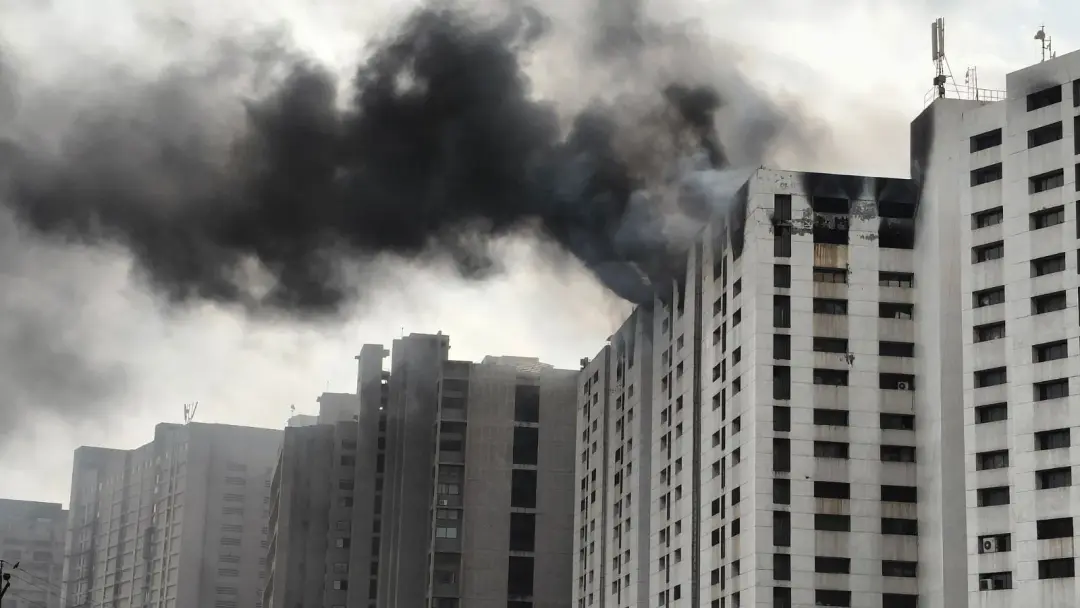
Man arrested for Surat textile market fire over Rs 10,000 dues
The Surat Crime Branch on Monday arrested a man for setting fire to Shyam Sangini Textile Market on September 9, causing an estimated loss of around Rs 24 crore. Police said Vinod Salve of Maharashtra's Dhule district, a former accountant at a shop in the market, confessed he acted to teach the owner a lesson after his pending salary of Rs 10,000 was not paid. The fire took 14 hours to douse.
Source
Indian Express — Cities · read the original report ↗
Desk check · compared with the source
What the desk checked (5)
- Fire at Shyam Sangini Textile Market on September 9 caused estimated loss of about Rs 24 crore. — Figure appears in source, attributed to police account; described as an estimate.
- Accused Vinod Salve of Dhule district, Maharashtra, confessed to setting the fire over Rs 10,000 pending salary. — Attributed to police primary interrogation; confession untested in court.
- Salve bought petrol worth Rs 150 in Dindoli a day before the fire and sprinkled it on parcels on the sixth floor. — Attributed by name to Additional Commissioner of Police Karanraj Vaghela.
- Salve worked at the shop since April 2026 on a monthly salary of Rs 30,000. — Date appears in source but is internally inconsistent with a September 9 fire; likely a typographical error in the original.
- Fire took 14 hours to douse after a call at around 12.50 am. — Figures appear in source, attributed to fire department account; no document cited.
Analysts’ view opinion
Legally, this is an arson case — deliberately setting property on fire sits among the graver offences in Indian criminal law, with severity rising as the scale of damage rises. The strength of the investigation here appears to rest largely on circumstantial and technical material such as CCTV footage and the claimed petrol purchase; a confession said to have been made to police is not, by itself, decisive at trial. With the case handed from the Crime Branch to Saroli police station, the probe is still at an early stage.
- As a matter of general legal principle, statements made to police carry limited evidentiary weight, and courts look for independent material that corroborates them.
- The CCTV footage, the described petrol purchase and the accused's movements form a circumstantial chain — the case will stand or fall on how well that chain is proved.
- Identifying a masked figure from footage is a natural point of challenge for the defence, so independent evidence linking the accused to the footage becomes crucial.
- Because the FIR was first registered against an unknown person, the process now moves to naming the accused and filing a charge sheet within the statutory period after arrest.
- The Rs 24 crore loss figure is an estimate at this stage; insurance and civil recovery disputes could run separately from the criminal case.
What to watch — Watch the remand orders, which sections the accused is charged under, and whether forensic reports corroborate the footage.
Everything so far is the police version and allegation — guilt has not been tested in court, and neither the loss estimate nor the harassment claims have been independently verified.
Deep dive
Research brief · 8 facts · 8 dates · exam-readyThe brief
Context
A fire on the sixth floor of Shyam Sangini Textile Market in Surat's Saroli area on September 9 destroyed shops and goods, with losses estimated at around Rs 24 crore. Surat's textile markets are dense trading hubs where parcels of sarees and dress materials are stacked in passages overnight for delivery. Police initially lodged an FIR against an unknown person for arson, and later used CCTV footage to identify a former accountant of a shop in the market. The accused, Vinod Salve of Dhule district in Maharashtra, was arrested on Monday and allegedly confessed he set the fire because his pending salary of Rs 10,000 was not paid.
Key facts
- Fire at Shyam Sangini Textile Market, Surat, broke out on the sixth floor in the early morning of September 9; estimated loss around Rs 24 crore.
- The fire department received a call around 12.50 am and the blaze took 14 hours to douse.
- All shops on the sixth floor were gutted; some shops on the fifth floor of the six-storey building were also affected.
- Accused Vinod Salve, a resident of Dhule district in Maharashtra, worked as an accountant at a textile trading shop on the market's sixth floor.
- Salve's monthly salary was Rs 30,000; he allegedly acted because pending dues of Rs 10,000 were not paid after he quit a month earlier.
- CCTV footage showed a masked man sprinkling something on parcels stacked in the passage and setting them ablaze; he was inside the building for just four minutes after midnight of September 8.
- Additional Commissioner of Police Karanraj Vaghela said Salve bought petrol worth Rs 150 in a bottle from a pump in Dindoli a day before the fire.
- After the fire, Salve went to Rajasthan and Ayodhya in Uttar Pradesh, returned to Surat on Sunday night, and was detained in Dindoli on Monday.
Timeline
- April 2026 (as stated in the source)Salve begins working as an accountant at a textile trading shop on the sixth floor of Shyam Sangini market on Rs 30,000 a month.
- About a month before the fireSalve quits the job, alleging nagging and scolding by the senior accountant and shop owner, and begins asking for pending dues of Rs 10,000.
- A day before the fireSalve buys petrol worth Rs 150 in a bottle from a pump in Dindoli, Surat.
- After midnight of September 8A masked man enters the market, spends four minutes inside, sprinkles petrol on parcels on the sixth-floor passage and sets them on fire, per CCTV.
- September 9, around 12.50 amFire department receives the call and sends teams; the fire takes 14 hours to douse.
- After the fireSalve escapes on his bike, avoids his native place and travels to Rajasthan and Ayodhya.
- Sunday nightSalve returns to Surat.
- MondaySurat city crime branch detains him from Dindoli area and arrests him; he is handed over to Saroli police station.
Who has a stake
- Shop owners and traders of Shyam Sangini Textile Market — Suffered gutted shops and goods with total estimated losses of around Rs 24 crore; sixth floor fully destroyed, fifth floor partly affected.
- Vinod Salve, the accused — Arrested on arson charges; alleged confession over unpaid dues of Rs 10,000 and claimed workplace humiliation.
- Surat City Crime Branch and Saroli police station — Identified and arrested the accused through CCTV and a tip-off; further investigation now with Saroli police.
- Surat fire department — Deployed teams after a 12.50 am call and fought the blaze for 14 hours in a six-storey market building.
- Migrant workers in textile trade (Dindoli area) — The case highlights wage disputes and employer-employee friction in Surat's migrant-dependent textile economy.
Why it matters
A dispute over Rs 10,000 in unpaid wages allegedly triggered a fire causing about Rs 24 crore in losses, showing how small, unresolved wage grievances in informal trading establishments can escalate into major crime. It also underlines fire-safety vulnerability in Surat's multi-storey textile markets, where parcels of inflammable cloth are stacked in passages overnight, and the role of CCTV evidence in cracking arson cases.
UPSC angle
Prelims pointers
- Shyam Sangini Textile Market is located in the Saroli area of Surat, Gujarat; the fire hit its six-storey building on September 9.
- Estimated loss from the fire: around Rs 24 crore; time taken to douse: 14 hours.
- Accused Vinod Salve is from Dhule district, Maharashtra; arrested by Surat City Crime Branch from Dindoli, Surat.
- Additional Commissioner of Police Karanraj Vaghela detailed the case, including petrol worth Rs 150 bought from a Dindoli pump.
- The original FIR was lodged against an unknown person for arson before the accused was identified via CCTV footage.
- The accused's claimed pending salary was Rs 10,000 against a monthly pay of Rs 30,000.
Mains framing
The Surat textile market fire illustrates how unresolved wage disputes in the informal and semi-formal trade sector can turn into serious crime: a former accountant allegedly committed arson because pending dues of Rs 10,000 were withheld through repeated excuses, causing losses of about Rs 24 crore and a 14-hour firefighting operation. The case points to three intersecting gaps recorded in the source. First, weak grievance redress for employees in trading establishments, where dues are settled informally and complaints of humiliation by seniors have no visible outlet. Second, fire-safety vulnerability in crowded multi-storey markets, where parcels of sarees and dress materials are left in passages overnight, giving a single individual four minutes to destroy an entire floor. Third, the investigative dependence on CCTV footage and tip-offs, which here converted an FIR against an unknown person into an arrest. The way forward, based on what the story establishes, lies in accessible and time-bound settlement of wage claims, stricter enforcement of fire and storage norms in market buildings, and sustained surveillance and access control in such high-value commercial complexes; further conclusions on policy are not stated in the source.
Key terms
- Arson
- The criminal act of deliberately setting fire to property; the Surat FIR was initially lodged against an unknown person for arson.
- Surat City Crime Branch
- Specialised investigation wing of Surat police that traced and detained the accused on a tip-off in the Dindoli area.
- FIR (First Information Report)
- The first police record of a cognisable offence; here filed against an unknown person before the accused was identified.
- Shyam Sangini Textile Market
- A six-storey textile trading market in Surat's Saroli area where the September 9 fire gutted all sixth-floor shops.
- Dindoli
- A largely migrant locality in Surat where the accused bought petrol and was later detained by police.
Practice questions
- A dispute over Rs 10,000 in unpaid wages allegedly caused losses of Rs 24 crore in Surat. Discuss the adequacy of grievance redress mechanisms for workers in India's informal trading establishments.
- Examine the fire-safety challenges posed by dense multi-storey commercial markets in Indian cities, with reference to the Surat textile market fire.
- How has electronic evidence such as CCTV footage changed the investigation of property crimes like arson? Illustrate with the Surat case.
Grounded only in the source report — figures and dates are the source's, not inferred.