
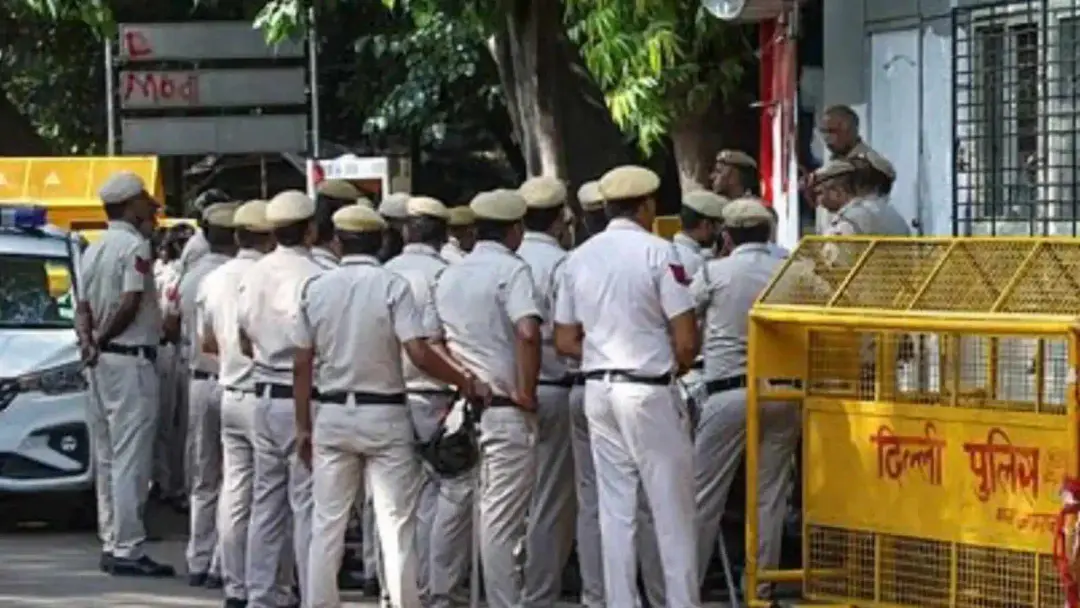
Teen raped by three men posing as cops in Delhi park
Three men posing as policemen allegedly raped a 16-year-old girl in a park in Southeast Delhi, police officers said. The girl had visited Kalkaji Mandir on Monday evening with a 17-year-old male friend and stepped out at 7.30 pm. Three men aged 25-30 questioned them and threatened legal action. Her statement says one held her friend while two assaulted her. A PCR call came at 8.45 pm; a POCSO case was registered. Accused Asif was arrested after an encounter, sustaining a leg bullet injury.
Source
Indian Express — Cities · read the original report ↗
Desk check · some claims need care
What the desk checked (5)
- Three men posing as policemen raped a 16-year-old girl in a Southeast Delhi park on Monday at around 7.30 pm. — Attributed to unnamed police officers in the source; alleged, not adjudicated.
- One accused held the victim's 17-year-old male friend while the other two assaulted her. — Attributed to the victim's statement to police as recorded in the source.
- A PCR call was made at 8.45 pm and a case was registered under the POCSO Act after medical examination. — Times and legal provision appear in the source, attributed to police.
- Accused Asif was arrested early Tuesday after a brief encounter in which he sustained a bullet injury to his leg. — Attributed to police; no independent confirmation in source.
- At least four rape cases involving children and teenagers were reported in Delhi in the last month. — Figure appears in the source without a named authority; treat as the publication's count.
Analysts’ view opinion
This is not framed as an ordinary sexual assault allegation alone — the accused are said to have impersonated policemen and used the threat of "legal consequences" to overpower the teenagers. Because the survivor is 16, the POCSO Act applies, which brings stricter procedural protections: a special court, mandatory confidentiality for the survivor, and time-bound investigation and trial norms. The police account of one accused being arrested with a bullet injury to the leg after an encounter also brings into play the settled procedural scrutiny that applies to police firing in India.
- With a case registered under POCSO, the recording of the survivor's statement, the medical examination and the trial itself carry heightened safeguards compared with an ordinary case.
- The alleged impersonation of police officers and coercion through the threat of legal action could be central to how the prosecution establishes absence of consent and aggravation — though the story does not specify which sections have been invoked.
- The 17-year-old friend is an eyewitness and himself a minor, so child-protection norms would apply to how his testimony is recorded as well.
- Indian law requires a defined, independently scrutinised process whenever a person is injured in police firing; the story does not indicate what stage that process is at here.
- With two accused still absent, identification procedures, forensic reports and the timing of the chargesheet will largely determine how strong the case becomes.
What to watch — Watch for the arrest of the two remaining accused, the forensic findings, whether the chargesheet is filed within POCSO timelines, and whether the mandated process around the encounter is completed.
Everything here rests on police statements and the survivor's account at an early stage; no guilt has been established in court, and the story offers no independent verification of the circumstances of the encounter.
Deep dive
Research brief · 8 facts · 6 dates · exam-readyThe brief
Context
Three men who claimed to be policemen allegedly raped a 16-year-old girl in a park in Southeast Delhi on a Monday evening, after she stepped out of the Kalkaji Mandir with a 17-year-old male friend. Police say the trio, aged 25-30, questioned the teenagers about their whereabouts, threatened them with legal consequences and then assaulted the girl before fleeing. A PCR call was made at 8.45 pm, the girl was taken for medical examination and a case was registered under the POCSO Act. One accused, Asif, was arrested early the next morning after a brief encounter in which he was shot in the leg; the case is one of at least four rapes of children and teenagers reported in the capital in the last month.
Key facts
- A 16-year-old girl was allegedly raped by three men posing as policemen in a park in Southeast Delhi.
- The incident happened on Monday at 7 pm, after the victim visited Kalkaji Mandir with a 17-year-old male friend.
- At 7.30 pm she came out of the temple and went for a stroll with her friend in a nearby park, where three men aged 25-30 approached them.
- The accused claimed to be policemen, questioned the teenagers about their whereabouts and threatened legal consequences before the assault.
- As per the victim's statement, one accused held her friend while the other two took turns to assault her.
- A PCR call was made at 8.45 pm; police took the girl for medical examination and registered a case under sections of the POCSO Act.
- Early Tuesday morning, accused Asif was nabbed after a brief encounter in Southeast Delhi and sustained a bullet injury to his leg; police said the other two will be nabbed soon.
- At least four rape cases, all against children and teenagers, were reported in Delhi in the last month.
Timeline
- August 4A 17-year-old girl was allegedly raped on a sleeper bus that travelled nearly 47 km from Greater Noida to Old Delhi's Kashmere Gate without being checked at a single police picket.
- Four days before this incidentA 16-year-old girl was allegedly gangraped and stabbed to death in Outer North Delhi by her friend and his three friends; the accused, three of them minors, have been apprehended.
- Monday, 7 pmThe 16-year-old victim went to offer prayers at Kalkaji Mandir with her 17-year-old male friend.
- Monday, 7.30 pmShe came out of the temple and went for a stroll in a nearby park, where three men claiming to be policemen approached the duo and then allegedly raped her before fleeing.
- Monday, 8.45 pmA PCR call was made; police arrived, took the girl for medical examination and registered a POCSO case.
- Early Tuesday morningA police team nabbed accused Asif after a brief encounter in Southeast Delhi; he sustained a bullet injury to his leg.
Who has a stake
- The 16-year-old survivor — Her safety, medical care, privacy and the protections and speedy trial guaranteed to a child victim under the POCSO Act.
- Her 17-year-old male friend — Was held by one accused during the assault; a key witness in the case.
- Delhi Police (Southeast district) — Responded to the PCR call at 8.45 pm, registered the POCSO case, arrested one accused after an encounter and must trace the two others.
- Accused Asif and two unidentified men aged 25-30 — Face prosecution under POCSO; Asif was arrested with a bullet injury to his leg.
- Residents and visitors around Kalkaji Mandir — Public safety in temple precincts and adjoining parks, and the risk posed by men impersonating policemen.
- Children and teenagers in the national capital — At least four rape cases against minors in Delhi in the last month raise questions about their everyday safety.
Why it matters
The case combines two serious harms: sexual violence against a minor and the impersonation of police authority to intimidate victims into submission, which corrodes public trust in the uniform itself. It also comes amid a cluster of at least four rapes of children and teenagers in Delhi in a month, including one in which a 16-year-old was gangraped and stabbed to death, and one on a bus that crossed 47 km without a single police check.
UPSC angle
Prelims pointers
- POCSO Act: the law invoked for sexual offences against persons below 18 years; applied here as the victim is 16.
- PCR call: the Police Control Room emergency call that alerted Delhi Police at 8.45 pm in this case.
- Kalkaji Mandir, the temple the victim visited, is in Southeast Delhi district.
- The three accused were aged between 25 and 30 years and claimed to be policemen.
- In the August 4 case, a 17-year-old was allegedly raped on a sleeper bus that covered nearly 47 km from Greater Noida to Kashmere Gate uncheck by any police picket.
- In the Outer North Delhi case four days earlier, three of the apprehended accused were minors.
Mains framing
The Kalkaji case illustrates how sexual violence against minors in urban India is often enabled by a coercive misuse of perceived authority: the accused, aged 25-30, did not merely assault the girl but first posed as policemen, questioned the teenagers about their whereabouts and threatened them with legal consequences, exploiting the moral policing of young couples in public spaces to isolate and intimidate. The pattern around it points to systemic gaps rather than isolated criminality: unlit and unpatrolled parks adjoining crowded religious sites, and, in the August 4 bus case, a 47-km journey from Greater Noida to Kashmere Gate without a single police picket check. The police response here was quick in parts, with a PCR call at 8.45 pm, immediate medical examination, registration under the POCSO Act and arrest of one accused within hours, though two remain at large and one arrest involved an encounter in which the accused was shot in the leg, raising the usual questions about due process. The way forward suggested by the facts lies in visible patrolling of parks and temple precincts, verifiable identification of anyone claiming police powers, safe-travel checks on interstate buses, and child-sensitive investigation and trial so that POCSO's protective intent is realised rather than merely invoked.
Key terms
- POCSO Act
- The law on sexual offences against children, under which the case was registered because the victim is 16 years old.
- PCR call
- A Police Control Room emergency call; one was made at 8.45 pm, bringing police to the spot.
- Encounter
- An armed exchange with police; accused Asif was nabbed after a brief encounter and sustained a bullet injury to his leg.
- Impersonating a policeman
- Falsely claiming police identity to exercise authority, used here by the trio to question and threaten the teenagers.
- Medical examination
- The immediate forensic and medical check of the survivor, conducted by police after reaching the spot.
- Police picket
- A checkpoint for stopping and checking vehicles; the August 4 bus crossed nearly 47 km without being checked at one.
Practice questions
- Men posing as policemen used the threat of 'legal consequences' to isolate two teenagers in a public park. Discuss how the misuse of perceived police authority compounds sexual violence, and what safeguards can deter impersonation.
- At least four rape cases against children and teenagers were reported in Delhi in a month. Examine the adequacy of policing of public spaces and transport in the national capital in the light of these incidents.
- Critically assess the implementation of the POCSO Act in cases like this one, from the PCR call and medical examination to investigation and trial.
Grounded only in the source report — figures and dates are the source's, not inferred.