
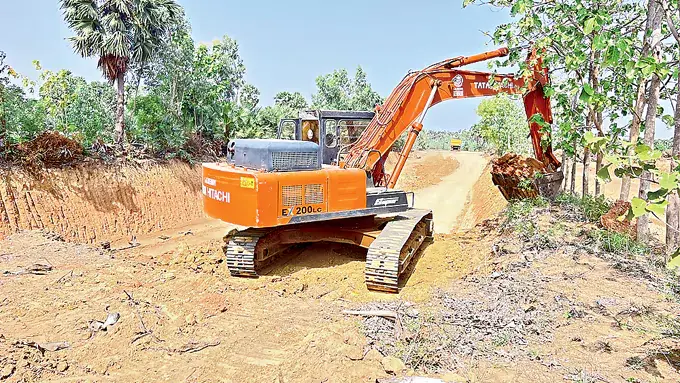
Illegal soil, gravel digging alleged in Venkatachalam mandal
Residents allege that soil and gravel are being dug without permission in the Edagali and Sarvepalli panchayats of Venkatachalam mandal in Nellore district. They say DKT lands allotted to tribal farmers are being bought at Rs 3 lakh to Rs 4 lakh an acre for gravel extraction, and that adjoining government lands are also being dug. Residents fear the resulting pits will turn dangerous during rains. Tahsildar Vijay said no permission was given for digging on DKT lands and action would follow after talks with mining officials.
Source
Nellore — స్థానికం · read the original report ↗
Desk check · some claims need care
What the desk checked (5)
- Illegal soil and gravel digging is widespread in Edagali and Sarvepalli panchayats of Venkatachalam mandal — Attributed to local residents in the source; no official data or enforcement records given
- DKT lands allotted to tribal farmers are being bought at Rs 3-4 lakh per acre and mined for gravel — Figures appear in the source but are unattributed; no buyer or seller named
- Some hold permits for gravel for government works but divert soil to private layouts and plots — Unattributed allegation in the source; no case or document cited
- Tahsildar Vijay said no permission was granted for digging on DKT lands and action will follow after talks with mining officials — Directly attributed to the named official
- Pits formed by digging could become fatal hazards during rains — Stated as a possibility by residents; no incident reported in the source
Analysts’ view opinion
Read legally, the allegations in Venkatachalam mandal sit at the intersection of three distinct bodies of law: minor mineral regulation, which makes extraction without a licence or beyond sanctioned depth an offence; land-assignment law, under which DKT pattas given to tribal cultivators are typically non-transferable and held for cultivation, not commercial quarrying; and revenue law protecting government land from encroachment. The Tahsildar's statement that no permission was granted for digging on DKT lands is legally significant, because it converts the villagers' complaint into a prima facie case of unauthorised extraction that the revenue and mining wings are duty-bound to verify. Equally notable is the allegation that permits obtained for government works were used to divert soil to private layouts — if established, that is a misuse of a conditional permission, not merely an unlicensed act.
- Assigned or DKT land is granted for a restricted purpose and is generally barred from alienation, so any sale at Rs 3-4 lakh an acre, if proven, raises the question of resumption of the land rather than a valid private title.
- Extracting gravel or earth without a licence, or deeper than sanctioned, is ordinarily dealt with under minor-mineral rules through seizure, penalty and recovery of royalty, alongside possible action for trespass on government land.
- Where a permit is issued for a specific government work, diverting the material to private plots would breach the permit's conditions and can expose the holder to cancellation and penal consequences.
- The villagers' claim that earlier complaints went unanswered is the weakest link in the enforcement chain and is the kind of inaction that typically invites higher-level or environmental scrutiny.
- Deep pits left near habitations create a public-safety and potential liability question for both the excavators and the authorities responsible for the land, particularly ahead of the rains.
What to watch — Watch whether the promised coordination between the Tahsildar and mining officials produces documented steps — site inspection, seizure or penalty notices, and any move to examine the validity of the DKT land transfers — or stops at an assurance.
The story rests on residents' allegations and one official's response; it does not establish who the excavators are, that any specific transfer or extraction has been legally found unlawful, or that any case has been registered.
Deep dive
Research brief · 8 facts · 3 dates · exam-readyThe brief
Context
Residents of Venkatachalam mandal in Nellore district, Andhra Pradesh, allege unchecked illegal digging of soil and gravel in government lands and in DKT (assigned) lands granted earlier to poor tribal cultivators. The extracted soil is said to be carted away to layouts and plots elsewhere for profit, leaving behind large pits. Complaints to officials have allegedly gone unheeded; the Tahsildar says no permission was granted for digging on DKT lands and that action will follow consultation with mining officials.
Key facts
- Illegal soil and gravel digging is alleged in the Edagali and Sarvepalli panchayat areas of Venkatachalam mandal, Nellore district.
- DKT lands earlier assigned by the government to poor tribals for cultivation are being bought from them at Rs 3 lakh to Rs 4 lakh per acre for gravel extraction.
- In some places digging is going deeper than the permitted limit, and adjoining government lands are also being dug, leaving pits resembling tanks.
- Some parties obtain permission for gravel digging in the name of government works but divert the soil to private layouts and plots outside the area.
- Residents fear the pits formed by gravel digging could become death traps during the rains.
- Locals complain that soil-carrying vehicles move at high speed, raising the risk of accidents.
- Residents say complaints made to officials have not been acted upon.
- Venkatachalam Tahsildar Vijay said no permission was given for digging on DKT lands and that action would be taken after speaking to mining officials about digging in Srikanth Colony and Sarvepalli limits.
Timeline
- Earlier (year not stated in the source)Government allotted lands to poor tribals of the area for cultivation and granted DKT pattas.
- Present (date not stated in the source)Gravel and soil are being dug in Edagali and Sarvepalli panchayats, allegedly without permission, and transported to other areas.
- After residents' complaintsTahsildar Vijay states no permission was given on DKT lands and promises action after discussion with mining officials.
Who has a stake
- Tribal DKT patta holders of Edagali and Sarvepalli — Risk of losing assigned cultivable land, sold at Rs 3-4 lakh an acre, to gravel operators.
- Local residents of Venkatachalam mandal — Danger from deep pits during rains and from speeding soil-carrying vehicles; unheeded complaints.
- Venkatachalam Tahsildar Vijay (revenue administration) — Responsible for protecting government and assigned lands and enforcing action.
- Mining department officials — Authority over quarrying permissions and depth limits; to be consulted before action.
- Gravel and soil operators / layout developers — Profit from diverting extracted soil to layouts and plots outside the area.
- State government — Loss of government land and revenue from unauthorised extraction beyond permitted depth.
Why it matters
Assigned (DKT) lands are a welfare instrument meant to give landless tribal families a livelihood; their purchase for gravel mining strikes at both land rights and local ecology. Unregulated pits and speeding tipper traffic turn a revenue-and-mining lapse into a public safety hazard, especially in the monsoon.
UPSC angle
Prelims pointers
- Venkatachalam mandal is in Nellore district, Andhra Pradesh; the affected panchayats are Edagali and Sarvepalli.
- DKT pattas are land assignment titles granted by the government to poor/tribal cultivators.
- Alleged sale price of DKT land for gravel extraction: Rs 3 lakh to Rs 4 lakh per acre.
- Tahsildar is the mandal-level revenue officer; here Tahsildar Vijay denied granting permission on DKT lands.
- Srikanth Colony and Sarvepalli are the specific areas the Tahsildar said would be taken up with mining officials.
Mains framing
The Venkatachalam case illustrates how minor mineral extraction becomes a governance failure at the intersection of revenue, mining and panchayat administration. Causes visible in the source include the transferability in practice of assigned DKT lands to gravel operators at Rs 3-4 lakh an acre, digging beyond permitted depth, permissions taken ostensibly for government works but used to supply private layouts and plots, encroachment into adjoining government lands, and unresponsiveness to local complaints. Implications are threefold: erosion of the welfare purpose of land assignment to poor tribals, environmental damage as pits turn into tank-like depressions, and public safety risks from monsoon-time drowning hazards and speeding soil-carrying vehicles. The way forward suggested by the story itself is coordinated action between revenue and mining authorities, as the Tahsildar promised, along with verification that no permission exists for DKT lands, enforcement of depth limits, tracking of where extracted soil is actually delivered, and a responsive grievance mechanism for residents whose earlier complaints went unattended.
Key terms
- DKT patta
- A government land assignment title given to poor/tribal families for cultivation, as granted in this area earlier.
- Gravel extraction
- Digging of gravel, a minor mineral, requiring official permission and adherence to depth limits.
- Tahsildar
- Mandal-level revenue officer responsible for land records and protection of government and assigned lands.
- Mandal
- Sub-district administrative unit in Andhra Pradesh; here, Venkatachalam mandal of Nellore district.
- Layout
- A plotted real estate development; extracted soil is allegedly diverted to such layouts and plots.
Practice questions
- Discuss how the transfer of assigned (DKT) lands to private operators for mineral extraction undermines the objectives of land assignment programmes for tribal households.
- Illegal minor mineral extraction is often a failure of inter-departmental coordination rather than of law. Examine with reference to the role of revenue and mining authorities.
- What safety and environmental risks arise from abandoned gravel pits in rural areas, and what regulatory safeguards can address them?
Grounded only in the source report — figures and dates are the source's, not inferred.