
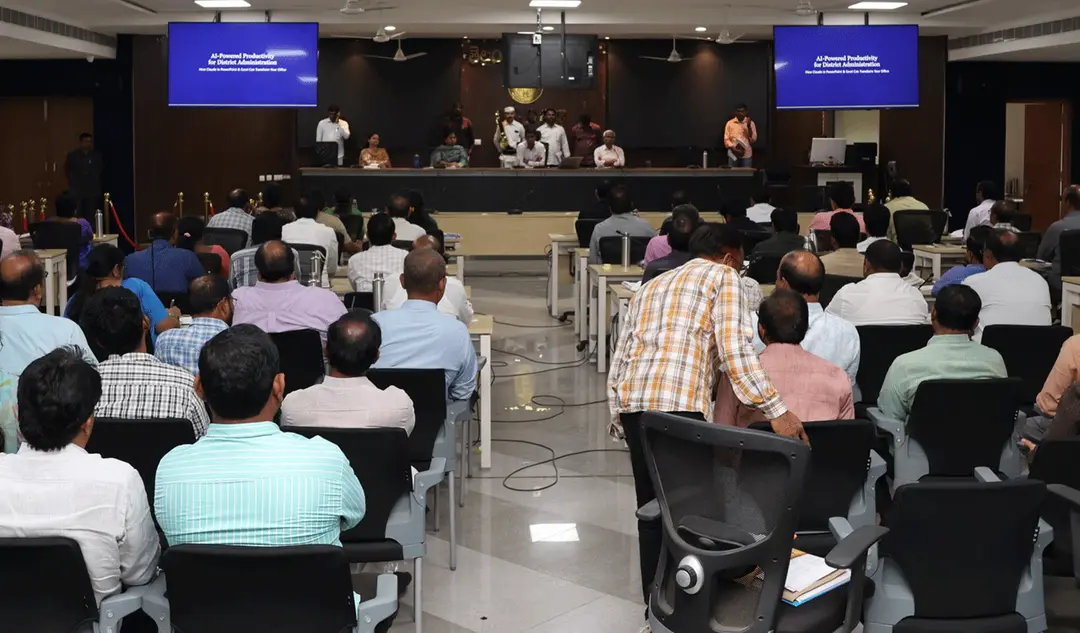
Khammam Collector urges officials to adopt AI in administration
Khammam District Collector Anudeep Durisetty asked officials to use artificial intelligence to achieve better results in administration. He made a PowerPoint presentation to create awareness on AI use. He said that if paddy purchase details of the last five years were uploaded, an AI application would list rice millers with high pending orders within seconds, and tasks taking two to three hours could be finished in minutes. Two district officers must present on AI use next week. Additional Collectors Dr P Sreeja, P Srinivasa Reddy and ZP CEO Deeksha Raina attended.
Source
Khammam — politics · read the original report ↗
Desk check · compared with the source
What the desk checked (5)
- Khammam Collector Anudeep Durisetty urged officials to use AI to improve administrative efficiency. — Attributed directly to the Collector in the source.
- He made a PowerPoint presentation to create awareness among officials about AI use in administration. — Stated as fact in the source; no independent corroboration available.
- Uploading five years of paddy purchase details would let an AI application list rice millers with high pending orders within seconds. — Illustrative example attributed to the Collector; technical outcome not verified.
- At least two district officers are to give a PowerPoint presentation on AI use in their department next week. — Instruction attributed to the Collector; timeline not independently confirmed.
- Additional Collectors Dr P Sreeja and P Srinivasa Reddy and ZP CEO Deeksha Raina attended. — Attendance list appears in the source without further sourcing.
Analysts’ view opinion
This is not the announcement of a new software project — it is an attempt to fold widely available, general-purpose AI tools into everyday district administration. The Collector's own example (uploading five years of paddy procurement data to get a list of rice millers with high pending orders in seconds) shows where the value sits: filtering data, summarising it and producing reports. The real test is not the technology but data quality, staff training and a process for verifying what the AI produces.
- The uses cited — Excel work, presentations, data analysis, programme monitoring — are productivity aids rather than automated decision-making.
- Output quality will depend entirely on the quality of the data uploaded; where government records are poorly digitised or inconsistent, AI answers can mislead as easily as they help.
- Asking two departments to present next week is a small-pilot approach rather than a big procurement, which tends to produce faster learning at lower risk.
- Using AI to monitor staff performance is the most sensitive element here and, without human review and transparent criteria, could invite resistance from employees.
- This fits the broader trend of cheap, general-purpose AI tools letting administrative units experiment directly instead of waiting for bespoke IT projects.
What to watch — Watch which specific tasks the departments pick for next week's presentations, and whether any guidance emerges on data privacy and verification.
The story does not establish which AI tools are being used, where data would be stored, what privacy or verification rules apply, or how much has actually been implemented.
Deep dive
Research brief · 8 facts · 2 dates · exam-readyThe brief
Context
Khammam District Collector Anudeep Durisetty has pushed district officials in Telangana to adopt artificial intelligence tools in routine administrative work. He made a PowerPoint presentation to officials explaining how AI could speed up file work, monitor scheme implementation and track staff performance. The move reflects a wider trend of district administrations experimenting with AI-assisted data analysis for service delivery, using existing departmental data such as paddy procurement records.
Key facts
- Khammam District Collector Anudeep Durisetty urged all officials to use artificial intelligence to improve administrative efficiency; report published 23 February 2026.
- The Collector made a PowerPoint presentation to create awareness among officials on using AI in administration.
- He said if paddy purchase details of the last five years were uploaded, an AI application would list rice millers with high pending orders within seconds.
- Tasks that currently take two to three hours could be completed in minutes using AI, the Collector said.
- AI could be used to monitor progress of government programmes in each department and the performance of staff.
- At least two district officers must give a PowerPoint presentation on AI use in their department next week.
- District officials were told to increase awareness about AI tools and train their staff; apps could be developed as per specific needs.
- Additional Collectors Dr P Sreeja and P Srinivasa Reddy and ZP CEO Deeksha Raina attended the meeting.
Timeline
- 23 February 2026Report published on Collector Anudeep Durisetty's PowerPoint presentation urging officials to adopt AI in administration in Khammam.
- Next week (after the meeting)At least two district officers are to present on how AI can be used in their respective departments.
Who has a stake
- Khammam District Collector Anudeep Durisetty — Driving AI adoption in district administration to speed up work and improve scheme delivery.
- District department officers and staff — Expected to learn AI tools, train staff and present department-specific AI use cases.
- Additional Collectors Dr P Sreeja and P Srinivasa Reddy — Senior district officials responsible for implementing and supervising the AI push.
- ZP CEO Deeksha Raina — Zilla Parishad administration's role in extending AI-based monitoring to rural development work.
- Rice millers and paddy procurement system — AI analysis of five years of paddy purchase data would flag millers with high pending orders.
- Scheme beneficiaries — AI use is projected to take government schemes to beneficiaries quickly and effectively.
Why it matters
District administration is where most citizen-facing government work happens, and delays in monitoring procurement or scheme delivery directly affect farmers and beneficiaries. Using AI on existing departmental data, as proposed in Khammam, can cut analysis time from hours to minutes and pinpoint where officials should focus. It also signals a shift in governance skills expected of field officials, raising questions of training, data quality and accountability.
UPSC angle
Prelims pointers
- Anudeep Durisetty is the District Collector of Khammam, Telangana (as per the source).
- Additional Collectors named: Dr P Sreeja and P Srinivasa Reddy; ZP CEO: Deeksha Raina.
- ZP CEO stands for Zilla Parishad Chief Executive Officer, a district-level rural administration post.
- Example cited: uploading five years of paddy purchase data to generate a list of rice millers with high pending orders in seconds.
- Directive: at least two district officers to present on departmental AI use within a week.
- Claimed efficiency gain: tasks taking two to three hours completed in minutes.
Mains framing
The Khammam initiative illustrates how artificial intelligence is being framed as a tool for administrative efficiency at the district level rather than only a national-level technology policy question. The stated causes of interest are slow manual processing, weak real-time monitoring of scheme progress and staff performance, and difficulty in prioritising action — as in identifying rice millers with high pending paddy orders from five years of procurement data. The implications are significant: faster turnaround (hours reduced to minutes), data-driven targeting of beneficiaries, and possible in-house app development for department-specific needs. But the source itself indicates that adoption depends on awareness and training of staff, which the Collector has asked district officers to lead, and on officers demonstrating concrete departmental use cases through presentations. A credible way forward, on the evidence in the source, is departmental pilot demonstrations, systematic staff training, and building AI use around existing administrative datasets; issues such as data privacy, accuracy safeguards and accountability for AI-assisted decisions are not stated in the source but naturally follow from such an approach.
Key terms
- Artificial Intelligence (AI)
- Computer systems that analyse data and perform tasks such as listing, monitoring and drafting, here proposed for administrative work.
- District Collector
- The senior-most administrative officer of a district, responsible for revenue, scheme delivery and coordination of departments.
- Additional Collector
- Senior officer assisting the District Collector in administration and development functions.
- ZP CEO (Zilla Parishad Chief Executive Officer)
- Officer heading the executive wing of the district-level rural local body.
- Paddy procurement data
- Records of government purchase of paddy; here cited as a five-year dataset for AI analysis of millers' pending orders.
Practice questions
- Examine how artificial intelligence tools can improve efficiency and monitoring in district administration, with reference to recent initiatives in Indian districts.
- "Technology adoption in governance depends less on tools and more on capacity building." Discuss in the light of the Khammam district AI initiative.
- What role can data analytics play in strengthening agricultural procurement and scheme delivery at the district level?
Grounded only in the source report — figures and dates are the source's, not inferred.